American rider’s fractured collarbone reshapes Visma–Lease a Bike’s strategy ahead of cycling’s defining spring week

The spring classics have a way of rewarding resilience, but they can just as quickly undo months of preparation in a single, unforgiving moment. That reality struck hard for Matteo Jorgenson, whose Ardennes ambitions came to an abrupt halt following a crash in the closing phase of the Amstel Gold Race.
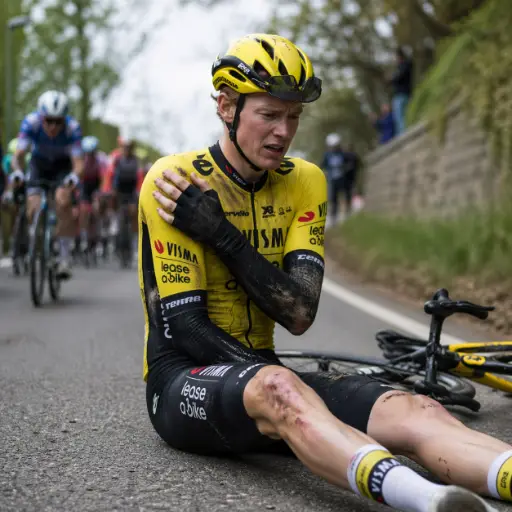
The American rider, representing Visma–Lease a Bike, sustained a fractured collarbone after hitting the tarmac during a tense finale marked by aggressive positioning and high speed. The incident, occurring just as the race entered its decisive stretch, not only ended his chances on the day but has now ruled him out of the remainder of the Ardennes classics.
Team officials confirmed that Jorgenson will miss both the midweek showdown at La Flèche Wallonne and the prestigious Liège–Bastogne–Liège, two races that traditionally define a rider’s standing in this demanding phase of the season. The announcement delivered a significant blow to a squad that had been counting on his versatility and climbing strength.
Witnesses described a chaotic sequence in which riders jostled for position on narrow roads, a hallmark of the Amstel Gold Race’s unpredictable finale. Jorgenson, who had been riding attentively near the front, was unable to avoid the crash once it unfolded ahead of him. Medical staff quickly attended to him at the roadside before he was transported for further evaluation, where the fracture was confirmed.
For Jorgenson, the timing could hardly be worse. The Ardennes classics represent a critical opportunity for riders who excel on short, steep climbs and explosive finishes. Having shown strong early-season form, the American had been viewed as a genuine contender capable of influencing race outcomes, if not outright victories.
His absence now forces a recalibration within the Visma–Lease a Bike camp. Known for its tactical depth, the team will need to redistribute leadership responsibilities across a roster already navigating a physically demanding calendar. While the squad remains competitive, losing a rider of Jorgenson’s profile inevitably alters both race strategy and internal dynamics.
Beyond the immediate sporting implications, the injury underscores the persistent risks inherent in professional cycling. Despite advances in safety measures and race organization, the combination of speed, technical terrain, and tightly packed pelotons continues to produce moments where crashes are unavoidable. For riders, the margin between contention and calamity remains razor thin.
Jorgenson’s focus now shifts from competition to recovery. Collarbone fractures are among the most common injuries in the sport, often requiring a period of immobilization followed by gradual rehabilitation. While recovery timelines can vary, the emphasis will be on ensuring a full and stable return rather than rushing back into racing prematurely.
There is cautious optimism within the team that he will regain form later in the season. Modern treatment methods and the athlete’s own conditioning typically allow for a strong comeback, though regaining race sharpness after time away is always a challenge.
For fans and observers, the incident serves as a reminder of cycling’s unpredictable nature. One moment, a rider is poised to shape the outcome of a major race; the next, their season trajectory is fundamentally altered. As the Ardennes classics continue without him, attention will inevitably turn to who steps forward in his absence.
Meanwhile, Jorgenson begins the quieter, less visible phase of an athlete’s journey—recovery, patience, and preparation for a return that, if history is any guide, may yet redefine his season.