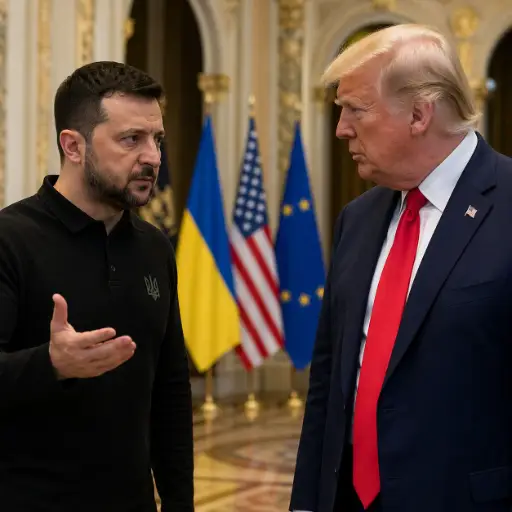
After months of strained transatlantic ties, Ukraine recalibrates its alliances and rhetoric, seeking firmer ground in Europe and beyond

In a noticeable shift in tone and strategy, Ukrainian President Volodymyr Zelensky has begun to distance himself from his American counterpart, Donald Trump, signaling a recalibration of Kyiv’s diplomatic posture at a critical moment in the war. After more than a year of uneasy cooperation marked by political ambiguity and fluctuating support, Ukraine is now broadening its network of partners while sharpening its expectations of Washington.
The change has not come overnight. For months, Ukrainian officials expressed concern behind closed doors about the reliability of U.S. commitments, particularly as domestic political debates in America increasingly influenced foreign policy decisions. Military aid packages became subject to prolonged negotiations, and rhetorical support from Washington often appeared inconsistent. For a country fighting a prolonged and existential war, such uncertainty carried tangible risks.
Now, the shift is visible both in policy and language. Kyiv has intensified outreach to European capitals, strengthening bilateral defense agreements and deepening integration with regional security frameworks. At the same time, Ukrainian officials have adopted a more candid tone toward the United States, emphasizing the need for predictability and long-term guarantees rather than episodic assistance.
European leaders have responded with a mix of urgency and opportunity. Several countries have accelerated joint weapons production initiatives with Ukraine, while others have committed to multi-year security arrangements. The European Union, long criticized for bureaucratic delays, has moved more decisively in recent months to streamline military aid and financial support mechanisms. For Kyiv, this represents not only a practical necessity but also a strategic hedge.
The evolving relationship with Washington remains complex. Despite tensions, the United States continues to be a crucial provider of advanced weaponry and intelligence. However, the perception in Kyiv is that American policy has become increasingly influenced by domestic political considerations, creating a level of unpredictability that Ukraine can no longer afford to ignore. Zelensky’s recent remarks, while measured, have reflected this reality. He has avoided direct confrontation but made clear that Ukraine must prepare for scenarios in which U.S. backing is less assured.
This recalibration also reflects broader geopolitical dynamics. As the conflict enters another prolonged phase, Ukraine faces the challenge of sustaining international attention and support. By diversifying its partnerships, Kyiv aims to reduce dependence on any single ally while reinforcing its position as a central actor in European security.
Military cooperation has been a key pillar of this strategy. Ukraine is not only seeking weapons but also investing in joint production and technological collaboration. Agreements with European partners now increasingly include provisions for manufacturing capabilities on Ukrainian soil, a move designed to ensure long-term resilience regardless of external political shifts. This approach also signals a transition from emergency support to structural integration.
Diplomatically, Ukraine has expanded its engagement beyond traditional allies. Outreach to countries in Asia, Africa, and Latin America has intensified, with Kyiv seeking to build broader coalitions and counter narratives that portray the conflict as a regional issue. These efforts are still in their early stages, but they reflect a growing awareness that global opinion plays a significant role in sustaining political and economic support.
At the same time, the rhetorical shift toward Europe has become more pronounced. Ukrainian leaders now speak of a shared future not only in terms of security but also economic and political integration. The language of partnership has evolved into one of belonging, with Kyiv positioning itself as an integral part of the European project rather than a peripheral partner. This narrative has found increasing resonance in European capitals, particularly as the war continues to reshape the continent’s security architecture.
The decision to adopt a more open tone toward Washington carries risks. The United States remains indispensable in several key areas, and any perception of discord could have unintended consequences. However, Ukrainian officials appear to have calculated that clarity is preferable to ambiguity. By articulating its expectations more directly, Kyiv hopes to stabilize the relationship on more predictable terms.
For Zelensky, the moment represents a delicate balancing act. He must maintain critical ties with Washington while demonstrating to both domestic and international audiences that Ukraine is not solely dependent on one partner. This requires not only diplomatic finesse but also a clear strategic vision.
The coming months will test whether this recalibrated approach can deliver tangible results. Much will depend on the consistency of European commitments and the trajectory of U.S. policy. What is clear, however, is that Ukraine is no longer content to navigate uncertainty passively. Instead, it is actively reshaping its alliances, seeking to build a more resilient and diversified foundation for the long struggle ahead.
As the war continues to define the geopolitical landscape, Kyiv’s evolving strategy underscores a broader lesson: in an era of shifting alliances and domestic pressures, even the closest partnerships cannot be taken for granted. For Ukraine, adaptation has become not just a necessity, but a defining feature of its survival.