Middle East Tensions Threaten the World’s Hidden Internet Arteries

As geopolitical tensions intensify across the Middle East, a new and largely invisible front is emerging beneath the waters of the Persian Gulf. Iranian officials and state-linked media have increasingly hinted that undersea internet cables and regional data infrastructure could become strategic targets in a widening confrontation that is no longer confined to military bases, oil routes or airspace. What was once the domain of cyber espionage and isolated hacking campaigns is now evolving into a broader struggle over the physical architecture of the global internet.
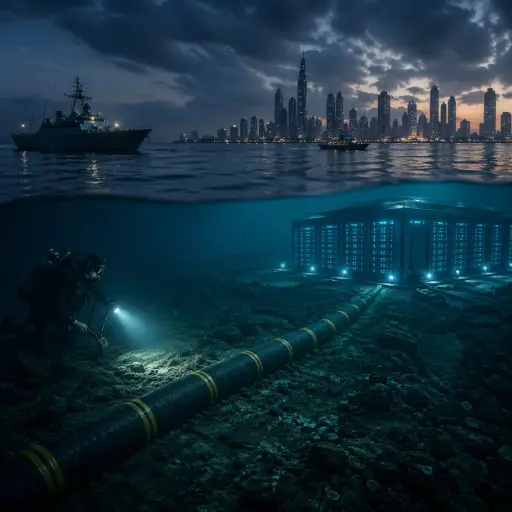
The warnings have alarmed telecommunications operators, cybersecurity analysts and Western intelligence services alike. Beneath the sea floor of the Gulf and surrounding waters lies one of the most critical digital corridors on Earth. A dense network of fiber-optic cables carries enormous volumes of data between Europe, Asia and parts of Africa, supporting financial transactions, cloud computing, artificial intelligence systems, global logistics and everyday internet communication for hundreds of millions of people.
While satellites dominate the public imagination, more than ninety-five percent of international internet traffic still travels through submarine cables. Many of the routes linking Europe to Asia pass through strategic choke points near the Arabian Peninsula, making the Gulf region a vital junction in the global digital economy. Any disruption there could trigger cascading consequences far beyond the Middle East.
In recent weeks, Iranian media outlets closely aligned with the country’s security establishment have openly discussed the vulnerability of regional digital infrastructure. Commentators have framed data centers and undersea communication networks as part of the “strategic ecosystem” supporting rival states and Western interests in the region. Although Tehran has stopped short of issuing direct threats, the messaging has been interpreted by analysts as deliberate signaling.
Several Gulf states have accelerated security reviews around key digital facilities. Data centers in the United Arab Emirates, Saudi Arabia and Qatar now sit at the intersection of energy security and information warfare. These facilities host cloud services for multinational corporations, banking systems and government operations across multiple continents. Protecting them has become as strategically important as safeguarding ports, airports or oil terminals.
The concern is not merely theoretical. Undersea cables have long represented a vulnerable point in global communications. In the past, accidental damage caused by anchors, earthquakes or fishing activity has temporarily disrupted internet access across entire regions. A deliberate attack, however, could produce far more serious and coordinated consequences. Security experts warn that even limited sabotage against a handful of major cable routes in the Gulf could slow financial markets, interrupt cloud-based services and destabilize sensitive communications infrastructure.
Western naval forces operating in the region have reportedly increased monitoring activities near critical maritime communication corridors. Private cybersecurity firms are also observing heightened digital probing activity aimed at infrastructure operators throughout the Gulf. Although there is no public evidence of imminent physical attacks, the convergence of cyber operations, military signaling and information warfare has created growing anxiety among governments and telecommunications providers.
The broader context is equally important. The Middle East is rapidly transforming into a global data crossroads. Gulf monarchies have invested billions into becoming international hubs for cloud computing, artificial intelligence and digital finance. Technology giants from the United States, Europe and Asia have expanded regional operations there, attracted by strategic geography, modern infrastructure and ambitious state-backed digital initiatives.
That transformation has also created new vulnerabilities. The concentration of digital infrastructure in politically sensitive areas means that future conflicts may no longer focus solely on territory or energy supplies. Information flows themselves are becoming strategic assets. Analysts increasingly describe submarine cables as the “invisible arteries” of globalization — essential systems whose disruption could affect economies thousands of kilometers away from any battlefield.
Iran’s signaling reflects a broader evolution in modern conflict. Hybrid warfare now extends across cyber networks, energy systems, satellite communications and digital infrastructure. Rather than targeting populations directly, states can exert pressure by threatening the systems that modern societies depend on to function. In this environment, the distinction between military and civilian infrastructure becomes increasingly blurred.
European officials are watching developments closely because many major data routes connecting Europe to Asian markets transit through the Middle East. Telecommunications providers have already begun discussing redundancy strategies, including alternative cable routes and expanded satellite backup systems. However, replacing the capacity of submarine fiber-optic networks remains extremely difficult and expensive.
Industry experts warn that the world may have underestimated the geopolitical importance of undersea infrastructure for too long. Unlike pipelines or power plants, submarine cables remain largely out of sight and poorly understood by the public. Yet they underpin almost every aspect of modern digital life, from online banking and international trade to social media and streaming platforms.
The current tensions serve as a reminder that the global internet is not an abstract cloud floating above politics. It is a physical network of cables, servers, landing stations and data centers exposed to the same geopolitical pressures shaping the wider world. As rival powers increasingly view digital infrastructure as a strategic leverage point, the risks surrounding these hidden systems are likely to grow.
For now, no major disruption has occurred. But the message emerging from the Gulf is unmistakable: in the next phase of geopolitical confrontation, the battle for influence may run not only through skies and seas, but also through the silent cables lying deep beneath them.