The veteran Communist leader says the Kremlin risks losing public control if worsening living conditions are ignored.

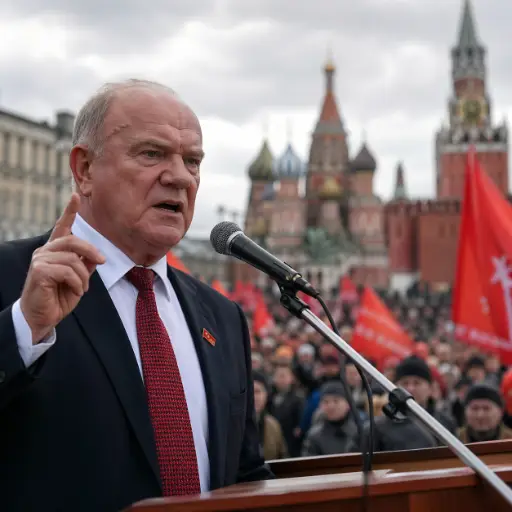
A stark warning from Communist Party leader Gennady Zyuganov has reignited debate inside Russia over the country’s economic trajectory and the growing strain on ordinary citizens. Speaking in unusually dramatic terms, the longtime head of the Communist Party of the Russian Federation suggested that unless Moscow takes urgent action to stabilize the economy and address deepening social inequality, Russia could face unrest comparable to the revolutionary upheaval of 1917.
The comments, reported by The Moscow Times and widely discussed across Russian political circles, come at a moment of visible anxiety for many households across the country. Rising prices, stagnating wages in several sectors, labor shortages, and the prolonged economic consequences of geopolitical confrontation have intensified pressure on regional governments and local communities.
Zyuganov, one of the most recognizable figures of Russia’s post-Soviet political landscape, has spent decades criticizing what he describes as the excessive concentration of wealth and power among economic elites. But his latest remarks stood out because of their tone. Rather than offering standard opposition criticism, the Communist leader framed the current moment as historically dangerous, invoking memories of the collapse of imperial Russia and the revolutionary wave that reshaped the twentieth century.
According to analysts in Moscow, such language reflects growing concern among sections of the political establishment that economic fatigue is beginning to erode public patience. Although the Kremlin continues to project confidence and emphasizes industrial resilience, military production growth, and adaptation to sanctions, many Russians outside major urban centers report declining purchasing power and increasing uncertainty about the future.
Independent economists note that Russia’s wartime economic model has produced contradictory effects. On one hand, state spending tied to defense industries has boosted employment in strategic sectors and sustained production in key industrial regions. On the other hand, inflation and dependence on state-directed spending have distorted parts of the economy, while small businesses and civilian industries continue to face mounting difficulties.
In several regions, shortages of skilled labor have forced employers to raise salaries, yet those increases have often failed to keep pace with the cost of living. Consumer prices for food, transportation, utilities, and imported goods remain a persistent concern for families. The result is a widening psychological divide between official narratives of stability and the daily experience of many citizens.
Political observers say Zyuganov’s intervention may also reveal concern within the opposition itself. The Communist Party remains the country’s largest officially tolerated opposition force, but it operates within a tightly controlled political environment. By referencing the possibility of revolutionary unrest, Zyuganov appears to be positioning his party as both a warning voice and a potential outlet for social frustration.
The comparison with 1917 carries enormous symbolic weight in Russia. That year saw the collapse of the Romanov monarchy, mass protests fueled by economic hardship and war fatigue, and eventually the Bolshevik Revolution that transformed the country into the Soviet Union. Mentioning such parallels in contemporary Russia is politically sensitive because it evokes fears of instability, fragmentation, and the unpredictable consequences of state failure.
Some Kremlin-aligned commentators dismissed Zyuganov’s remarks as exaggerated political theater designed to attract attention ahead of future electoral campaigns. Others, however, acknowledged that economic discontent has become increasingly difficult to ignore, especially in poorer regions where local budgets are under pressure and infrastructure problems persist.
Despite strict controls over public demonstrations and political organization, signs of social frustration occasionally emerge online and in regional disputes involving wages, housing, and public services. While no major nationwide protest movement currently threatens the authorities, experts caution that prolonged economic pressure can gradually undermine confidence in institutions, especially when expectations of stability are central to the government’s legitimacy.
International sanctions continue to shape the broader economic environment. Russia has adapted by redirecting trade toward Asian markets, increasing domestic production in selected industries, and deepening cooperation with non-Western partners. Nevertheless, access to technology, investment, and foreign capital remains more limited than before the conflict with the West intensified. Economists argue that these structural constraints could become more severe over time.
For younger Russians, the debate increasingly centers on opportunity and mobility. Many professionals have left the country in recent years, while others question whether long-term economic growth is achievable under current conditions. In major cities such as Moscow and St. Petersburg, visible consumer activity continues, but beneath the surface there is growing discussion about debt, affordability, and long-term financial insecurity.
Zyuganov’s warning may not signal an imminent political crisis, but it highlights a deeper concern shared even by some establishment figures: that economic hardship, if left unmanaged, can eventually evolve into political instability. Russian history offers powerful reminders of how quickly social patience can collapse when living standards deteriorate and trust in institutions weakens.
For now, the Kremlin remains firmly in control, backed by strong security structures and centralized political authority. Yet the appearance of increasingly urgent rhetoric from veteran insiders suggests that concerns about the country’s economic direction are no longer confined to independent critics or foreign observers.
As Russia moves further into a period of prolonged geopolitical confrontation and economic adaptation, the government faces a difficult balancing act — maintaining national unity while preventing the social exhaustion that has historically preceded moments of dramatic political change.