Kyiv turns to Ankara in a renewed diplomatic effort to revive stalled peace negotiations as the war grinds on and international pressure for dialogue intensifies.

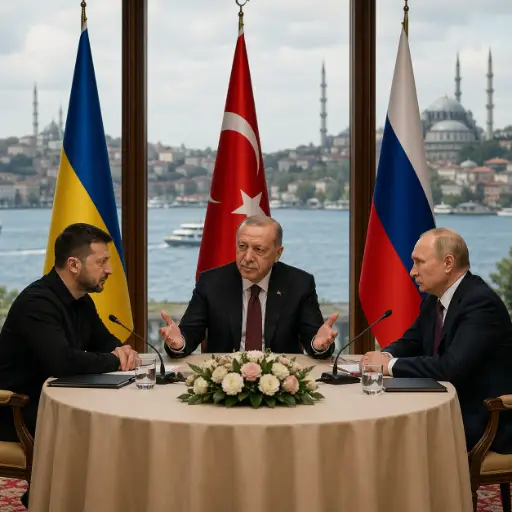
Ukraine has asked Turkey to host a direct meeting between President Volodymyr Zelensky and Russian President Vladimir Putin, according to information reported by Reuters, marking Kyiv’s latest attempt to restart peace negotiations that have remained largely frozen for months.
The proposal places Ankara once again at the center of one of the world’s most delicate diplomatic crises. Turkish officials have not publicly confirmed whether such a summit could take place, but the request itself signals a growing recognition among regional powers that the conflict has entered a dangerous phase of prolonged attrition, with neither side able to secure a decisive breakthrough on the battlefield.
For Ukraine, the move reflects a calculated political and diplomatic strategy. Kyiv continues to insist that any meaningful negotiations must involve Ukraine’s territorial integrity and long-term security guarantees. At the same time, Ukrainian officials appear increasingly aware that international fatigue over the war is becoming more visible, particularly among countries seeking stability in energy markets, trade routes, and global food supplies.
Turkey has long positioned itself as one of the few NATO members capable of maintaining communication channels with both Moscow and Kyiv. Since the beginning of the conflict, Ankara has balanced military cooperation with Ukraine while preserving economic and political ties with Russia. This dual-track policy has often drawn criticism from Western allies, yet it has also allowed President Recep Tayyip Erdoğan to present Turkey as a rare intermediary trusted by both camps.
Diplomatic observers say Ankara’s involvement is not accidental. Turkey previously played a key role in negotiations over Black Sea grain exports and prisoner exchanges, initiatives that demonstrated its ability to facilitate limited agreements even during periods of intense fighting. A possible meeting between Zelensky and Putin would represent a far more ambitious undertaking, but analysts believe Turkey may currently be one of the few venues acceptable to both sides.
Despite the renewed diplomatic activity, expectations remain cautious. Previous attempts at direct talks have repeatedly collapsed amid deep disagreements over occupied territories, military conditions, and future security arrangements. Public rhetoric from both Moscow and Kyiv also remains uncompromising, with each side continuing to frame the conflict in existential terms.
Still, the renewed push for dialogue comes at a moment of growing international concern. European governments are increasingly focused on the long-term economic and political consequences of a prolonged war, while countries across the Global South have intensified calls for negotiations to prevent further instability in commodity markets and global shipping corridors.
Western diplomats familiar with the situation suggest that even arranging preliminary discussions would be considered a significant development. Trust between the two sides remains extremely low, and military operations continue across multiple regions. Yet some analysts argue that diplomatic openings often emerge precisely during periods of battlefield deadlock, when strategic calculations begin to shift behind closed doors.
For Zelensky, proposing a summit carries both opportunity and political risk. Domestically, Ukrainian leadership must avoid any perception of weakening its position or conceding territory under pressure. Internationally, however, demonstrating openness to negotiations may strengthen Kyiv’s standing among allies eager to show continued support for diplomatic solutions alongside military assistance.
Russia, meanwhile, has maintained that it remains formally open to negotiations, though Kremlin officials continue to insist that current territorial realities must be recognized in any future settlement. Those conditions remain unacceptable to Kyiv, making any direct encounter between the two leaders highly complex before substantive groundwork is completed.
Turkey’s geopolitical ambitions also play an important role in the equation. Ankara has spent recent years attempting to expand its diplomatic influence across the Black Sea region, the Middle East, and parts of Africa. Successfully hosting high-level talks between Russia and Ukraine would significantly reinforce Turkey’s international standing at a time when global powers are competing for influence in a rapidly changing world order.
Security considerations surrounding any potential summit would also be enormous. Organizing a face-to-face meeting between Zelensky and Putin would require extensive coordination involving intelligence agencies, military officials, and international mediators. Even symbolic details such as venue selection, protocol arrangements, and public messaging could become politically sensitive issues.
Nevertheless, the fact that Kyiv has formally approached Turkey underscores a broader reality: despite continued fighting, diplomatic channels have not entirely disappeared. Behind the scenes, governments remain engaged in quiet conversations aimed at exploring possible openings for future negotiations, humanitarian agreements, or temporary confidence-building measures.
Whether Turkey can transform this latest initiative into a concrete diplomatic breakthrough remains uncertain. But the request itself reflects a growing awareness that the conflict’s long-term trajectory may ultimately depend not only on military developments, but also on the ability of international mediators to create conditions for dialogue between two leaders whose positions remain profoundly divided.
As the war enters another tense chapter, Ankara may once again find itself balancing between East and West, diplomacy and strategy, ambition and caution — attempting to achieve what many other powers have so far failed to deliver: a credible path back to the negotiating table.