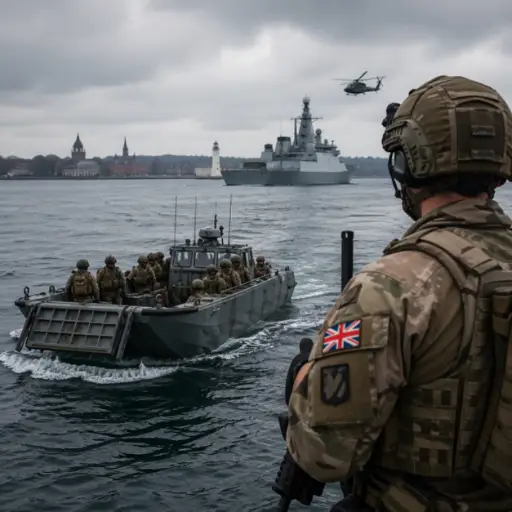
Russia says Western military activity near its borders signals preparation for a future confrontation, as tensions around the strategic Baltic enclave deepen once again.

Moscow has sharply escalated its rhetoric against NATO countries, accusing several European states led by the United Kingdom of preparing scenarios for a potential military operation against the Russian exclave of Kaliningrad. The accusations were voiced by Russian Deputy Foreign Minister Alexander Grushko in comments published by the state-run agency RIA Novosti, where he pointed to recent statements by American General Christopher Donahue as evidence of what Russia describes as increasingly aggressive Western planning near its borders.
The remarks come at a moment of renewed friction between Russia and the Atlantic alliance, with military exercises, troop deployments and strategic messaging intensifying across the Baltic region. Kaliningrad, a heavily militarized Russian territory wedged between Poland and Lithuania on the Baltic Sea, has long occupied a central role in the geopolitical rivalry between Moscow and NATO. The enclave hosts advanced missile systems, naval assets and air defense infrastructure, making it one of the most sensitive military zones in Europe.
According to Grushko, the latest NATO exercises and strategic discussions suggest that Western powers are no longer limiting themselves to defensive scenarios. He argued that the alliance is now openly examining operational concepts involving direct pressure on Kaliningrad, which Russia views as a potential precursor to broader confrontation.
The Russian diplomat specifically referenced comments attributed to General Christopher Donahue, a senior American military figure whose recent assessments of NATO readiness in Eastern Europe have drawn considerable attention in Moscow. Russian officials claim those statements reveal an increasing willingness among NATO planners to consider rapid operations aimed at neutralizing Russian military capabilities in the Baltic region in the event of a crisis.
Western officials, however, reject the accusations and insist that NATO activities remain defensive in nature. Military exercises conducted in Northern and Eastern Europe are regularly described by alliance members as precautionary responses to Russia’s actions in Ukraine and the wider security concerns generated by the conflict. British and NATO representatives maintain that strengthening military coordination in the Baltic area is intended to reassure member states bordering Russia, not to prepare an invasion.
Security analysts note that Kaliningrad has become a focal point in the broader strategic contest between Russia and NATO since the start of the war in Ukraine. The enclave’s location allows Russia to project military power deep into Europe while simultaneously creating vulnerabilities for NATO countries along the alliance’s northeastern flank. The so-called Suwałki Gap, a narrow corridor between Poland and Lithuania separating Kaliningrad from Belarus, is often cited by military experts as one of Europe’s most fragile strategic zones.
In recent years, NATO forces have significantly expanded their presence around the Baltic Sea. Joint exercises involving British, American, German and Scandinavian troops have increased in scale and frequency, reflecting concerns over regional stability and the possibility of spillover tensions from the war in Ukraine. Moscow interprets these developments as part of a deliberate campaign of military encirclement.
Russian officials have repeatedly warned that any attempt to isolate or threaten Kaliningrad would provoke a severe response. The enclave is considered by the Kremlin to be a vital strategic outpost and an integral part of Russian territory whose defense carries both military and symbolic importance. Statements from Moscow increasingly portray the Baltic region as one of the main arenas of confrontation between Russia and the West.
At the same time, diplomatic channels between Russia and NATO remain largely frozen, leaving little room for de-escalation through direct political dialogue. Analysts warn that the absence of communication mechanisms increases the risk of misunderstanding and miscalculation, particularly during large-scale military exercises conducted near contested zones.
The latest accusations also reflect a broader information battle between Moscow and Western capitals. Russian state media frequently portrays NATO expansion and military activity as evidence of hostile intentions, while Western governments accuse the Kremlin of using inflammatory rhetoric to justify its own military posture and sustain domestic support during prolonged geopolitical confrontation.
For European governments, the challenge lies in balancing deterrence with the avoidance of further escalation. Countries bordering Russia continue to strengthen defense cooperation and military preparedness, fearing that instability in Eastern Europe could deepen. Yet officials across the continent are also aware that increasingly confrontational language from both sides risks hardening divisions and pushing the region toward a more dangerous phase of strategic rivalry.
As military maneuvers continue across the Baltic theater and diplomatic relations remain strained, Kaliningrad once again finds itself at the center of Europe’s evolving security crisis. Whether the current rhetoric represents political signaling or the emergence of a more serious strategic standoff may depend on how both Russia and NATO manage the fragile balance between deterrence and provocation in the months ahead.