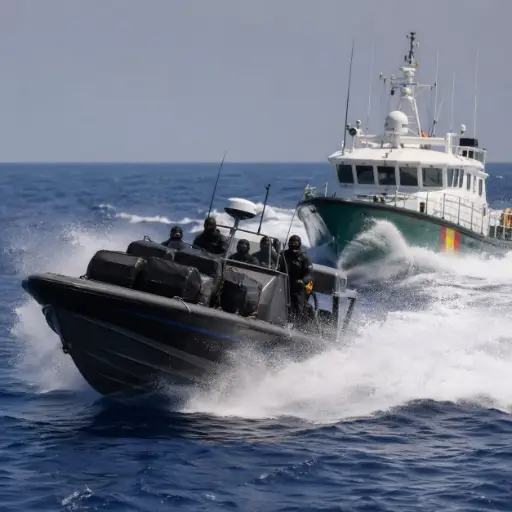
The ruling closes one of Europe’s most dramatic maritime narcotics cases, exposing the growing violence of Atlantic drug routes and the role of foreign crews in high-risk smuggling operations.

The Atlantic waters surrounding the Canary Islands have once again become the center of Europe’s escalating war against international drug trafficking. In a landmark ruling delivered this week, Spain’s Supreme Court upheld a 30-year prison sentence against Czech national Jiří Jokl, convicted over a deadly collision during a high-speed anti-drug operation that resulted in the death of a Spanish customs officer.
The case, which has drawn attention across both Spain and the Czech Republic, stems from a violent maritime chase that unfolded off the Canary Islands during a coordinated anti-narcotics interception. Spanish authorities accused Jokl, captain of a fast smuggling vessel transporting a large shipment of drugs across Atlantic trafficking routes, of deliberately ramming a customs patrol boat while attempting to evade capture.
According to investigators, the impact threw one customs officer into the sea. Amid rough waters and chaotic rescue efforts, the officer disappeared beneath the surface and drowned before emergency teams could recover him. The incident shocked Spain’s law-enforcement community and triggered renewed political pressure for harsher measures against increasingly aggressive trafficking networks operating between Africa and Europe.
Spanish prosecutors argued throughout the lengthy court proceedings that the collision was not accidental but rather part of a calculated attempt to escape arrest at any cost. The Supreme Court agreed with lower court findings, concluding that Jokl bore direct responsibility for the death of the officer and for leading an operation linked to organized drug smuggling in the Atlantic corridor.
Several other Czech nationals connected to the operation were also sentenced. Spanish authorities described the group as part of a wider transnational trafficking structure using high-performance speedboats capable of transporting narcotics from the North African coast toward European territory. Such vessels, known locally for their speed and maneuverability, have become increasingly common in maritime smuggling operations around the Canary Islands and southern Spain.
The ruling arrives at a time when European anti-drug agencies are warning of a major shift in trafficking patterns. As enforcement intensifies in traditional Mediterranean routes, criminal organizations have increasingly redirected operations toward the Atlantic Ocean, exploiting the vast maritime spaces surrounding the Canary archipelago. Spanish customs services and the Guardia Civil have reported a steady increase in violent confrontations at sea, with smugglers willing to take extreme risks to avoid capture.
Investigators involved in the Jokl case said the chase reflected a broader transformation in organized crime tactics. Smuggling crews are now often composed of multinational teams recruited specifically for dangerous maritime operations. Authorities believe these groups operate with military-style coordination, advanced navigation systems and increasingly powerful boats capable of outrunning conventional patrol vessels.
The death of the customs officer became a symbol in Spain of the mounting dangers faced by maritime enforcement units. Colleagues and government officials paid tribute to the victim during earlier hearings, describing him as an experienced officer committed to combating narcotics trafficking in one of Europe’s most contested maritime zones.
For Spanish prosecutors, the Supreme Court’s decision sends a strong message to international trafficking organizations. Officials stated that attacks against law-enforcement personnel would be treated with maximum severity, particularly in cases involving fatal consequences during anti-drug operations.
The case has also sparked debate in the Czech Republic, where attention has focused on the growing involvement of Czech citizens in organized criminal networks operating abroad. Security analysts note that while Czech groups have historically been associated more with synthetic drug production within Central Europe, recent years have seen increasing participation in broader international trafficking operations, including maritime smuggling linked to cocaine and hashish routes.
Experts following the trial say the verdict could become a legal reference point for future prosecutions involving violence during maritime interdictions. Spanish courts have progressively expanded the scope of criminal responsibility in organized smuggling cases, especially when attempts to flee place officers or civilians at risk.
Meanwhile, Spanish authorities continue to strengthen surveillance around the Canary Islands, deploying additional aerial monitoring systems, faster interception boats and expanded intelligence cooperation with European and African partners. Officials warn that despite major arrests and seizures, the Atlantic route remains highly active and extremely profitable for criminal groups.
The Jokl case illustrates how Europe’s drug trade has evolved far beyond hidden warehouses and urban distribution networks. Increasingly, the battle is unfolding far from shore, in dangerous stretches of open water where split-second decisions can carry deadly consequences.
For the family of the fallen customs officer, the ruling marks the end of a long legal struggle, though not the end of the loss itself. For investigators and maritime officers patrolling the Atlantic routes, it stands as another stark reminder that Europe’s anti-drug war is becoming more violent, more international and far more unpredictable than in previous decades.