Unexpected remarks by Emmanuel Macron during a visit to a primary school on the Mediterranean island have reignited debate over leadership, legacy, and the next chapter of French politics.

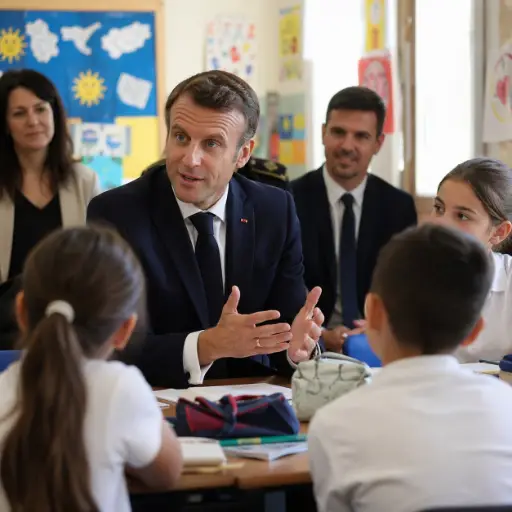
During what was expected to be a routine diplomatic and cultural visit to Cyprus, French President Emmanuel Macron delivered a statement that immediately captured political attention across Europe. Speaking informally with teachers and students inside a primary school classroom, Macron suggested that he intends to leave political life entirely once his presidential mandate comes to an end.
The comments, delivered in a relaxed atmosphere far removed from the formal halls of the Élysée Palace, surprised even members of the French delegation accompanying him. Witnesses described the exchange as spontaneous and unusually personal for a leader known for carefully controlled messaging. According to several attendees, Macron reflected on public service, leadership fatigue, and the importance of “knowing when a chapter is complete.”
The French president has long been the central figure of European liberal politics, navigating France through periods marked by social unrest, economic reforms, geopolitical tensions, and shifting alliances within the European Union. His remarks in Cyprus therefore carried significance far beyond a simple personal reflection. Political analysts in Paris quickly interpreted the statement as the clearest indication yet that Macron does not intend to seek another role at the center of French political life after leaving office.
Inside the brightly decorated classroom where the discussion took place, Macron reportedly answered questions from children about leadership, responsibility, and international cooperation. Teachers present said the president appeared unusually candid, speaking less like a head of state and more like a mentor addressing younger generations about the future.
“It is important to serve your country,” Macron reportedly told the students, “but it is also important to know how to step aside and let others build the future.”
The statement immediately fueled speculation in France regarding the country’s political succession. Although Macron remains one of Europe’s most internationally recognized leaders, his presidency has often divided public opinion at home. Supporters credit him with modernizing parts of the French economy and strengthening France’s role in European affairs, while critics accuse him of governing with an increasingly technocratic and distant style.
In Paris, opposition parties reacted swiftly. Figures from both the left and the right described the president’s comments as the opening signal of a broader political transition already underway. Some conservatives argued that Macron’s era had exhausted itself politically, while left-wing voices claimed the president’s acknowledgment reflected growing public fatigue after years of contentious reforms and protests.
Within Macron’s own political camp, however, reactions were notably cautious. Several ministers refused to comment directly on the president’s future, insisting instead that the government remains focused on ongoing domestic and international priorities. Nonetheless, behind closed doors, discussions about potential successors and the restructuring of the political center are expected to intensify in the coming months.
The Cyprus visit itself had originally focused on educational cooperation, Mediterranean security, and European partnerships in the region. Yet the school exchange rapidly overshadowed the broader diplomatic agenda. International media outlets soon circulated excerpts of Macron’s remarks, framing them as a rare glimpse into the personal thinking of a president who has dominated French political life for nearly a decade.
For many observers, the symbolism of the setting was impossible to ignore. Rather than announcing his intentions during a major televised address or an official press conference, Macron chose a conversation with children in a classroom — a setting associated with renewal, generational change, and the future.
Political historians note that French presidents have traditionally struggled with life after office. Some remained influential behind the scenes, while others attempted political comebacks with varying degrees of success. Macron’s apparent desire to withdraw entirely from politics would therefore represent a significant break from the habits of the French political establishment.
Questions now emerge over what role Macron could pursue outside public office. Some analysts believe he may seek involvement in international diplomacy, European institutions, academia, or global economic initiatives. Others argue he may genuinely wish to step away from public life after years spent under intense political and media scrutiny.
Public reaction in France has been mixed. On social media, supporters praised the president for what they described as honesty and realism, while critics accused him of attempting to shape his historical legacy before the end of his mandate. Meanwhile, younger voters appeared particularly attentive to the broader message about political renewal and generational transition.
Across Europe, the remarks also triggered concern among allies who have viewed Macron as one of the European Union’s most assertive leaders during moments of international instability. Diplomats in Brussels privately acknowledged that his eventual departure could leave a leadership vacuum within the bloc at a time when Europe faces mounting security, economic, and political pressures.
Despite the growing debate, the French presidency later attempted to downplay the significance of the comments, insisting that Macron remains fully committed to his responsibilities and current agenda. Officials emphasized that the president was engaging in a broader philosophical discussion rather than delivering a formal political announcement.
Even so, the impact of the moment appears unlikely to fade quickly. In a political era dominated by scripted appearances and strategic communication, Macron’s words in a Cypriot classroom stood out precisely because of their informal and human tone.
As France gradually begins looking toward the post-Macron era, the president’s remarks may ultimately be remembered less as a resignation from politics and more as the first clear acknowledgment that a major political cycle in Europe is approaching its conclusion.