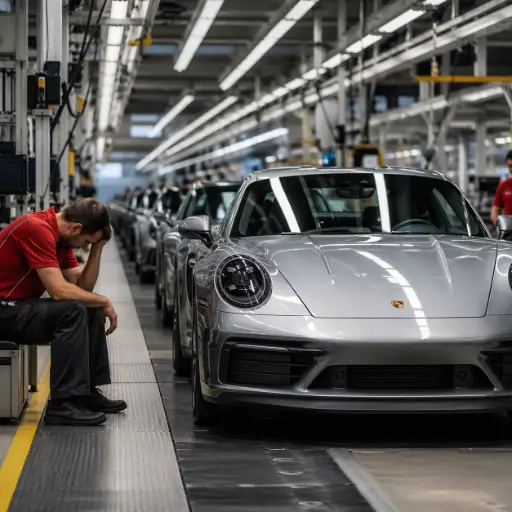
After years of prosperity and record demand, the German sports car manufacturer is confronting a difficult economic slowdown that is reshaping the mood inside its factories.

For the first time in many years, employees of the German luxury sports car manufacturer Porsche will not receive an annual bonus payment, according to information reported by the DPA news agency and confirmed by a company spokesperson. The decision comes as the automaker struggles with weakening economic performance, rising costs, and growing uncertainty across the global automotive sector.
The move marks a symbolic turning point for one of Germany’s most prestigious industrial brands. Porsche has long represented stability, profitability, and premium engineering success, often rewarding workers with generous annual bonuses tied to company performance. The suspension of those payments now highlights the mounting pressure facing even the strongest names in the European automotive industry.
Inside Porsche’s production facilities, the atmosphere has reportedly shifted from confidence to caution. Employees accustomed to years of strong financial results are now confronting a more uncertain future as management attempts to navigate slowing international demand and intensifying competition in the luxury vehicle market.
The company has not publicly disclosed all details behind the deteriorating results, but analysts point to several factors weighing heavily on the manufacturer. Weakening consumer demand in key international markets, persistent supply chain disruptions, and the enormous financial burden linked to the transition toward electric mobility are all contributing to the pressure on earnings.
Germany’s automotive sector as a whole is currently experiencing one of its most challenging periods in recent memory. Rising production costs, expensive energy prices, and increasing competition from Asian manufacturers are forcing traditional European carmakers to rethink long-established business models. For premium brands like Porsche, maintaining exclusivity and profitability while investing billions into new technologies has become an increasingly delicate balancing act.
Industry experts say the cancellation of employee bonuses carries significance beyond the company itself. In Germany, annual bonus payments are often viewed not only as financial rewards but also as symbols of corporate strength and mutual trust between employers and workers. Their absence sends a strong message about the seriousness of the current economic climate.
Labor representatives are expected to closely monitor the company’s next steps, especially regarding future investment plans and workforce stability. While Porsche has not announced large-scale layoffs, concerns are growing among employees about possible cost-cutting measures if market conditions continue to deteriorate.
Despite the difficult moment, Porsche remains one of the world’s most recognizable luxury automotive brands. The company continues to benefit from strong global brand loyalty and a reputation for engineering excellence. However, analysts warn that even iconic manufacturers are no longer immune to the economic turbulence affecting the global car industry.
The broader transition toward electric vehicles is also creating additional pressure. Carmakers across Europe are investing massive sums into battery technology, digital systems, and new production platforms while simultaneously attempting to preserve profits from traditional combustion-engine vehicles. The financial strain created by this transformation is beginning to reshape corporate strategies throughout the sector.
For many Porsche employees, the loss of the annual bonus is more than a financial disappointment. It represents the end of a long period of confidence during which the company appeared almost untouchable in the luxury automotive world. Workers who once associated the brand with steady growth are now facing the same economic anxieties affecting much of Europe’s industrial workforce.
Observers note that the coming months will be crucial for Porsche and the wider German automotive industry. Consumer demand remains unpredictable, geopolitical tensions continue to affect international trade, and the race toward electrification is accelerating faster than many traditional manufacturers originally anticipated.
While Porsche is unlikely to lose its global prestige overnight, the company’s latest decision reflects a changing reality for Europe’s industrial giants. Even the most successful luxury carmakers are now being forced to adapt to an economic environment defined by uncertainty, transformation, and growing competitive pressure.
The suspension of annual bonuses may ultimately prove temporary, but it has already become a powerful symbol of the challenges currently confronting one of Germany’s most celebrated automotive manufacturers.