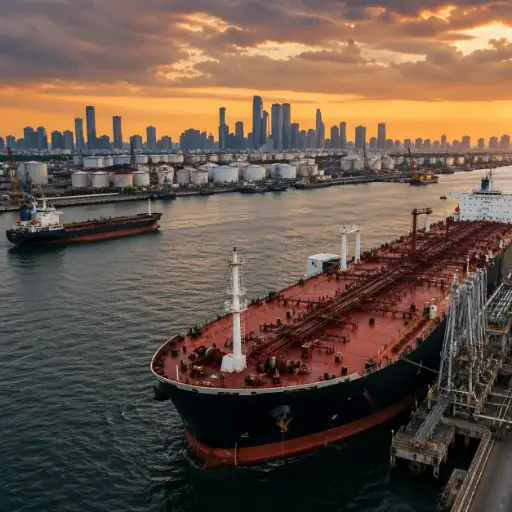
The world’s busiest refueling port is rapidly increasing imports from Russia after disruptions in Middle Eastern supply chains caused by escalating tensions involving Iran, Israel and the United States.

The geopolitical shockwaves spreading across the Middle East are beginning to redraw the global oil map, and few places illustrate the shift more clearly than Singapore. The Asian city-state, home to the busiest bunkering port on the planet, has quietly intensified purchases of Russian crude and fuel products as instability in the Gulf threatens long-established supply routes from Arab producers.
For decades, Singapore has functioned as one of the central arteries of international maritime trade. Thousands of vessels stop there each year to refuel, reload cargo and connect supply chains linking Asia, Europe and the Americas. The city’s vast refining and storage infrastructure has traditionally relied heavily on energy flows originating in the Middle East, particularly from Gulf exporters whose shipments crossed the Strait of Hormuz before reaching Southeast Asia.
That balance has now begun to change.
Following the outbreak of a broader regional conflict involving Iran and a wave of military strikes attributed to Israel and the United States, shipping companies and commodity traders have been forced to reconsider routes, insurance costs and long-term energy security. The heightened military tensions around strategic maritime corridors have sharply reduced confidence in uninterrupted deliveries from several Arab suppliers.
In response, Singaporean refiners and fuel distributors have accelerated purchases of discounted Russian oil, according to shipping analysts and energy traders operating across Asia. Tanker traffic data and market activity indicate that Russian crude grades, once redirected mainly toward China and India after Western sanctions, are increasingly finding their way into Southeast Asian refining networks.
The trend reflects more than a temporary reaction to war. It highlights the emergence of a new energy reality in which Asian economies are prioritizing supply stability over political alignment.
Russian exporters, squeezed out of much of the European market since the war in Ukraine, have spent the past two years building alternative trade channels across Asia. The latest turmoil in the Middle East has provided Moscow with an unexpected opportunity to deepen that foothold. Analysts say Russian suppliers have been quick to offer competitive pricing and flexible shipping arrangements at a moment when freight costs tied to Gulf deliveries are climbing rapidly.
Singapore has not publicly framed the increase in Russian imports as a strategic pivot. Officials continue to stress that the country maintains a diversified and market-driven energy policy. Yet traders in the region say the commercial logic is becoming difficult to ignore.
“The priority is reliability,” said one Asia-based shipping consultant familiar with regional fuel procurement. “When conflict threatens traditional routes, buyers naturally move toward whichever supplier can guarantee steady volumes at acceptable prices.”
The change is particularly significant because Singapore is not merely an oil consumer. It is one of the world’s most important redistribution hubs for marine fuel. Any shift in sourcing patterns there can influence shipping costs and fuel availability across major international trade lanes.
The impact is already visible in maritime markets. Insurance premiums for vessels operating near sensitive Gulf areas have risen, while some operators are quietly rerouting cargoes to avoid zones considered vulnerable to escalation. Energy traders also report increasing concern about the possibility of further disruptions if hostilities expand or if key chokepoints become targets in the conflict.
Despite fears of instability, Asian demand for energy continues to grow. Economies across the region remain heavily dependent on imported fossil fuels, and governments are seeking immediate solutions rather than long-term geopolitical positioning. Russian crude, sold below benchmark prices and supported by an expanding shadow tanker fleet, has become an increasingly attractive option.
Western governments are watching the development closely. Although sanctions on Russian oil were designed to reduce Moscow’s revenues without triggering a global supply shock, the redirection of exports toward Asia has allowed Russian producers to maintain a substantial presence in international markets. The Middle East crisis now risks strengthening that position further.
Energy economists warn that the current situation may accelerate a broader restructuring of global commodity flows already underway since the invasion of Ukraine. Instead of a single integrated oil market dominated by Western financial systems, the world is gradually moving toward parallel trading networks shaped by geopolitical alliances, sanctions and regional security concerns.
Singapore sits at the center of that transformation.
The city-state has long built its success on neutrality, efficiency and adaptability. In times of crisis, those qualities become even more valuable. By expanding purchases from Russia while traditional Middle Eastern supplies face uncertainty, Singapore is demonstrating the pragmatic calculations increasingly guiding global energy policy.
For now, the strategy appears to be working. Fuel continues to move through the port, ships continue to arrive, and regional supply chains remain operational despite rising geopolitical tensions. But the deeper implications are harder to measure.
What began as a regional military confrontation is steadily reshaping global commerce far beyond the battlefield. And in the crowded waters surrounding Singapore, the consequences are arriving one tanker at a time.