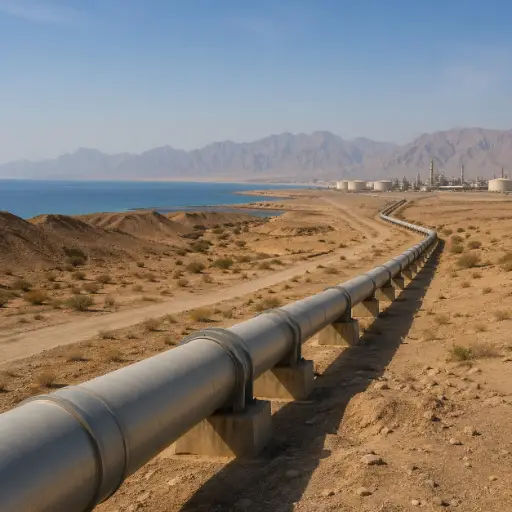
Arab states revive strategic pipeline projects as threats at sea reshape the global energy corridor

The Persian Gulf is once again becoming the center of a geopolitical race over oil routes, security and regional influence. Faced with growing instability along the Middle East’s maritime chokepoints, Gulf states are accelerating discussions about new overland export corridors that could reduce their dependence on vulnerable sea lanes and protect energy supplies from regional conflict.
For decades, the economies of the Gulf have relied on one strategic artery above all others: the Strait of Hormuz. Nearly a fifth of the world’s traded oil passes through the narrow waterway separating Iran from the Arabian Peninsula. But mounting tensions between Tehran and Western powers, combined with repeated threats by Iran to disrupt shipping traffic, have renewed fears that the strait could become a geopolitical pressure point with global consequences.
At the same time, another maritime bottleneck farther south has become increasingly dangerous. The Bab al-Mandab Strait, connecting the Red Sea to the Gulf of Aden, has been repeatedly targeted by Yemen’s Houthi movement. Attacks on commercial shipping have forced several international carriers to reroute vessels around Africa, increasing transport times and costs. Energy markets have reacted nervously to every escalation.
The result is a strategic reassessment across the Gulf.
Governments that once considered large land-based export pipelines too expensive or politically unrealistic are now treating them as a matter of national security. Several projects that had remained dormant for years are being reexamined behind closed doors, while regional energy planners openly discuss the need for “alternative corridors” capable of bypassing dangerous maritime zones.
Among the most closely watched proposals is a vast pipeline system that would transport Iraqi crude from the southern oil fields near Basra through Kuwait and Saudi Arabia toward ports in Oman on the Arabian Sea. Such a route would allow exports to avoid both the Strait of Hormuz and the increasingly militarized waters surrounding Yemen.
The project is ambitious not only in scale, but also politically. It would require unprecedented cooperation between countries that have historically competed for regional influence. Yet analysts note that the Gulf’s changing security environment is pushing former rivals toward pragmatic partnerships centered on economic survival and energy stability.
Oman, long seen as a neutral diplomatic actor in the region, could emerge as one of the key beneficiaries. Ports along its Arabian Sea coastline would gain strategic importance as alternative export terminals outside the direct reach of Iranian naval pressure. Gulf producers are increasingly attracted by the idea of securing direct access to open ocean routes that cannot be easily blocked.
Another project attracting renewed attention is the proposed oil pipeline connecting Iraq’s southern production centers with Turkey’s Mediterranean coast. Iraqi officials have repeatedly expressed interest in strengthening export capacity through Turkish territory, especially as Baghdad seeks to diversify routes beyond the Gulf.
The concept is not new. Iraq and Turkey have cooperated on pipeline infrastructure for decades, although political instability, sabotage and disputes between Baghdad and the Kurdish Regional Government repeatedly disrupted operations. Now, however, the strategic logic appears stronger than ever.
European energy planners are also watching developments closely. Since the reshaping of global energy markets following the war in Ukraine, Europe has become increasingly sensitive to disruptions affecting oil and gas supplies. A more diversified Middle Eastern export network could provide greater resilience for global markets already strained by geopolitical fragmentation.
Security experts argue that the Gulf states are responding to a broader transformation in modern warfare. Instead of conventional military confrontations, countries increasingly face hybrid threats involving drones, missiles, cyberattacks and proxy groups capable of targeting strategic infrastructure at relatively low cost. Oil tankers and narrow maritime passages have become exposed vulnerabilities.
The attacks launched by Houthi forces against commercial vessels in the Red Sea demonstrated how relatively limited operations can create disproportionate economic effects. Insurance premiums for shipping companies surged, while global supply chains faced renewed uncertainty. The incidents also highlighted how quickly regional conflicts can spill into international commerce.
Saudi Arabia has already invested heavily in infrastructure designed to reduce reliance on Hormuz. Existing east-west pipeline networks allow part of the kingdom’s oil exports to reach the Red Sea directly. The United Arab Emirates has pursued similar strategies through pipelines connecting inland oil fields with ports outside the strait.
Yet these systems alone are no longer viewed as sufficient.
Energy strategists increasingly speak about a “multi-corridor Gulf,” where oil exports would move through several parallel routes across land and sea, minimizing the risk of catastrophic disruption if one passage were blocked. Such a transformation would fundamentally reshape the geography of global energy trade.
The economic implications are enormous. Building pipelines across deserts, mountains and politically sensitive territory requires investments worth tens of billions of dollars. Technical obstacles remain significant, especially in remote areas lacking infrastructure. Security protection for the pipelines themselves would also become a permanent challenge.
Nevertheless, the cost of inaction may appear even higher.
Financial markets remain highly sensitive to instability in the Gulf. Even temporary fears surrounding Hormuz can trigger rapid increases in oil prices, affecting inflation and economic growth far beyond the Middle East. Gulf monarchies understand that their long-term economic credibility depends on convincing global markets that their exports can remain reliable under any circumstances.
The renewed pipeline diplomacy also reflects a deeper shift in regional politics. Energy infrastructure is increasingly becoming a tool of geopolitical influence. Countries capable of hosting strategic corridors gain leverage not only through transit revenues, but also through political partnerships with both producers and consumers.
Turkey hopes to strengthen its role as a critical energy bridge between the Middle East and Europe. Oman seeks to position itself as a secure maritime gateway outside the Gulf’s most dangerous waters. Iraq, meanwhile, is attempting to transform its enormous oil reserves into long-term geopolitical relevance despite continuing internal instability.
Iran is observing these developments carefully. Tehran has historically viewed control over Hormuz as one of its principal strategic advantages. Any successful effort to bypass the strait could gradually weaken that leverage. Analysts therefore expect the regional competition surrounding export corridors to intensify in the coming years.
For now, most of the projects remain at the planning and negotiation stage. Financing, political coordination and security guarantees still represent major hurdles. But the momentum is unmistakable.
The Gulf states no longer see alternative oil routes as optional prestige projects. They increasingly view them as insurance policies for an era defined by fragmented alliances, regional confrontation and unpredictable maritime security.
In the deserts stretching from Iraq to Oman and Turkey, a new energy map is quietly beginning to take shape — one designed not merely for profit, but for survival.