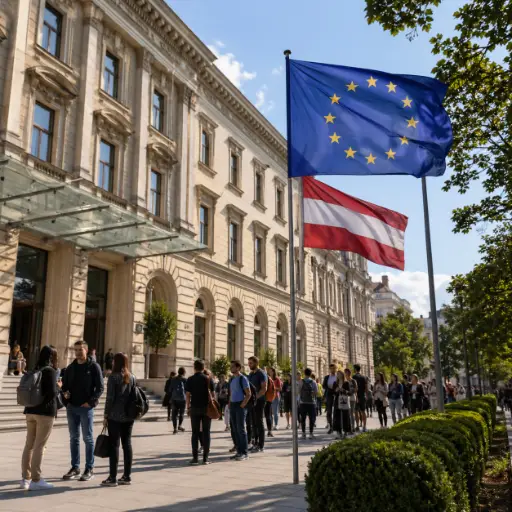
Seven years after its forced departure from Budapest, CEU’s decision to remain headquartered in Austria highlights the enduring political divide between Viktor Orbán’s government and liberal institutions in Central Europe

The Central European University (CEU), once one of Budapest’s most internationally respected academic institutions, will continue to keep its main campus in Vienna, confirming that it has no plans to return fully to the Hungarian capital from which it was gradually pushed out after a controversial wave of legislation reshaped the country’s higher education system. While the university still operates educational activities in both Budapest and Vienna, its institutional center of gravity remains firmly anchored in Austria — a powerful symbol of the political transformation that has defined Hungary over the past decade.
The decision carries significance far beyond the academic world. It reflects the continuing standoff between Prime Minister Viktor Orbán’s nationalist government and the liberal democratic institutions that his administration has increasingly portrayed as foreign influences threatening Hungarian sovereignty. For many observers across Europe, CEU’s relocation became one of the clearest examples of democratic backsliding inside the European Union.
Founded by billionaire philanthropist George Soros after the collapse of communism, CEU was established with the ambition of fostering open societies, critical thinking, and international cooperation in post-Cold War Central Europe. For years, the university represented Budapest’s cosmopolitan identity and attracted students from across the world. Its departure marked not merely the loss of a prestigious institution, but also the erosion of Hungary’s reputation as a regional intellectual hub.
The roots of the conflict date back to the tightening political climate under Orbán’s Fidesz government. Hungarian authorities argued that reforms to higher education law were necessary to ensure transparency and equal treatment among foreign universities operating in the country. Critics, however, viewed the measures as deliberately crafted to target CEU because of its association with Soros, who had become one of Orbán’s principal political enemies.
The legislation introduced conditions that CEU ultimately could not fulfill under the political circumstances of the time. As negotiations between the university and the Hungarian government deteriorated, CEU announced the transfer of most of its degree programs to Vienna. The move triggered international condemnation from academics, European institutions, and human rights organizations, many of which accused Budapest of attacking academic freedom and independent thought.
Years later, the political wounds have not healed. Although CEU still maintains a presence in Budapest through research projects, public lectures, and selected educational programs, university officials have repeatedly indicated that the conditions for a meaningful return no longer exist. Vienna, meanwhile, has evolved from a temporary refuge into a stable institutional home.
The Austrian capital offered CEU not only logistical security but also political support. Austrian authorities welcomed the university as a symbol of democratic openness and intellectual pluralism at a time when concerns over populism and authoritarian tendencies were growing across Europe. CEU’s modern campus in Vienna has since become a visible reminder of the ideological fault lines dividing parts of the European Union.
For Orbán’s supporters, however, the university’s departure remains framed differently. Government allies continue to argue that Hungary merely enforced legal standards and defended national interests against foreign political influence. In pro-government narratives, CEU represented a broader network of liberal activism connected to Soros and Western institutions seeking to shape Hungarian domestic politics.
This narrative has proven politically effective inside Hungary, where Orbán has consolidated power through a blend of nationalism, cultural conservatism, and skepticism toward supranational institutions. The confrontation with CEU became part of a larger political strategy portraying Hungary as a defender of traditional sovereignty against global liberalism.
The issue also exposed the limitations of European pressure. Despite criticism from Brussels and legal challenges surrounding Hungary’s education policies, the broader political trajectory remained unchanged. Orbán emerged politically stronger at home, while institutions such as CEU adapted by relocating rather than expecting a reversal from the Hungarian government.
Analysts note that CEU’s continued presence in Vienna demonstrates how political conflicts over education and culture are increasingly shaping Europe’s geopolitical landscape. Universities are no longer viewed simply as centers of learning, but as actors in ideological struggles involving nationalism, identity, migration, and democratic values.
For students and faculty members, the relocation has carried personal and professional consequences. Some Hungarian academics left the country alongside the institution, contributing to concerns over intellectual migration from Hungary to Western Europe. Others remained, navigating a more constrained academic environment where political sensitivities have become increasingly difficult to separate from university life.
At the same time, CEU’s survival and adaptation in Vienna have also become a story of resilience. The university has preserved its international profile and continues to attract students from dozens of countries. Yet its exile from Budapest remains deeply symbolic. The city that once embodied post-communist openness now stands as a cautionary example in debates about democratic erosion inside the European Union.
As Europe enters another period of political uncertainty marked by rising populism, geopolitical tensions, and polarization over the future of liberal democracy, CEU’s story retains sharp relevance. The university’s decision to remain in Vienna is not simply an administrative matter. It is a reminder that battles over education, culture, and institutional independence continue to define the political future of Central Europe.
Even without formally closing its doors in Budapest, CEU’s center has unmistakably shifted westward. And with Hungary’s political climate showing little sign of change, the possibility of a full return appears more distant than ever.