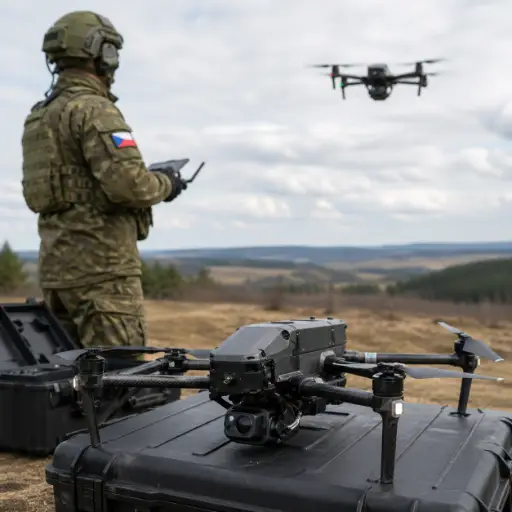
Prague’s rapid expansion of unmanned aerial procurement signals a strategic shift in European defense, deepening ties with Taipei and reshaping regional security priorities.

The Czech Republic has quietly become Taiwan’s most important drone customer in Europe, purchasing nearly 100 million dollars’ worth of Taiwanese unmanned systems during the first months of this year alone. The volume surpasses the combined purchases of all other countries worldwide over the same period and exceeds Poland’s entire annual imports from Taiwan recorded last year.
The surge reflects more than a simple military procurement trend. Analysts describe it as part of a broader geopolitical realignment in Central Europe, where governments increasingly view advanced drone technology as essential for national defense, border surveillance, and strategic resilience in an era marked by growing instability.
Officials in Prague have avoided detailed public commentary on the contracts, citing security concerns and operational sensitivity. However, defense industry sources confirm that the acquisitions include reconnaissance drones, tactical battlefield systems, electronic warfare platforms, and several categories of autonomous aerial vehicles designed for rapid deployment.
The purchases arrive at a time when European governments are reassessing their military readiness following years of heightened tensions across the continent. The war in Ukraine dramatically accelerated interest in drone warfare, exposing how relatively inexpensive unmanned systems can reshape modern combat dynamics. Czech defense planners appear determined not to fall behind.
Taiwanese manufacturers have become increasingly attractive partners for European buyers seeking alternatives to Chinese technology and faster delivery schedules than those offered by some Western defense contractors. Taiwan’s drone sector has expanded rapidly in recent years under strong government backing, with companies focusing heavily on resilience, anti-jamming capabilities, and battlefield adaptability.
For the Czech Republic, the cooperation also carries political symbolism. Prague has steadily strengthened its relationship with Taipei despite repeated criticism from Beijing. Czech political leaders have openly supported closer economic and technological cooperation with Taiwan, especially in sectors linked to cybersecurity, semiconductors, and advanced manufacturing.
Security experts say the drone agreements fit naturally into that evolving partnership.
“The Czech Republic is positioning itself as one of the most technologically agile defense players in Central Europe,” said one European defense analyst familiar with the regional market. “Taiwan offers systems that are combat-oriented, rapidly scalable, and politically compatible with European security priorities.”
The numbers have surprised many observers within the defense industry. Poland, long considered one of Europe’s fastest-growing military spenders, had previously dominated regional drone acquisitions from Taiwanese suppliers. Prague’s accelerated procurement now places the Czech Republic at the forefront of European demand.
Industry insiders point to several factors behind the shift. Czech military modernization programs have intensified, while local defense companies are reportedly exploring joint production and technology transfer arrangements with Taiwanese firms. Such cooperation could eventually allow parts of the drone manufacturing process to move into Europe, reducing dependence on overseas supply chains.
That possibility has gained importance after recent disruptions in global logistics and rising fears surrounding semiconductor availability. Taiwan remains a global leader in advanced electronics manufacturing, giving its drone producers a strategic advantage in both hardware integration and rapid innovation.
European Union officials have also encouraged member states to diversify technology sourcing away from authoritarian regimes. In practice, that has pushed many governments to reconsider procurement relationships involving sensitive digital infrastructure or dual-use technologies.
Taiwan’s growing presence in the European drone market therefore represents both a commercial opportunity and a diplomatic challenge.
Beijing has repeatedly warned European countries against expanding official or strategic cooperation with Taipei. Chinese authorities consider Taiwan part of their territory and oppose international partnerships that could strengthen the island’s political standing.
Yet Central European governments have become increasingly willing to challenge Chinese pressure, particularly in areas connected to national security. Prague’s latest procurement decisions are likely to deepen tensions further.
Within the Czech Republic itself, support for stronger defense investment has increased significantly in recent years. Public debate around military preparedness shifted sharply after Russia’s invasion of Ukraine, with policymakers emphasizing the need for flexible and technologically advanced capabilities.
Drones now sit at the center of that transformation.
Military strategists note that unmanned systems are no longer viewed merely as support tools. They have become core operational assets capable of reconnaissance, targeting, logistics, surveillance, electronic disruption, and direct combat engagement. Smaller nations, especially those seeking cost-effective modernization, increasingly see drones as a force multiplier capable of compensating for limited manpower or slower procurement cycles in traditional weapons systems.
Taiwanese manufacturers appear well positioned to benefit from this trend. Unlike many larger defense exporters, they have focused on agile production, modular designs, and rapid customization for foreign clients.
Several Czech defense companies are reportedly studying opportunities to integrate Taiwanese drone technologies into broader NATO-compatible systems. Although officials have not confirmed future plans publicly, industry representatives believe additional contracts could follow later this year.
The developments are being closely watched across Europe.
Countries in the Baltic region, Scandinavia, and Eastern Europe are all expanding investments in unmanned aerial systems as governments prepare for a more technologically intensive security environment. Demand for surveillance drones in particular has risen sharply around border monitoring and infrastructure protection.
For Taiwan, the Czech deals represent more than economic success. They mark a symbolic breakthrough in Europe at a time when Taipei is seeking stronger international partnerships beyond Asia and North America.
For Prague, meanwhile, the purchases underline a new strategic identity: a medium-sized European state determined to modernize rapidly, diversify its alliances, and secure a leading role in the continent’s evolving defense architecture.
The pace and scale of the Czech acquisitions suggest that drones are no longer a niche capability. They are becoming one of the defining instruments of modern European security policy.