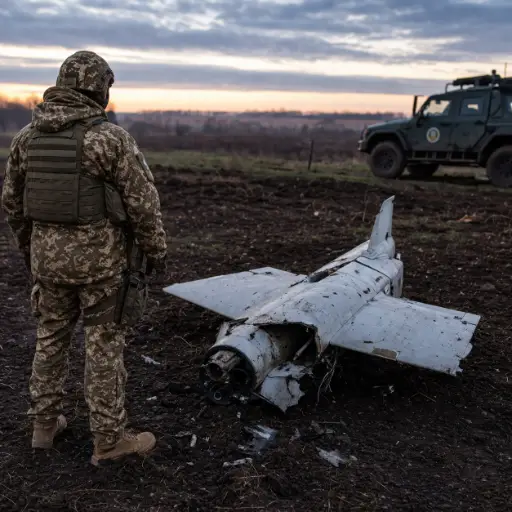
Fragments of two Russian drones discovered on Romanian territory have renewed fears that the war in Ukraine is increasingly spilling beyond its borders, raising fresh security concerns inside NATO’s eastern flank.

Romania awoke to heightened tension after authorities confirmed that debris from two Russian drones had fallen on its territory following a massive overnight air assault against neighboring Ukraine. The incidents, reported in the eastern city of Galați and later in Tulcea County near the Danube Delta, have intensified concerns over the growing risks faced by NATO member states bordering the conflict zone.
According to the Romanian Ministry of Defense, the first fragments were discovered shortly after a large-scale Russian attack targeted Ukrainian infrastructure and port facilities near the Danube River. Hours later, additional drone debris was identified in southeastern Romania, prompting military inspections and security sweeps in the affected areas.
Although no casualties or major structural damage were reported, the discoveries once again highlighted how close the war has come to the borders of the European Union and the North Atlantic Treaty Organization. Romanian officials condemned the incidents as a serious violation of national airspace while reaffirming the country’s commitment to maintaining regional security alongside its NATO allies.
The attacks occurred during another night of intense bombardments across southern Ukraine, where Russian forces have increasingly focused on strategic logistics hubs and export corridors connected to the Black Sea. Ukrainian authorities reported waves of drones approaching critical port infrastructure, triggering anti-aircraft responses throughout the region.
Residents living near the Romanian-Ukrainian border described hearing explosions during the night and witnessing military aircraft operating at unusually low altitudes. In several villages close to the Danube, emergency alerts were issued to warn civilians about potential aerial threats crossing near the frontier.
Security analysts say the repeated appearance of drone fragments inside Romania reflects the changing dynamics of the war, particularly the growing use of long-range unmanned systems. While most drones are intercepted before reaching their intended targets, falling debris has become an increasing hazard in border regions where defensive operations occur close to civilian areas.
Romania has repeatedly strengthened surveillance and air defense measures along its eastern frontier since the beginning of the Russian invasion of Ukraine. Additional radar systems, NATO patrol flights, and military monitoring units have been deployed near the Black Sea and the Danube corridor in response to previous incidents involving stray drones and missile fragments.
The latest discoveries are expected to further intensify discussions within NATO regarding airspace protection and rapid-response coordination among eastern member states. Alliance officials have consistently emphasized that every incursion near NATO territory is monitored closely, even when incidents appear accidental or linked to intercepted aerial targets.
Political leaders in Bucharest reacted cautiously but firmly. Government representatives stressed that investigators are working to determine the exact origin and flight paths of the drones while maintaining direct communication with allied partners. Romanian defense authorities also secured the impact zones to collect evidence and assess any potential risks from unexploded components.
The events come at a particularly sensitive moment for regional security. Attacks around Ukraine’s southern ports have increased in recent weeks as Moscow attempts to disrupt export routes vital for grain shipments and economic activity. The Danube corridor has consequently become one of the most strategically important areas in the broader conflict.
For many residents in southeastern Romania, the war no longer feels distant. Communities near the border have grown accustomed to air raid sirens across the river, military patrols, and nighttime alerts. The discovery of drone debris on Romanian soil has deepened anxieties among civilians who fear that isolated incidents could eventually escalate into more serious confrontations.
International observers warn that even unintended violations of NATO territory carry significant political and military implications. While alliance leaders continue to avoid direct confrontation with Russia, incidents involving drones, missiles, or military aircraft near member states are treated with increasing urgency.
Despite the tension, Romanian officials sought to reassure the public that the situation remains under control. Military teams continue to monitor the border region closely, and NATO surveillance missions over the Black Sea remain active as part of broader efforts to deter further security breaches.
As the conflict in Ukraine enters another volatile phase, the appearance of Russian drone debris inside Romania serves as a stark reminder that the consequences of the war are no longer confined within Ukrainian borders. Along NATO’s eastern edge, the line between neighboring observer and exposed frontline state appears increasingly fragile.