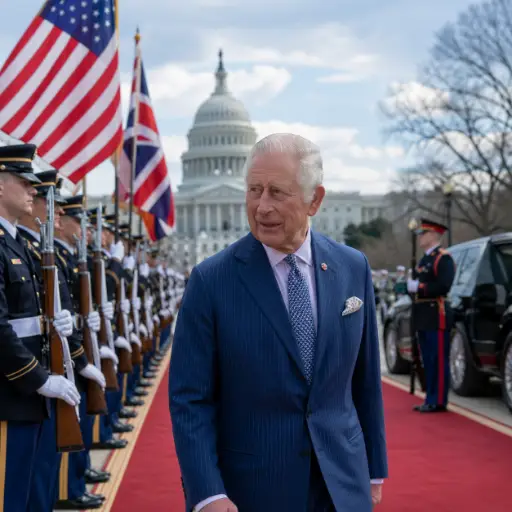
Royal visit marking the anniversary of American independence comes at a delicate moment for transatlantic relations, with global conflicts and political tensions expected to shape talks behind closed doors

King Charles III arrived in Washington at the beginning of the week for a highly symbolic visit linked to the celebrations surrounding the 250th anniversary of American independence. The trip, described by Buckingham Palace as an opportunity to highlight the “shared history of both nations,” carries both ceremonial weight and significant diplomatic importance at a time when relations between the United States and the United Kingdom face growing political and strategic pressure.
The British monarch’s presence in the American capital is designed to underline the enduring alliance between two countries whose histories have been intertwined for centuries — from colonial conflict and revolution to military partnerships and global cooperation. Yet behind the carefully choreographed ceremonies, analysts see a visit shaped as much by present-day uncertainty as by historical reflection.
Washington welcomed the King with military honors and official receptions attended by senior American political figures, diplomats and representatives of the British government. Streets around major institutions were lined with British and American flags, reinforcing the visual message of unity that both governments appear eager to project. The visit comes during a period in which the so-called “special relationship” between London and Washington has increasingly been tested by diverging priorities on trade, defense spending, international strategy and approaches to ongoing global crises.
For King Charles III, the journey also represents one of the most politically sensitive foreign visits since ascending to the throne. Unlike previous royal tours focused largely on cultural diplomacy and public appearances, this visit unfolds against a backdrop of international instability. Officials on both sides of the Atlantic are believed to be discussing ongoing conflicts in Eastern Europe and the Middle East, as well as broader concerns over security alliances and economic uncertainty.
Although Buckingham Palace has emphasized the ceremonial and historical nature of the visit, diplomatic observers note that the timing is impossible to separate from the current geopolitical climate. Relations among Western allies have faced strains in recent years over military commitments, energy policy, defense cooperation and the future direction of NATO. In that context, the King’s appearance in Washington is being interpreted as an effort to reinforce continuity and stability at a moment when global alliances are under pressure.
The symbolism of the trip is particularly striking given the historical origins of American independence itself. The anniversary commemorations inevitably recall the conflict that separated the American colonies from the British Crown centuries ago. Yet modern leaders on both sides are presenting the anniversary not as a reminder of division, but as evidence of how former rivals evolved into strategic partners with deep cultural and political ties.
Historians point out that royal visits to the United States have often served broader diplomatic purposes beyond ceremonial tradition. During periods of uncertainty, the British monarchy has frequently been used as a form of soft power capable of reinforcing relationships that governments alone sometimes struggle to maintain. King Charles III now finds himself continuing that role during a particularly fragile international moment.
Public reaction to the visit has been mixed. Supporters view the trip as a meaningful reminder of longstanding cooperation between democratic allies facing increasingly complex global threats. Critics, however, question whether symbolic gestures can truly mask disagreements over foreign policy, economic strategy and domestic political tensions that continue to affect both countries.
The King’s meetings are expected to include discussions on climate policy, international security and humanitarian concerns connected to current conflicts around the world. Charles has long been associated with environmental advocacy, and American officials are believed to see climate cooperation as one area where London and Washington can still present a united front despite differences elsewhere.
Security surrounding the visit has been extensive, reflecting not only the profile of the royal guest but also the tense international environment. Authorities in Washington implemented heightened protection measures around official venues and diplomatic areas throughout the city. The increased precautions mirror broader anxieties shared across Western capitals regarding political instability and security threats linked to ongoing conflicts overseas.
For many Americans, the royal visit also carries a cultural fascination that extends beyond politics. Crowds gathered near ceremonial locations hoping to catch a glimpse of the British monarch, while television coverage devoted significant attention to the historic and symbolic dimensions of the trip. Despite changing political climates over the decades, the British royal family continues to attract strong public interest in the United States.
At the same time, the visit highlights how much the relationship between the two nations has evolved since the era of revolution. What began as a struggle for independence eventually transformed into one of the world’s closest strategic alliances, defined by cooperation during major wars, intelligence sharing and economic partnership. That shared history now serves as both the backdrop and the message of the King’s presence in Washington.
Diplomatic experts say the visit is ultimately intended to send a signal far beyond the United States and the United Kingdom. At a time of rising geopolitical tension, uncertainty in global markets and continuing armed conflicts, both governments appear eager to demonstrate that the transatlantic alliance remains intact. Whether ceremonial symbolism alone can strengthen that message remains uncertain, but the images emerging from Washington are clearly designed to project continuity, resilience and unity.
As celebrations connected to the anniversary continue, King Charles III’s visit stands as a reminder that history still plays a powerful role in modern diplomacy. The legacy of conflict that once defined relations between Britain and America has long since been replaced by partnership, but the challenges facing both nations today suggest that maintaining that partnership may require more than tradition alone.