Limited voting choices on the occupied West Bank and Hamas’ exclusion from Gaza polls highlight the deep political divisions shaping Palestinian society

The Palestinian movement Fatah, led by Palestinian Authority President Mahmoud Abbas, has declared a decisive victory in the latest local elections held across the Israeli-occupied West Bank, presenting the outcome as proof that the movement continues to dominate Palestinian political life despite years of public frustration and institutional paralysis.
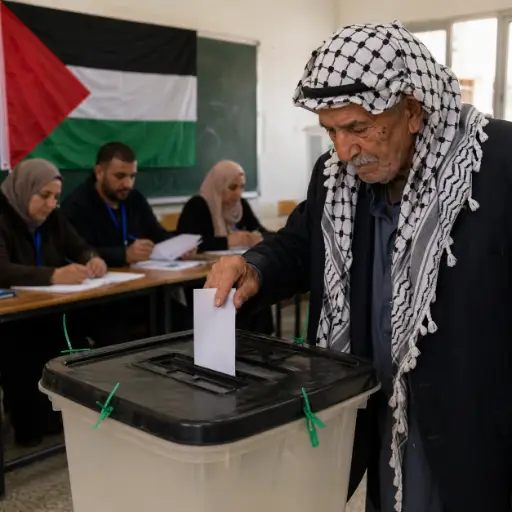
The municipal vote, closely watched across the Middle East, unfolded under unusual and highly restrictive circumstances. In many districts, Palestinians were offered only a single joint electoral list, effectively eliminating meaningful competition in large parts of the territory. While officials from Fatah celebrated the results as a sign of political stability, critics argued that the process exposed the shrinking space for democratic contest inside Palestinian politics.
The elections carried particular symbolic weight because they represented one of the few opportunities for Palestinians to participate in voting after years without national elections. Parliamentary and presidential elections have repeatedly been postponed, deepening public skepticism toward the Palestinian political establishment and widening the gap between leadership institutions and younger generations.
According to Palestinian election officials, turnout varied significantly from one municipality to another. In several towns and villages, voting day passed quietly, marked more by resignation than enthusiasm. Residents interviewed by regional media described a political atmosphere shaped by fatigue, economic hardship and uncertainty over the future of Palestinian governance.
Fatah’s leadership quickly framed the results as a public endorsement of Mahmoud Abbas and the Palestinian Authority at a time of mounting regional pressure. The movement has struggled in recent years to maintain legitimacy amid accusations of corruption, inefficiency and political stagnation. Yet the absence of strong electoral competition in many districts complicated attempts to portray the vote as a broad democratic mandate.
Observers noted that in numerous municipalities, rival factions agreed on unified candidate lists before polling even began. That arrangement reduced the likelihood of internal political confrontation but also deprived voters of genuine electoral choice. Analysts say the phenomenon reflects a wider trend inside Palestinian politics, where local alliances are increasingly designed to avoid instability rather than encourage open competition.
The elections also drew attention because voting took place in Gaza for the first time in nearly two decades, although only in the city of Deir al-Balah. The limited nature of the vote underlined the continuing political and territorial split between the West Bank and the Gaza Strip, divisions that have shaped Palestinian public life since Hamas seized control of Gaza after violent clashes with Fatah forces.
Hamas, designated as a terrorist organization by the European Union, the United States and several other countries, did not participate in the Gaza vote. The Islamist movement has maintained tight political and security control over the enclave for years, while relations with the Palestinian Authority remain deeply fractured despite repeated international mediation attempts.
The restricted municipal election in Deir al-Balah therefore carried more symbolic significance than political consequence. Still, many Palestinians viewed the reopening of polling stations in Gaza as a reminder of how rare electoral participation has become for ordinary citizens living under divided leadership.
Political analysts say the elections highlighted two parallel realities within Palestinian society. On one side stands Fatah, determined to preserve institutional authority in the West Bank despite declining popularity and growing criticism. On the other stands Hamas, which continues to wield power in Gaza while remaining isolated from many international diplomatic processes.
The broader regional environment also weighed heavily over the elections. Continuing violence in the occupied territories, tensions with Israel and worsening humanitarian conditions in Gaza have intensified public frustration. Many Palestinians increasingly see local governance issues — including infrastructure, employment and basic services — as inseparable from the wider political deadlock that has stalled prospects for a negotiated peace process.
International observers followed the elections cautiously, noting that even limited municipal voting can influence the internal balance of Palestinian politics. Western governments and regional actors alike have long encouraged Palestinian leaders to renew democratic institutions, but repeated delays to national elections have weakened confidence in the possibility of meaningful political reform.
For younger Palestinians in particular, the latest vote illustrated a difficult contradiction. While elections remain one of the few mechanisms for political participation, many feel the current system offers little chance for real change. In several urban areas, independent civic activists attempted to mobilize support around local issues, yet their influence remained overshadowed by established political factions and negotiated electoral arrangements.
Despite the controversy surrounding the process, Fatah officials insisted the elections demonstrated resilience within Palestinian institutions at a time of extraordinary pressure. Party representatives argued that maintaining municipal governance and public administration remains essential in the face of ongoing conflict and economic instability.
Critics, however, warned that controlled electoral environments risk further alienating a population already frustrated by years of political division and stalled leadership renewal. Without broader national elections and reconciliation between Palestinian factions, analysts say local victories alone are unlikely to resolve the deeper legitimacy crisis facing Palestinian politics.
As the region continues to navigate conflict, diplomatic uncertainty and internal fragmentation, the municipal elections offered a revealing snapshot of the current Palestinian landscape: fragmented, politically exhausted and still searching for a path toward representative governance.