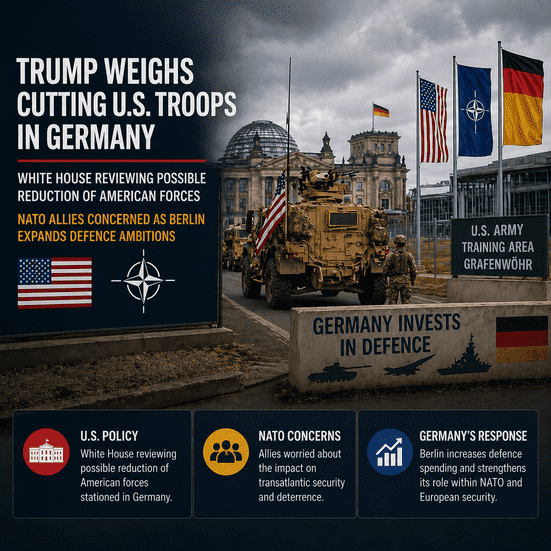
A possible cut to U.S. forces stationed in Germany would amplify allied doubts just as Berlin is trying to become Europe’s military anchor.

WASHINGTON/BERLIN, MAY1, 2026
President Donald Trump has again placed the American military presence in Germany at the centre of a transatlantic argument. In a social-media post on Wednesday, he said the United States was reviewing a possible reduction of troops stationed in Germany, with a decision to come soon. No order has been announced, and U.S. officials have not described a plan. But in NATO capitals, the review itself lands like a warning shot: Washington’s security guarantee can no longer be treated as politically automatic.
Germany is not just another host nation. It is the logistical hub of America’s European posture and a launchpad for operations far beyond the continent. Ramstein Air Base, U.S. European Command, U.S. Africa Command and Landstuhl Regional Medical Center make Germany central to American power projection, intelligence flow, airlift and medical evacuation. The U.S. had just over 68,000 active-duty personnel permanently assigned to overseas bases in Europe at the end of 2025, more than half of them in Germany. Any drawdown would therefore be read not only as a bilateral rebuke to Berlin but as a signal about the future shape of NATO deterrence.
The geography explains the anxiety. From Germany, U.S. forces can reinforce NATO’s eastern flank, support missions in the Middle East and Africa, and connect European logistics to American air and medical infrastructure. Ramstein is not a symbolic base on a map; it is part of the nervous system of U.S. global operations. That makes Germany both an ally dependent on American forces and a platform from which America serves its own strategic interests.
The immediate trigger is political. Trump has been sharply critical of Germany and other allies for refusing to provide the naval support he demanded in the Strait of Hormuz during the two-month Iran war. Chancellor Friedrich Merz has also irritated the White House by questioning Washington’s strategy and warning that the conflict is damaging Europe’s economy. Merz has tried to keep the relationship on workable terms, but Trump’s response has been to revive one of his oldest grievances: that Europeans rely too heavily on American protection while making insufficient military contributions of their own.
That criticism is familiar, but the timing is new. Berlin is no longer the low-spending ally Trump attacked during his first term. Germany has just published its first standalone military strategy in the history of the Bundeswehr and is openly aiming to become Europe’s strongest conventional force. The document, presented by Defence Minister Boris Pistorius and the country’s top military leadership, gives national form to a transformation that accelerated after Russia’s full-scale invasion of Ukraine. It envisages a larger, faster and more deployable German military, a deeper industrial base and a more explicit leadership role inside NATO.
Berlin’s new military ambition is also more than a headline. German officials are talking about larger active forces, a deeper reserve, faster procurement and an industrial base able to sustain high-intensity war. Those goals reflect lessons from Ukraine, where ammunition stocks, air defence and drone warfare have exposed the limits of Europe’s post-Cold War peace dividend. But turning budgets into brigades remains the hard part. Germany can announce leadership faster than it can recruit soldiers, train units, buy equipment and repair readiness gaps.
U.S. defence officials have, at least publicly, welcomed that shift. Defence Undersecretary Elbridge Colby praised Germany’s new strategy as a clear path forward and argued that Berlin was stepping up after years of underinvestment. Germany’s top general, Carsten Breuer, was in Washington this week to discuss the plan with American officials and said he heard appreciation for Berlin’s ambitions. He gave no indication that a troop reduction had been raised in those talks. That contrast — strategic applause from the Pentagon, political pressure from the president — is precisely what unsettles European governments.
For NATO planners, the question is not whether Germany can eventually carry more weight. It is what happens during the transition. European rearmament is real, but it is slow, expensive and uneven. Ammunition production, air defence, long-range fires, logistics, command systems and troop readiness cannot be built by announcement. A sudden American reduction in Germany would create operational and psychological gaps before Europe has the capacity to fill them. Even a modest cut could force allies to revisit assumptions about reinforcement routes, command structures and the credibility of deterrence on NATO’s eastern flank.
Eastern European allies will read any German drawdown through their own threat perception. Poland, the Baltic states and Nordic governments have spent years urging both Washington and Berlin to take Russia’s military rebuilding seriously. For them, the presence of U.S. forces in Europe is not an abstract legacy of 1945; it is the practical backstop that makes deterrence credible while European capacity catches up. If the United States removes troops to make a political point, those allies will ask whether the same logic could apply in a future crisis.
For Trump, the review may be a bargaining instrument rather than a settled strategic choice. He has threatened troop cuts before. In 2020, he announced a plan to remove about 9,500 of the roughly 34,500 U.S. troops then stationed in Germany, only for the move to stall and later be reversed by President Joe Biden. Trump’s current posture carries the same pressure logic: make allies fear the withdrawal of American assets, then demand more spending, more support for U.S. policy and less criticism from European leaders. The difference is that NATO is already more anxious, the Iran war has widened the rift, and Russia remains a persistent threat to the alliance’s east.
There is a counterargument inside the security establishment: U.S. forces in Germany are not charity. They serve American interests. German bases support missions in Europe, the Middle East and Africa; they reduce deployment times; they give Washington command infrastructure it would be expensive and politically difficult to recreate elsewhere. Pulling troops home would satisfy a political message but could reduce U.S. reach. That is why military-to-military relations between Washington and Berlin remain steadier than the public rhetoric suggests. Generals and planners tend to see Germany not as a dependent, but as strategic real estate.
Domestic politics on both sides of the Atlantic deepen the uncertainty. In the United States, troop reductions play well with voters who believe allies have exploited American power. In Germany, the possibility of a drawdown strengthens arguments for greater strategic autonomy but also risks fuelling public unease about militarisation. Merz must therefore defend a bigger Bundeswehr while avoiding the impression that Germany is being forced into rearmament by American volatility rather than by its own assessment of Europe’s security environment.
Berlin’s predicament is that it must respond without appearing panicked. Merz cannot ignore a threat to the most important foreign military presence on German soil. Nor can he allow German rearmament to be cast as a project undertaken under American coercion. His government’s message is likely to remain twofold: Germany is taking greater responsibility for European defence, and the U.S. presence remains mutually beneficial. The harder question is whether that reassurance still works with a president who treats alliances as transactions.
The review may end with no major change. It may produce a symbolic reduction, a relocation or a drawn-out planning exercise. But the damage to certainty has already begun. NATO’s deterrence rests not only on tanks, aircraft and bases, but on the confidence that allies will act together in a crisis. By putting Germany’s troop levels back on the table, Trump has reminded Europe that the American pillar can wobble even when the alliance formally stands. Berlin is building a larger military because it knows that reality. The irony is that Washington is now testing whether Germany can become stronger without NATO becoming weaker.