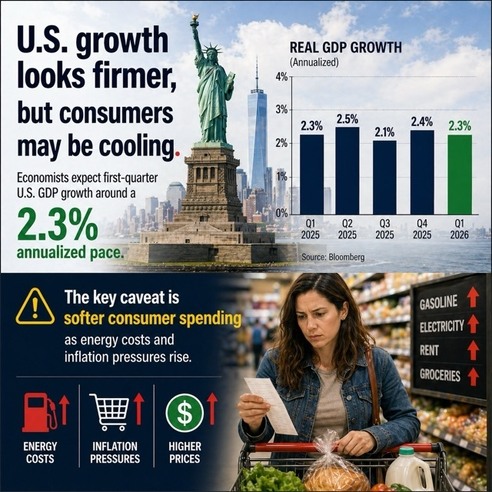
First-quarter GDP came in at a 2.0% annualized pace, below the 2.3% economists expected, as government spending and investment offset softer household demand.

WASHINGTON, May 2, 2026
The U.S. economy began 2026 with firmer growth than at the end of last year, but the details of Thursday’s report were less reassuring than the headline. Gross domestic product expanded at a 2.0 percent annualized rate in the first quarter, according to the Commerce Department’s Bureau of Economic Analysis, rebounding from a 0.5 percent pace in the final three months of 2025. Economists polled ahead of the release had expected growth around 2.3 percent.
The miss was not dramatic. The warning was in the composition. A rebound in government spending after last year’s federal shutdown, continued investment linked to artificial intelligence and data centers, and gains in exports helped lift overall output. But consumer spending, the main engine of the U.S. economy, slowed further just as energy costs, inflation pressure and uncertainty from the war with Iran began to squeeze household budgets.
The first-quarter report lands in an awkward middle ground. It is strong enough to suggest the economy is not rolling over. It is soft enough under the surface to raise questions about how long growth can hold near 2 percent if households become more cautious. For the Federal Reserve, which left interest rates unchanged this week, the data support patience. For the White House, the numbers offer relief from recession talk but not a clean economic victory.
The rebound from the fourth quarter partly reflected a mechanical reversal. Federal spending and investment, which had been disrupted by the 43-day government shutdown, recovered sharply. That recovery added to GDP growth, but economists are unlikely to treat it as a durable trend. Government outlays can lift a quarter; they do not, on their own, prove that private demand is strengthening.
Business investment looked more robust. Spending tied to the artificial intelligence boom continued to underpin equipment purchases and data-center construction. That investment has become one of the economy’s central supports, helping offset weakness elsewhere and giving corporate America a growth story even as consumers show signs of fatigue. The risk is concentration: if too much momentum depends on one capital-spending cycle, the expansion becomes more vulnerable to any pause in technology investment.
The consumer picture was more cautious. Household spending still grew, but at a slower rate. Consumers had already been losing momentum before the latest shock to energy prices, and the war with Iran has pushed gasoline costs higher, with Reuters reporting the average U.S. pump price above $4 a gallon. Higher fuel bills act like a tax on household cash flow, especially for lower- and middle-income families.
Inflation is the second pressure point. Tariffs have lifted prices on some goods, and energy costs threaten to keep inflation expectations elevated. Even where official inflation pass-through has been moderate, the lived experience of prices matters for spending decisions. Consumers do not need a formal recession forecast to delay a car purchase, trade down at the grocery store or cut back on discretionary services.
That behavioral shift is what economists are watching. Consumer spending accounts for roughly two-thirds of U.S. economic activity. A slowdown from strong to moderate growth is manageable. A slowdown that turns into caution across income groups would be more serious, particularly if wage growth is cooling and the labor market is no longer generating the kind of job gains seen in 2023 and 2024.
Imports also complicated the GDP reading. Because imports are subtracted in the calculation of domestic output, a rise in imported goods can drag on headline growth even when it reflects demand from businesses or consumers. In the current environment, trade flows are harder to interpret because companies are managing tariffs, supply-chain uncertainty and geopolitical risk. The headline says growth improved; the details say the economy is still adjusting to a messy global backdrop.
Financial markets are likely to read the report as confirming a hold-and-watch Fed. Growth is not weak enough to demand immediate easing, while inflation and energy risks make rate cuts harder to justify. The central bank’s policy rate remains in the 3.50 percent to 3.75 percent range, and officials have emphasized uncertainty. If consumer demand weakens materially, pressure to cut would build. If inflation stays sticky, the Fed’s room to respond narrows.
For President Trump, the report carries mixed political implications. A 2.0 percent growth rate is respectable, especially after a shutdown-damaged fourth quarter. But voters tend to feel gasoline prices and grocery bills more acutely than annualized GDP. The economy can expand while households feel squeezed. That divergence is dangerous in an election year because it undercuts the argument that aggregate growth automatically translates into confidence.
The next two quarters will test whether the first-quarter rebound was a bridge to steadier growth or a temporary bounce. If AI investment remains strong, energy markets stabilize and wage income holds up, the U.S. could continue expanding at a moderate pace. If gasoline prices stay high, inflation expectations rise and consumers pull back further, the 2.0 percent figure may come to look less like resilience and more like the last clean reading before the squeeze deepened.