Germany’s defence minister tried to drain the drama from Washington’s decision.

The withdrawal of 5,000 American troops from Germany, Boris Pistorius said, was “foreseeable”; Europe, he added, must take more responsibility for its own security. On one level, he is right. The Pentagon’s announcement fits a longer American retreat from the role it played in Europe after 1945: less guarantor, more transactional landlord; less alliance leader, more creditor demanding payment. But the timing, tone and political context make it impossible to treat this as merely strategic housekeeping. It looks, and is meant to look, like pressure.
The drawdown is expected to unfold over the next six to twelve months. Washington has not clarified which bases will be affected, nor whether the troops will return to the United States or be redeployed elsewhere. That ambiguity matters. Germany is not a peripheral posting: it hosts Ramstein, Landstuhl and the headquarters of US European and Africa commands. American forces in Germany are not simply defending Germans; they are also part of the infrastructure through which Washington projects power into the Middle East, Africa and eastern Europe.
So Pistorius’s calm is partly diplomatic necessity. Berlin cannot afford to appear panicked every time Donald Trump turns troop numbers into a bargaining chip. Germany is already trying to expand the Bundeswehr, accelerate procurement and rebuild the military-industrial capacity it neglected for decades. But the minister’s composure should not obscure the political message from Washington. Trump has said the United States will cut “a lot further” than 5,000 troops. The move also cancels a planned US long-range fires battalion in Germany, including Tomahawk-capable deterrence that Berlin had wanted as a signal to Moscow.
This is the real damage. Five thousand soldiers are not, by themselves, the collapse of NATO. The cancellation of capabilities that Europe cannot quickly replace is more serious. For all the rhetoric about European sovereignty, the continent still depends heavily on the United States for long-range strike, air defence, intelligence, logistics and nuclear deterrence. Trump knows this. So does Vladimir Putin. That is why even senior Republicans in Washington warned that a premature reduction of US forces could weaken deterrence and send the wrong signal to the Kremlin.
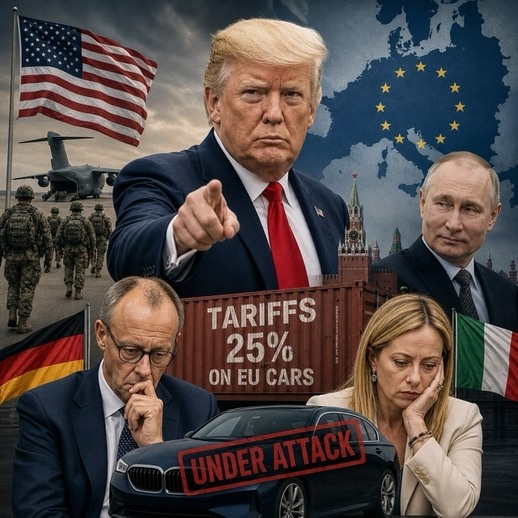
The withdrawal comes at the same time as another blow: Trump’s new tariff threat against European cars and trucks. He has said he will raise duties on EU automotive imports to 25%, up from the previously agreed 15%, accusing Brussels of failing to honour its trade commitments. The Kiel Institute estimates the measure could cost Germany nearly 15 billion euros in output, with longer-term losses potentially rising to about 30 billion euros. Italy, Slovakia and Sweden are also exposed because of their automotive sectors.
That makes the lesson particularly bitter for Friedrich Merz and Giorgia Meloni. Both had argued, in different ways, for managing Trump with restraint rather than confrontation. Germany and Italy were among the governments favouring preservation of the EU-US trade understanding, while others, led by France and Spain, wanted tougher safeguards against American reversals. The reward for moderation has been humiliation: a renewed tariff assault on Europe’s industrial core and a military decision that leaves Berlin looking vulnerable at the very moment it is being asked to lead.
The word “appeasement” is often overused in European politics, but here it captures a hard truth. Trump does not interpret accommodation as goodwill. He interprets it as available leverage. Flattery, visits, concessions and careful language have not protected European leaders from his attacks. European officials increasingly see that even those who tried to stabilise relations through regular engagement and trade deals have found themselves back in Trump’s crosshairs.
Nor can the security decision be separated from the war in Ukraine. Any weakening of American commitment to Europe is read in Moscow as a shift in the balance of risk. Trump may present the drawdown as a fair demand that Europeans pay more for their own defence. That argument has force: Europe did underinvest for too long. But reducing deterrence before European capabilities are ready does not produce autonomy. It produces a gap. And in strategic affairs, gaps are invitations.
For Putin, the symbolism is useful even if the immediate military effect is limited. The American president is publicly quarrelling with the German chancellor, threatening further troop cuts, cancelling a deterrent deployment and opening another trade front against Europe’s largest economy. That is not a coherent Western posture. It is exactly the kind of fragmentation Russia has tried to encourage for years: America irritated, Germany exposed, Europe divided between caution and resistance.
The question for Europe is therefore no longer whether Trump is reliable. That has been answered. The question is whether Europe can move fast enough to make American unreliability less dangerous. Berlin’s instinct to stay calm is understandable. Panic would serve Trump, and it would serve Moscow. But calm cannot become passivity. A Europe that merely absorbs each insult, each tariff threat, each military downgrade, will not be seen as mature. It will be seen as manageable.
Pistorius is right that the decision was predictable. But predictability does not make it harmless. The United States is no longer simply asking Europe to do more. Under Trump, it is making European dependence more costly, more public and more politically humiliating. The answer cannot be another round of pleading for favour in Washington. It has to be accelerated rearmament, deeper European defence integration, and a trade policy that recognises coercion when it sees it.
Europe is being pushed into adulthood by an ally behaving like a creditor. Germany may call the troop withdrawal foreseeable. But the message from Washington is sharper than that: protection is conditional, loyalty is not reciprocal, and softness does not buy mercy.