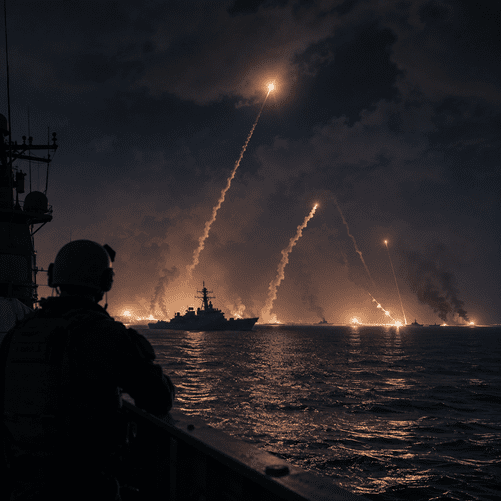
Washington says the operation targeted missile, drone and radar facilities after a cargo vessel was hit by a drone near one of the world’s most important maritime routes.

The United States has carried out airstrikes against Iranian military targets after a drone attack damaged a commercial cargo ship in the Strait of Hormuz, sharply escalating tensions around a vital waterway for global energy and trade.
U.S. Central Command said American aircraft struck Iranian missile and drone storage locations as well as coastal radar sites. Washington described the operation as a direct response to what it called an Iranian attack on the Singapore-flagged M/V Ever Lovely, which was transiting the Strait of Hormuz when it was hit by a one-way attack drone.
The cargo vessel reportedly sustained damage to its upper deck but was able to continue its voyage. No deaths or injuries were reported. U.S. officials said additional drones were launched during the incident and intercepted before reaching other ships.
The confrontation has placed renewed strain on a ceasefire understanding reached between Washington and Tehran only days earlier. President Donald Trump accused Iran of committing a “foolish violation” of the agreement, while Vice President JD Vance warned that attacks on commercial shipping would be answered with force.
Iranian officials rejected Washington’s version of events and warned that further U.S. strikes could trigger broader retaliation. Iranian state media acknowledged attacks near the Strait of Hormuz and on Qeshm Island, an area of strategic military importance close to the Persian Gulf shipping lanes.
The incident has heightened fears over the security of the Strait of Hormuz, through which a significant share of the world’s oil supply passes. Any disruption in the narrow waterway can quickly affect energy markets, shipping insurance costs and the movement of commercial goods between Asia, the Middle East and Europe.
For the Trump administration, the strikes were intended to send a clear signal that the United States would defend freedom of navigation and respond militarily to attacks on commercial vessels. But the operation also carries risks. A limited strike could deter further attacks, but it could also push Iran or allied forces toward another round of retaliation.
The latest escalation comes at a delicate moment for regional diplomacy. The ceasefire framework had raised hopes for a temporary reduction in hostilities and possible follow-up negotiations on Iran’s military posture and nuclear program. The drone attack and U.S. response now threaten to weaken that process before it can take hold.
Shipping companies and regional governments are watching closely. Even after the U.S. strikes, commercial operators remain cautious about sending vessels through the area. Maritime security analysts warn that uncertainty alone can slow traffic, raise costs and create pressure on global supply chains.
The immediate question is whether both sides will treat the latest exchange as a contained episode or the beginning of a wider confrontation. For now, the Strait of Hormuz has again become the center of a dangerous test between military deterrence, diplomatic restraint and the security of international commerce.