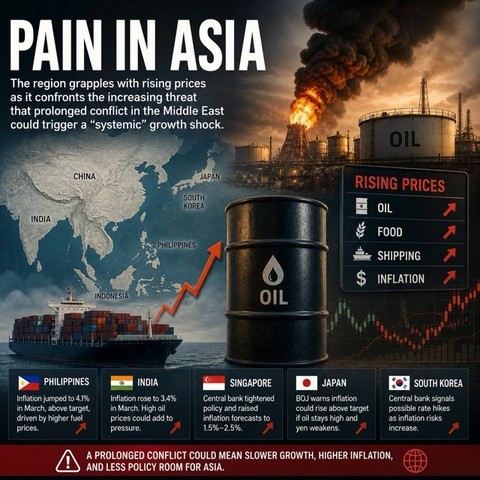
The region grapples with rising prices as it confronts the increasing threat that prolonged conflict in the Middle East could trigger a “systemic” growth shock.

SINGAPORE, May 6, 2026
Asia began the week with a thin layer of market calm, but little real relief. Shares rose in parts of the region on Monday as investors parsed signs of diplomacy around the Middle East conflict, yet oil stayed painfully high, with Brent trading around $108 a barrel and the Strait of Hormuz still at the centre of the global energy scare. The United States said it would start efforts to free ships stranded near the strait, but traders were reserving judgment on whether flows through one of the world’s most important energy corridors could normalize soon.
For Asian governments, the problem is no longer just expensive crude. It is the risk that a drawn-out war turns a price shock into a broader growth shock: higher import bills, weaker currencies, rising subsidies, tighter monetary policy and eroding household incomes feeding on one another. The IMF says Asia entered 2026 on solid ground, but the Middle East war has now pushed up oil and gas prices, widened trade gaps and narrowed governments’ room to respond, especially for fuel-importing economies.
The region’s vulnerability is structural. Reuters reported in April that Asia imports about 60% of its crude oil from the Middle East, making it the continent most exposed to the energy shock. Since the Iran war began on February 28, several Asian currencies have been hit, with India and the Philippines intervening to support their exchange rates and the rupee, rupiah and peso sliding to record lows against the dollar.
The World Bank has framed the shock in global terms. In its latest Commodity Markets Outlook, it forecast a 24% jump in energy prices in 2026, a 16% rise in overall commodity prices and warned that the risks were markedly tilted toward higher prices if the war persists. It said the Strait of Hormuz had carried 35% of global seaborne crude trade before the war and that attacks on infrastructure and shipping disruptions had triggered the largest oil supply shock on record.
Across Asia, the pain is already visible at the pump, in food markets and in central bank language. In the Philippines, headline inflation jumped to 4.1% in March from 2.4% in February, breaching the central bank’s target range. Diesel prices rose 59.5% from a year earlier and gasoline 27.3%, pushing transport costs sharply higher. The central bank warned that a prolonged oil shock could broaden price pressures beyond fuel.
India has so far avoided a full inflation break-out, but the margin is narrowing. Retail inflation rose to 3.4% in March, still below the Reserve Bank of India’s 4% target, but officials and economists warned that a prolonged Middle East war could lift energy and food costs. India imports about 90% of its oil, and its central bank has estimated that a 10% increase in prices above $85 a barrel could add 50 basis points to inflation and trim growth by 15 basis points.
Singapore has already moved. The Monetary Authority of Singapore tightened policy in April and raised its 2026 headline and core inflation forecasts to 1.5%–2.5%, from 1.0%–2.0% previously. The government has announced nearly S$1 billion in support, including cash handouts and fuel vouchers, as officials try to cushion households without losing control of expectations.
Japan shows the harder trade-off facing rich Asian economies. The Bank of Japan kept rates steady at 0.75%, but warned that inflation could rise well above target if oil remains around $105 a barrel, the yen weakens further and stocks fall. Japan sources more than 90% of its crude from the Middle East, leaving the economy acutely exposed to any prolonged closure or disruption around Hormuz.
South Korea, meanwhile, is confronting the same inflation-growth dilemma from a position of export strength. Chip demand has supported growth, but the Bank of Korea’s senior deputy governor said on Monday it was time to stop thinking about rate cuts and start considering hikes, citing higher inflation pressure even after fuel price caps and other government measures.
The region’s policymakers are trying to avoid the mistakes of past energy shocks: blanket subsidies that blow holes in budgets, rate cuts that worsen currency pressure, and price controls that create shortages. The IMF has urged Asian countries to keep policy in balance, warning against excessive energy subsidies even as governments protect the vulnerable. Its Asia-Pacific director said countries needed to keep powder dry for future shocks while managing today’s crisis.
The risk is that time itself becomes the enemy. Short shocks can be absorbed through inventories, fiscal buffers and one-off transfers. Long shocks seep into wage demands, fertilizer costs, freight rates, food prices and exchange-rate expectations. The World Bank warned that fertilizer prices could rise 31% this year, including a 60% increase in urea, threatening future crop yields and pushing food inflation higher later in the year.
The Asian Development Bank has put numbers on the downside. Under its baseline, developing Asia and the Pacific are still expected to grow 5.1% in 2026, with inflation rising to 3.6%. But if hostilities persist through the third quarter, growth could slow to 4.7% and inflation could rise to 5.6%. If the conflict drags on for a year, the region could lose about 1.3 percentage points of growth over 2026 and 2027.
That is why officials are increasingly treating the Middle East conflict not as a distant geopolitical crisis, but as an Asian macroeconomic event. It threatens consumers in Manila, farmers in India, refiners in South Korea, importers in Japan and central bankers from Jakarta to Singapore. The shock is uneven: commodity exporters and economies with stronger external balances have more room to absorb it, while fuel importers with weak currencies and large subsidy bills are exposed first.
Still, Asia is not in the same position it was during earlier crises. Foreign-exchange reserves are larger, banking systems are better capitalized, and many governments have more credible inflation-targeting frameworks. The danger is less a sudden 1997-style financial collapse than a grinding stagflation squeeze: slower growth, higher prices and less policy freedom.
For now, markets are trading headlines from Hormuz. Households are living the consequences. Until tankers move freely, fuel costs ease and inflation expectations stop climbing, Asia’s economic pain is likely to deepen — and the region’s celebrated growth resilience will remain under its sternest test in years.