After years of inconsistency and disappointment, Arsenal’s dramatic return to Europe’s biggest stage signals the arrival of a new era at the Emirates.

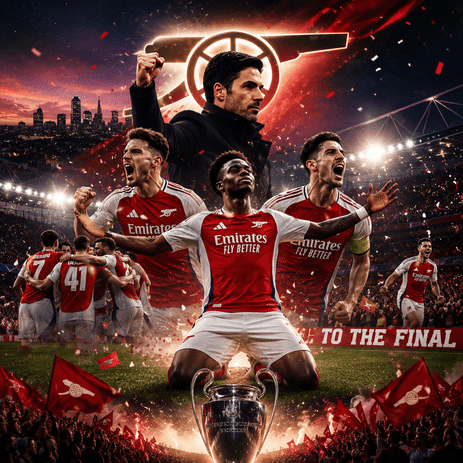
Arsenal reached their first UEFA Champions League final in two decades on Tuesday night, defeating Atletico Madrid 2-1 on aggregate in a tense semi-final that may come to define Mikel Arteta’s reign in North London. Bukayo Saka’s decisive goal at the Emirates Stadium secured a 1-0 second-leg victory and sent Arsenal into a final against either Paris Saint-Germain or Bayern Munich in Budapest later this month.
For Arsenal supporters, the result carried enormous emotional significance. Since their defeat to Barcelona in the 2006 final, the club has spent years drifting between promise and frustration, frequently rebuilding but rarely convincing Europe’s elite that they truly belonged among them. Tuesday’s victory suggested that period may finally be over.
Arteta described the achievement as an “incredible night,” praising the squad’s resilience and growing belief after a difficult stretch earlier in the season. Arsenal’s European campaign has been built not only on attacking quality, but also on defensive discipline. The club has now recorded nine clean sheets in this season’s Champions League campaign, underlining the tactical maturity that has increasingly defined Arteta’s side.
At the center of Arsenal’s resurgence stands Bukayo Saka, whose influence continues to grow both domestically and internationally. The England international once again delivered in a defining moment, reinforcing his status as one of Europe’s most decisive young forwards. Midfielder Declan Rice, another cornerstone of Arsenal’s revival, said the team had rediscovered confidence and momentum after struggling earlier in the campaign.
The victory also highlighted Arsenal’s evolution from an entertaining but fragile side into a team capable of surviving high-pressure knockout football. Atletico Madrid created dangerous moments throughout the tie, but Arsenal’s organization and composure ultimately proved decisive. Arteta’s side appeared calmer, more disciplined, and psychologically stronger than in previous European campaigns.
Beyond football, Arsenal’s return to the Champions League final carries major commercial and symbolic importance. Europe’s elite competition remains one of the sport’s largest financial and global branding platforms. Reaching the final strengthens Arsenal’s position in attracting sponsors, elite players, and international supporters at a time when competition among top clubs is increasingly shaped by financial power as much as sporting success.
The final in Budapest on May 30 will represent Arsenal’s greatest opportunity in a generation to secure European football’s most prestigious trophy. Whether they face Bayern Munich or Paris Saint-Germain, the challenge will be immense. Yet after years of rebuilding, instability, and skepticism, Arsenal arrive at the final no longer as outsiders chasing relevance — but as genuine contenders.