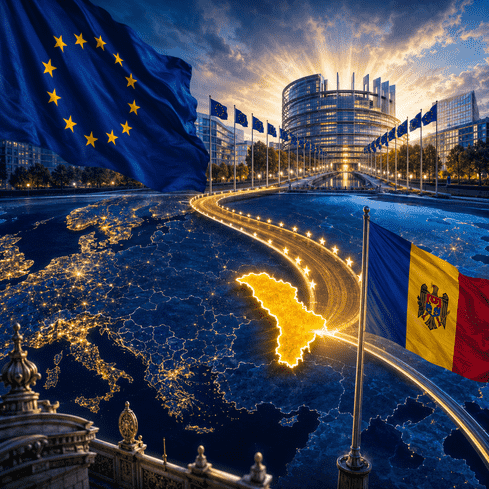
Brussels sees Chișinău’s reform drive as a strategic test of Europe’s influence on Russia’s border

The European Union is moving to accelerate Moldova’s accession process, signaling that enlargement has become one of Brussels’ most important geopolitical tools in the confrontation with Russian influence in Eastern Europe.
EU foreign policy chief Kaja Kallas said the bloc wants to “move fast” on Moldova’s membership talks, arguing that the current political window should be used before future changes inside EU member states create new obstacles. Speaking alongside Moldovan President Maia Sandu, Kallas said Moldova had made significant progress on reforms and stressed that the separatist region of Transdniestria should not block the country’s European path.
For Moldova, the statement is more than diplomatic encouragement. It is a strategic guarantee at a moment when the small country remains exposed to pressure from Moscow, internal political polarization and the unresolved status of Transdniestria, a breakaway region where Russian troops have been stationed for decades.
President Sandu has made EU integration the defining project of her government, presenting membership as both an economic modernization plan and a security shield. Her administration aims to sign an EU accession treaty by 2028, an ambitious timeline that would require rapid progress on judicial reform, anti-corruption measures, administrative capacity and alignment with EU law.
The urgency reflects a wider change in European politics. Since Russia’s full-scale invasion of Ukraine in 2022, EU enlargement has shifted from a slow technocratic process to a central security policy. Moldova, Ukraine and other candidate countries are now seen not only as future members, but as frontline states whose political direction could shape the balance of power between Brussels and Moscow.
Yet the road ahead remains difficult. EU accession requires unanimous support from all member states, and enlargement has repeatedly been slowed by bilateral disputes, domestic politics and concerns over institutional readiness. Kallas’ warning about using the current political climate reflects a familiar European fear: that one change of government inside the EU could delay an entire country’s membership track.
Transdniestria remains another delicate issue. Brussels’ position that the breakaway region should not prevent Moldova from advancing is politically significant, because it suggests the EU may be willing to separate accession progress from the full resolution of frozen conflicts. That approach could carry implications for other candidate countries with unresolved territorial disputes.
For Russia, Moldova’s EU acceleration represents another strategic setback. Moscow has long viewed the post-Soviet space as a zone of privileged influence. A Moldova anchored firmly inside the EU would reduce Russia’s ability to use energy, media networks, political proxies and frozen conflicts to shape the country’s direction.
For Brussels, the challenge is credibility. If the EU encourages Moldova to move quickly but then allows the process to stall, it risks weakening pro-European forces and strengthening anti-EU narratives. If it delivers real progress, Moldova could become a powerful example of how the Union can project stability beyond its borders.
The decision now facing Europe is whether enlargement will remain a promise or become policy. Moldova’s case may show whether the EU is prepared to act with the speed required by a more dangerous geopolitical era.