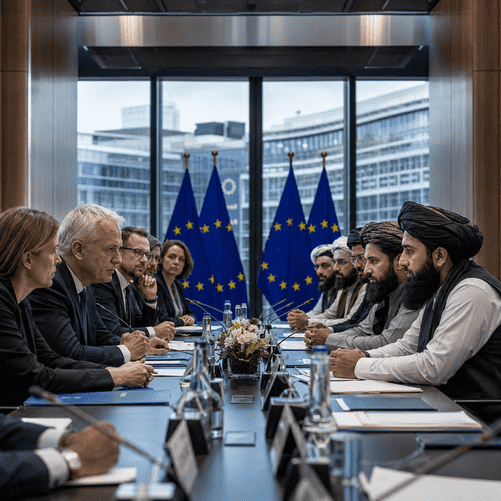
The proposed meeting reflects Europe’s hardening asylum policy, while rights groups warn that deportations to Afghanistan could put returnees at risk

The European Union is preparing for an unprecedented migration meeting with Taliban officials in Brussels, a step that underscores how far European governments are willing to go as they seek tougher tools to deport rejected asylum seekers and migrants considered security risks.
According to Reuters, the European Commission is planning the talks in coordination with Sweden and other member states. The meeting has not yet been scheduled and would not amount to formal EU recognition of the Taliban, which returned to power in Afghanistan in 2021. Still, the symbolism is significant: it would be the first such migration-focused engagement with Taliban representatives in the EU capital.
The initiative comes as migration has again become one of the most politically sensitive issues in Europe. Governments across the bloc are under pressure from voters and opposition parties to accelerate deportations, especially in cases involving rejected asylum claims or people accused of posing security threats. Yet deportations to Afghanistan remain legally and diplomatically complicated because EU countries do not formally recognize the Taliban government.
Human rights organizations have strongly criticized the idea, warning that forced returns to Taliban-controlled Afghanistan could violate the principle of non-refoulement, which prohibits sending people back to places where they may face persecution, torture, or serious harm. The concern is especially acute given the Taliban’s restrictions on women and girls, repression of dissent, and the country’s continuing humanitarian crisis.
The talks also fit into a broader European shift toward stricter migration management. On the same day, European ministers were preparing to discuss proposals for transferring rejected asylum seekers to third-country “return hubs,” another controversial idea aimed at making removals easier but criticized by rights groups as a weakening of asylum protections.
For Brussels, the challenge is political as much as legal. Engaging the Taliban may help unblock deportation procedures, but it risks legitimizing a regime that the EU has refused to recognize and that remains internationally isolated. For European leaders, the question is whether domestic pressure for tougher migration enforcement can be reconciled with the bloc’s stated commitment to human rights and international law.
The proposed meeting could therefore become a test case for Europe’s new migration politics: more pragmatic, more security-focused, and increasingly willing to engage with difficult partners — even when the moral and diplomatic costs are high.