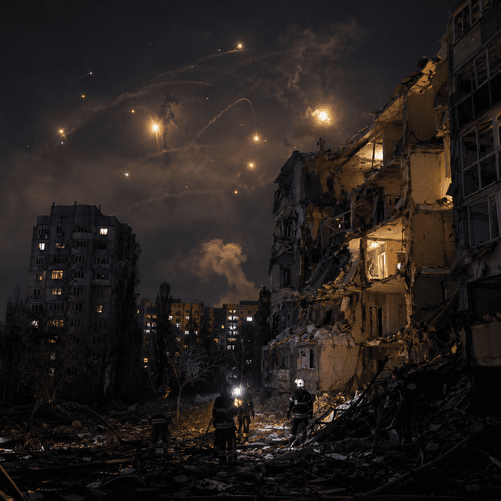
Kyiv says Moscow launched more than 200 drones overnight, exposing the fragility of U.S.-backed efforts to pause the war

Russia launched a major overnight drone assault on Ukraine after the expiration of a short ceasefire, Ukrainian officials said, shattering hopes that the temporary pause could become the foundation for a wider de-escalation. The attack came after a U.S.-mediated truce linked to Russia’s Victory Day commemorations ended on May 11, with Kyiv accusing Moscow of immediately returning to large-scale strikes.
According to Ukrainian authorities, Russia fired 216 drones at targets across the country, of which Ukrainian air defenses intercepted 192. The strikes hit multiple regions, damaging energy infrastructure, residential buildings, transport facilities, and a kindergarten. At least one person was reported killed, while several others were injured.
The renewed bombardment has become a political message as much as a military operation. Ukrainian Foreign Minister Andrii Sybiha said Kyiv had asked for the ceasefire to be extended, but Moscow responded with escalation rather than restraint. President Volodymyr Zelenskiy said Russia’s actions showed it had no real intention of ending the war.
The collapse of the truce also highlights the limits of international mediation. The ceasefire was presented as part of a broader U.S. peace initiative, but fighting reportedly continued along parts of the front even during the pause, with both sides accusing the other of violations. The immediate return of drone attacks now raises doubts over whether short-term humanitarian pauses can survive without stronger enforcement mechanisms or a clearer diplomatic framework.
For Ukraine, the attack reinforces the centrality of air defense in the next phase of the war. Russia has increasingly relied on mass drone barrages to overwhelm Ukrainian systems, target infrastructure, and exhaust civilian resilience. Kyiv, meanwhile, is accelerating its own technological response, including expanded use of artificial intelligence and drone-defense systems developed with Western partners.
The timing is significant. While Moscow publicly suggests the war may be approaching an end, its battlefield behavior points in the opposite direction. For Kyiv and its allies, the latest strikes will likely strengthen the argument that any future ceasefire must be backed by enforceable guarantees, not symbolic pauses. Until then, the war remains locked in a familiar pattern: brief diplomatic openings followed by renewed violence.