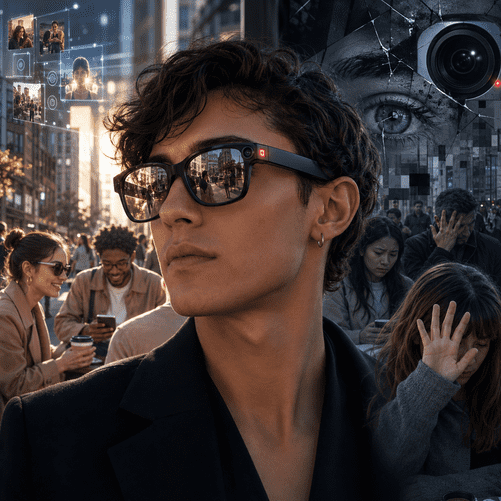
As Meta’s Ray-Bans dominate the market, questions mount over covert recording, legal loopholes, and the future of public anonymity

SAN FRANCISCO — Seven million pairs of Meta’s Ray-Ban smart glasses have been sold, making them the fastest-growing consumer electronics product in recent history. Yet, this commercial triumph is casting a long shadow over the technology’s future. As the devices become ubiquitous, a growing wave of concerns regarding privacy, consent, and the erosion of public anonymity is challenging the narrative that wearable AI is a seamless step forward for society.
The Rise of the Invisible Camera
Meta’s partnership with EssilorLuxottica has successfully disguised advanced surveillance technology within the familiar frames of Ray-Bans. The devices feature an almost invisible camera, small speakers, and a touch-sensitive frame that allows users to snap photos or record video with a casual gesture.
Despite the company’s marketing tagline, “Designed for privacy, controlled by you,” critics argue the reality is starkly different. The recording indicator light is often too dim to be noticed in daylight, leaving subjects unaware they are being filmed. This “invisibility” has fueled a new genre of content where men, predominantly, approach women in public spaces—leaving beaches, entering shops, or standing on street corners—to record their reactions to unsolicited questions or pick-up lines.
“They’re some of the fastest-growing consumer electronics in history,” Meta CEO Mark Zuckerberg stated earlier this year, highlighting the device’s market dominance. However, the human cost of this growth is becoming increasingly visible.
Legal Gray Areas and “Paid” Removal
The ubiquity of these devices has exposed significant gaps in privacy law. In many jurisdictions, recording in public spaces remains legal, leaving victims of covert filming with little recourse. Women have reported discovering videos of themselves online only after the content has gone viral, often accompanied by harassment and abuse.
In one particularly disturbing case reported by the BBC, a woman who requested the removal of a secret recording of herself was told by the uploader that deletion was “a paid service.”
The controversy extends beyond public spaces. Meta has faced two lawsuits following revelations that workers in Kenya, tasked with reviewing video footage to train AI models, were exposed to graphic content, including scenes of sex and bathroom usage. Plaintiffs allege they were unaware such recordings existed or that their footage was being shared for human review. Meta maintains that users were informed of potential human review in its terms of service, but the disconnect between legal fine print and user expectation remains a point of contention.
A Market Poised for Expansion
Despite the backlash, the industry shows no signs of slowing down. Meta currently holds an estimated 80% of the smart glasses market, but competitors are preparing to enter the fray:
- Apple: Reportedly developing its own version, potentially launching next year.
- Snap: Planning a new iteration of its “Specs” glasses.
- Google: Set to re-enter the market more than a decade after the failed Google Glass, which was shelved due to similar privacy concerns.
Researchers predict that if current trends continue, up to 100 million people could own a pair of smart glasses within the next few years. This saturation raises profound questions for institutions. How will courthouses, museums, hospitals, and movie theaters enforce no-recording policies when millions of eyeglasses double as hidden cameras?
The User Experience vs. Societal Cost
Not all usage is malicious. Mark Smith, a partner at advisory firm ISG, wears his Meta Ray-Bans daily for legitimate purposes. He appreciates the ability to listen to podcasts while washing dishes, take calls without blocking ambient noise, and capture travel moments without pulling out a phone.
“The basic features are great,” Smith noted, though he admitted the privacy risks are obvious. “The small light that turns on when the glasses are recording appears dim in daylight and often goes unnoticed.”
This ambiguity is at the heart of the societal divide. While Meta CTO Andrew Bosworth argues that high sales figures suggest widespread social acceptance, privacy advocates see a different picture.
The “Glass” Curse Returns?
David Harris, a former Meta AI researcher and current adviser on AI policy, warns that the industry is repeating the mistakes of the past. “Technology like this is fundamentally an invasion of privacy and it’s really going to face more and more backlash,” Harris said, drawing parallels to the Google Glass era.
The stigma is already forming. In December, a man recorded a video complaining after a woman on the New York City Subway broke his Meta glasses, presumably in response to covert filming. The internet, rather than condemning the woman, hailed her as a hero.
Furthermore, reports indicate Meta plans to integrate facial recognition into future versions of the glasses. This would allow wearers not only to record surreptitiously but to instantly identify strangers, a feature that privacy experts say could fundamentally alter the nature of public interaction.
As the technology evolves, the question remains whether society will adapt to a world where being recorded is the default, or if a new wave of legal and social pushback will force a redesign of the smart glasses paradigm.