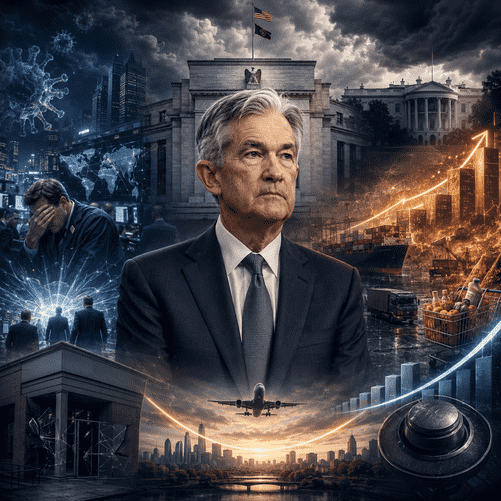
From emergency lender of last resort to political lightning rod, Jerome Powell’s eight-year tenure reshaped the central bank’s mission and tested its autonomy against an unprecedented assault from the White House.

Over eight turbulent years, Jerome Powell’s chairmanship of the Federal Reserve has been defined by a series of existential tests: a global pandemic that froze markets, the highest inflation in four decades, and the most sustained political pressure campaign on the central bank in its modern history. As Powell transitions his role to successor Kevin Warsh, he leaves behind an institution that successfully engineered a “soft landing” for the economy but remains embroiled in a fierce battle over its independence.
The Pandemic Gauntlet
When the coronavirus pandemic struck in March 2020, Powell and the Fed faced a scenario internal models described as a potential depression, with unemployment potentially nearing 20%. In a response described by Powell as “swimming after a speedboat,” the central bank slashed rates to zero and launched unprecedented lending programs into corporate and municipal markets never before touched by the Fed.
The aggressive pivot worked. Markets that had seized up stabilized, earning Powell praise even from President Donald Trump, who had previously criticized the chair. “I would go to bed thinking that a market wouldn’t open up,” recalled Ajay Rajadhyaksha of Barclays, “and then at eleven o’clock there was a new program.” Yet, Powell later described those weeks as harrowing, noting the constant fear of getting it wrong.
The Transitory Mistake
The victory over market panic was followed by a miscalculation that would define the next phase of Powell’s tenure. By mid-2021, as the economy reopened, the Fed bet that rising prices were “transitory,” a view shared by most economists at the time. Officials, having under-reacted during the 2008 financial crisis, felt they had over-corrected by keeping monetary policy loose too long.
The strategy collapsed by November 2021. Inflation accelerated, fueled by supply-chain bottlenecks and a $1.9 trillion stimulus package that the Fed’s deflation-focused framework had not anticipated. By the time Russia invaded Ukraine in 2022, pushing prices to a 40-year high, Powell acknowledged the error. “We underdid it in the great financial crisis, so we overdid it here,” admitted Patrick Harker, then president of the Philadelphia Fed.
The Fastest Hike and the Soft Landing
To correct course, the Fed embarked on the fastest interest rate hiking cycle in four decades. Powell’s August 2022 speech at Jackson Hole, invoking the memory of Paul Volcker, signaled that significant economic pain might be necessary. Yet, Powell rejected calls from some economists to engineer a deep recession to crush inflation, steadfastly pursuing a “soft landing.”
The path was not without scars. The rapid rate increases contributed to the March 2023 collapse of Silicon Valley Bank, the largest bank failure since 2008, exposing blind spots in the Fed’s supervision of interest-rate risk. Powell later admitted, “I’ve had a few [regrets], sure,” but maintained that the alternative—crashing the economy intentionally—was not an option.
By summer 2024, the gamble appeared to pay off. Inflation fell toward the 2% target while unemployment remained modest, allowing the Fed to begin cutting rates. “I think it will go down as one of the great runs in modern Fed history,” said Daleep Singh, a former New York Fed official.
Defending Independence
Perhaps the most enduring chapter of Powell’s tenure was not economic, but political. Upon his return to the White House, President Trump launched an unprecedented campaign to bend the Fed to his will, labeling Powell a “major loser” and attempting to fire Fed Governor Lisa Cook. The administration also weaponized a criminal investigation into a cost-overrun at the Fed’s headquarters renovation, a probe Powell publicly denounced as a pretext to force rate cuts.
Powell’s resistance relied on the bipartisan credibility he had built over years of engagement with lawmakers. While the political fight continues—with the Cook case now at the Supreme Court and the renovation probe recently halted by prosecutors—Powell’s refusal to yield has been widely praised. Even critics like Stanford economist John Cochrane, who faulted Powell’s initial inflation response, conceded that Powell’s defense of the institution revealed “honesty, decency and reverence for the institution.”
A Legacy of Resilience
As Powell steps down as chair, he will remain on the Fed’s board, a move made to ensure continuity in the face of political turmoil—the first chair to do so in over 75 years. His tenure will be remembered for steering the economy through a pandemic, correcting a costly inflationary misstep without triggering a recession, and standing firm against a president attempting to politicize the central bank.
“It’s probably the most difficult time to be a central banker since the Fed was created,” said Singh. Yet, as the dust settles, Powell leaves the Fed’s analytical, evidence-driven culture intact, having successfully navigated the institution through its most tumultuous era in modern history.