Washington says Beijing agrees the strait must reopen, but China has avoided a clear commitment as the Gulf war keeps oil markets and global diplomacy under strain.

The war with Iran has entered a more dangerous diplomatic phase as U.S. President Donald Trump said Chinese President Xi Jinping agreed that Tehran must reopen the Strait of Hormuz, the vital energy corridor whose closure has disrupted global oil flows and intensified pressure on the world economy.
Speaking after talks in Beijing, Trump claimed there was common ground with China on the need to restore navigation through the strait. But Beijing stopped short of confirming any commitment to pressure Iran, instead criticizing the wider conflict and warning against escalation. The gap between Trump’s public remarks and China’s cautious response underscores the difficulty Washington faces in turning international concern over Hormuz into coordinated pressure on Tehran.
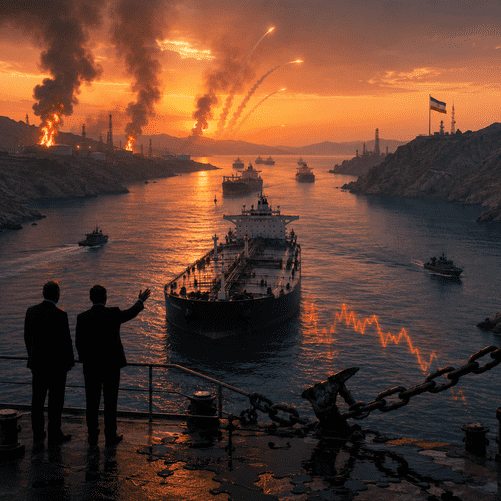
The Strait of Hormuz has become the central battlefield of the crisis. Iran blocked the passage after U.S. and Israeli strikes earlier this year, triggering severe disruption to one of the world’s most important oil routes. Reuters reported that oil prices have climbed to around $109 a barrel, while dozens of commercial ships have been redirected as the blockade continues.
For Washington, reopening the strait is now both an economic and strategic priority. Higher oil prices are feeding inflation concerns, raising transport costs and putting pressure on consumers and businesses across importing economies. The longer the disruption lasts, the greater the risk that the conflict spreads beyond the Middle East into a broader global economic shock.
Iran has proposed a managed-access arrangement that would allow passage for allies and commercial partners, but Tehran is demanding an end to the U.S. port blockade before fully reopening the waterway. Washington has rejected that sequencing, arguing that freedom of navigation must come first. Diplomatic mediation is continuing, with Pakistan involved in efforts to narrow the gap between the two sides.
The crisis is also testing Trump’s foreign-policy style. Reuters analysis described the confrontation with Iran as a major obstacle for the U.S. president’s high-pressure diplomacy, noting that threats and ultimatums have so far failed to produce Iranian concessions. Tehran’s leverage comes from its ability to keep Hormuz restricted, even after suffering military damage.
China’s role is crucial but uncertain. Beijing is one of the world’s largest energy importers and has strong economic reasons to want stable shipping lanes. At the same time, it has little incentive to appear aligned with U.S. strategy, especially if it views the war itself as the cause of the crisis. That makes Chinese pressure on Tehran possible, but far from guaranteed.
The regional consequences are already severe. Reuters has reported that the war has damaged Iran’s economy, strained Gulf states and increased the risk of further instability across the Middle East. Iran’s attacks on Gulf states and Israel’s continued campaign against Hezbollah have also deepened Tehran’s regional isolation.
The next phase will depend on whether diplomacy can produce a formula that allows both sides to step back without appearing to concede. A reopening of Hormuz would immediately ease oil-market pressure and reduce the risk of wider escalation. But if negotiations fail and the blockade continues, the Gulf war could become not only a regional military crisis, but a prolonged global economic and geopolitical emergency.