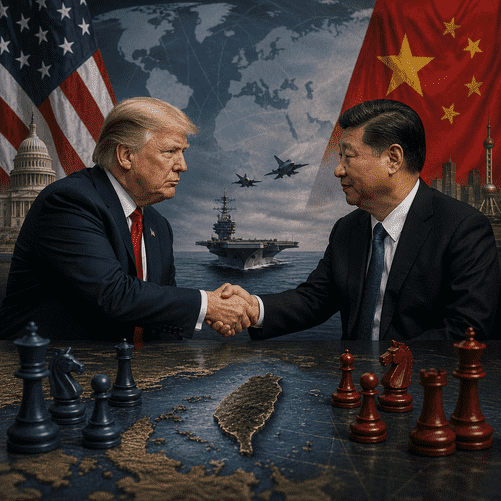
The Beijing summit cooled tensions between the United States and China, but unresolved disputes over trade, Taiwan, and strategic rivalry now shift attention to a possible September meeting in Washington.

The latest meeting between U.S. President Donald Trump and Chinese President Xi Jinping has ended without a major breakthrough, leaving the world’s two largest powers locked in a fragile diplomatic pause rather than a durable reset.
Speaking after the Beijing summit, UN Secretary-General António Guterres said the talks had helped ease tensions but had not produced a decisive agreement on the central disputes dividing Washington and Beijing. The most immediate issue is the future of a temporary trade truce, which remains uncertain and is due to expire later this year.
The summit was closely watched across Asia because any deterioration in U.S.-China relations carries consequences far beyond tariffs. Taiwan, maritime security, advanced technology, military deterrence, and global supply chains all remain connected to the broader rivalry between Washington and Beijing.
Taiwan remains one of the most sensitive flashpoints. During the Beijing talks, Trump reportedly signaled uncertainty over a major U.S. arms package for Taiwan after Xi strongly objected to the proposal. U.S. lawmakers have since urged the administration to proceed, arguing that arms support is essential to deterrence and regional stability.
The issue places Washington in a delicate position. Any hesitation on Taiwan arms sales may be read in Beijing as diplomatic progress, but in Taipei and among U.S. allies it could raise concern about the reliability of American security commitments. Taiwan’s government has continued to argue that U.S. arms supplies are grounded in law and serve as a defensive measure against regional threats.
The summit also unfolded against the backdrop of intensifying diplomacy between China and Russia. Russian President Vladimir Putin is visiting Beijing shortly after Trump’s trip, underscoring the growing strategic alignment between Moscow and Beijing since Russia’s full-scale invasion of Ukraine in 2022. Putin’s visit is expected to focus on bilateral cooperation, regional security, and economic ties.
For Washington, that timing is significant. The United States is attempting to stabilize relations with China while also limiting the strategic space available to Russia. Beijing, meanwhile, is using high-level diplomacy with both Washington and Moscow to project itself as a central power broker in a more fragmented international order.
The summit produced some positive signals. Trump invited Xi to Washington for a possible September visit, which could coincide with the UN General Assembly. Guterres said that meeting now carries greater importance because the Beijing talks did not settle the key disputes.
Still, the absence of a breakthrough means the coming months may be defined by uncertainty. Trade negotiators must decide whether to extend the current truce. Security officials will watch Taiwan closely. Asian allies will look for signs that Washington remains committed to regional deterrence. China will test how far it can push for concessions without triggering a new confrontation.
The Beijing summit did not collapse, but it did not resolve the core tensions either. It bought time. Whether that time becomes a path toward stability or simply a pause before another round of escalation may depend on what happens when Trump and Xi meet again in Washington.