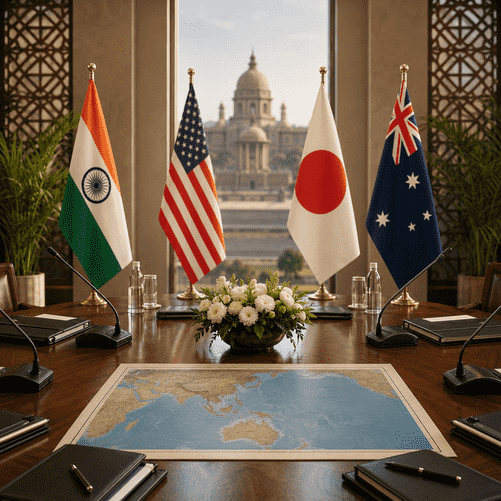
The United States, India, Japan and Australia will meet next week to discuss regional cooperation, supply chains and strategic balance in Asia

The foreign ministers of the Quad countries — the United States, India, Japan and Australia — are set to meet in New Delhi on May 26, in a diplomatic gathering that signals renewed momentum for one of the Indo-Pacific’s most closely watched political groupings.
Japan’s foreign ministry confirmed that Foreign Minister Toshimitsu Motegi will travel to India from May 25 to 27 to attend the meeting, while U.S. Secretary of State Marco Rubio is also expected to participate as part of a broader India visit. The meeting brings together four democracies that have increasingly coordinated on regional security, technology, maritime cooperation and supply-chain resilience.
The Quad is not a formal military alliance, but it has become an important diplomatic platform in Asia. Its members share concerns over the balance of power in the Indo-Pacific, particularly as China expands its economic and strategic influence across the region. The New Delhi meeting is expected to focus on cooperation in areas such as critical minerals, resilient supply chains, emerging technologies and regional connectivity.
For India, hosting the meeting offers an opportunity to reinforce its role as a central diplomatic actor between Washington and Asia’s major powers. New Delhi has sought to deepen cooperation with the United States, Japan and Australia while preserving its strategic autonomy and maintaining a broad network of international partnerships.
For Washington, the talks come at a time when U.S. diplomacy is trying to reassure partners about the durability of American engagement in Asia. Rubio’s trip to India follows a NATO ministerial meeting in Sweden and includes discussions on energy security, trade and defense cooperation, underscoring the connection between U.S. diplomacy in Europe and the Indo-Pacific.
The meeting also carries economic significance. Competition over critical minerals — essential for batteries, defense technology, semiconductors and clean-energy supply chains — has become a major strategic issue. Quad governments are expected to discuss how to reduce vulnerability to supply disruptions and expand cooperation among trusted partners.
Still, the grouping faces limits. India is careful not to appear locked into a bloc structure, while Australia and Japan balance economic exposure to China with security concerns. The United States, meanwhile, must convince partners that its regional commitments will remain stable despite domestic political shifts and trade tensions.
The New Delhi meeting will not transform the Indo-Pacific overnight. But it matters because it shows that the Quad remains politically active at a moment when Asian diplomacy is being reshaped by technology competition, resource security and shifting alliances.
For the region, the message is clear: the Quad is moving beyond symbolism. Its next challenge is to turn diplomatic coordination into practical cooperation that can strengthen resilience without forcing Asia into sharper confrontation.