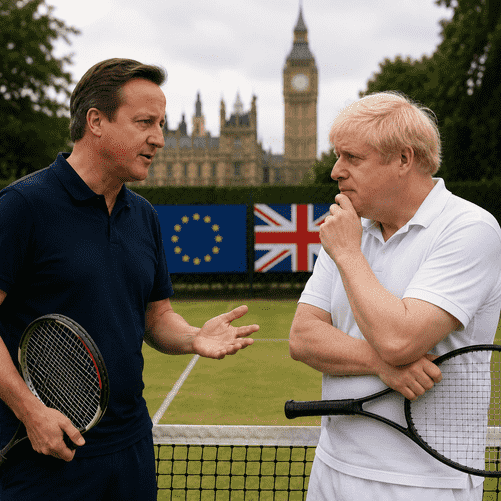
A new BBC documentary says David Cameron offered Boris Johnson a senior Cabinet role if he stayed out of the Leave campaign — a moment that exposes how personal ambition and party rivalry shaped Britain’s EU rupture.

David Cameron offered Boris Johnson a senior Cabinet position if he agreed not to campaign for Brexit, according to new revelations in a BBC documentary marking the tenth anniversary of Britain’s vote to leave the European Union.
The disclosure adds a striking personal dimension to one of the most consequential political decisions in modern British history. Johnson, then mayor of London and one of the Conservative Party’s most recognisable figures, ultimately chose to back Leave — a move that transformed the referendum campaign and helped turn Brexit from a pressure-group cause into a mainstream political insurgency.
According to the documentary, Cameron and Johnson discussed the referendum during a tennis match in early 2016 at the U.S. ambassador’s court in Regent’s Park. Cameron, then prime minister, was trying to persuade his longtime rival and sometime friend to support Britain remaining in the EU. As part of that effort, he reportedly raised the prospect of a “top five” Cabinet post, possibly defence secretary, if Johnson stayed on the Remain side.
The offer, if accepted, could have changed the dynamics of the campaign. Johnson was not merely another Conservative voice; he was a celebrity politician with a rare ability to reach voters beyond Westminster. His decision to join Leave in February 2016 gave the campaign credibility, energy and media attention at a critical moment.
Cameron’s former communications director, Craig Oliver, recalls in the programme that the prime minister appeared optimistic after the tennis meeting, believing Johnson might still be persuaded. That optimism did not last. Johnson later announced that, after what he called “a huge amount of heartache,” he would campaign for Britain to leave the EU. His move was followed by Michael Gove, another senior Conservative, deepening the split at the top of the party.
The revelation is politically explosive because it reopens an old question: was Johnson’s Brexit decision primarily ideological, strategic or personal? Johnson has long insisted that his choice was based on sovereignty and democratic control. Critics, however, have argued that backing Leave offered him a route to the Conservative leadership if Cameron lost the referendum.
Cameron’s alleged offer also underlines how seriously Downing Street viewed Johnson’s potential impact. By early 2016, Cameron had completed his EU renegotiation and committed the government to the 23 June referendum. He needed party unity to sell his settlement to the public. Instead, the Conservative Party split publicly and bitterly, turning the referendum into both a national choice and an internal Tory civil war.
The result was historic. On 23 June 2016, Britain voted by roughly 52% to 48% to leave the EU, with turnout above 70%. Cameron resigned the following morning, saying he could not be the leader to steer the country through Brexit after campaigning to remain. Johnson, after a chaotic leadership battle, did not immediately become prime minister, but his association with Brexit later became central to his rise to Downing Street.
A decade later, the tennis-court conversation captures the intimacy and volatility of the referendum’s origins. Brexit was driven by long-term forces — euroscepticism, migration politics, sovereignty debates and distrust of institutions — but it was also shaped by personal relationships inside a small Conservative elite.
The image of two future and former prime ministers playing tennis while negotiating Britain’s European future is almost cinematic. Yet behind the symbolism lies a deeper truth: the referendum was not only a public vote on Europe, but a private struggle for power within the party that governed Britain.
The BBC documentary’s revelation does not prove that Johnson’s decision was transactional. But it does show that Cameron understood the stakes of Johnson’s choice — and was willing to offer one of the highest prizes in government to prevent him from becoming the face of Brexit.
In the end, Johnson rejected the offer, Cameron lost the referendum, and Britain’s political landscape was transformed. What began as a bid to settle the Conservative Party’s European question instead unleashed a decade of division, leadership crises and constitutional upheaval whose consequences are still being felt.