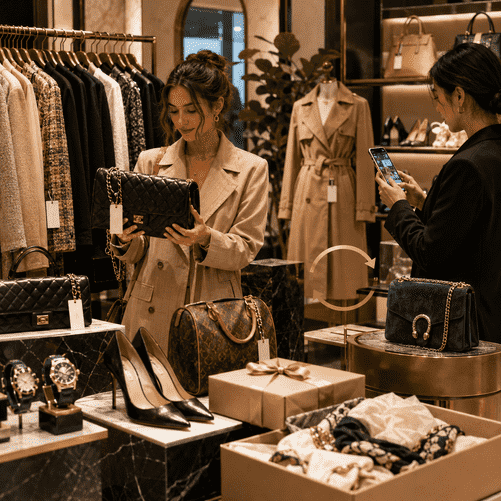
As shoppers become more selective and luxury prices keep rising, secondhand platforms are emerging as both an entry point for young consumers and a strategic tool for heritage brands.

Luxury fashion’s next battleground may not be the newest runway collection, but the products already sitting in someone else’s wardrobe.
Across the global fashion industry, resale is moving rapidly from a fringe habit into a central part of the luxury ecosystem. Once associated mainly with vintage hunters and bargain-conscious shoppers, secondhand luxury is now being embraced by younger consumers, digital platforms and, increasingly, the brands themselves. Vogue Business reported this week that resale has become a core part of how shoppers discover, evaluate and enter the luxury market, especially among Gen Z consumers seeking uniqueness, sustainability and better value.
The shift comes at a difficult moment for luxury houses. After years of aggressive price increases, consumers are becoming more cautious about what they buy and why. Business of Fashion, citing its State of Fashion 2026 analysis, noted that between 2023 and 2025, around 80% of luxury market growth came from price increases rather than higher sales volumes — a strategy that is becoming harder to sustain as shoppers demand clearer value.
That pressure is helping resale become more attractive. For younger buyers, a pre-owned handbag, watch or coat can offer access to heritage luxury without the full retail price. But the appeal is not only financial. Many shoppers also see resale as a way to buy pieces with character, rarity or investment potential — items that feel more personal than products pushed by seasonal marketing cycles.
Technology is accelerating the transformation. AI tools are increasingly being used to improve product discovery, automate listings, personalise recommendations and help sellers price items more efficiently. But trust remains the foundation of the market. Authentication, human review, transparent seller histories and platform credibility are still crucial, especially when buyers are spending hundreds or thousands of euros on branded goods.
For luxury brands, resale was once seen as a threat: a parallel market that could dilute exclusivity or compete with new-season sales. That view is changing. Some brands now treat resale as a customer-retention tool, a sustainability strategy and a source of insight into which products retain value over time. Vogue Business noted that brands and retailers including Eileen Fisher and Tommy Hilfiger have used resale not just to extend product life cycles, but also to keep customers engaged with the brand after the first purchase.
The rise of resale also reflects a deeper cultural shift in luxury. Consumers are no longer buying only for status; they are buying for meaning, durability and emotional connection. Vogue Business’s wider retail analysis argues that luxury shoppers increasingly expect products to justify their price through timelessness, repairability, storytelling and aftercare — not simply logo visibility or craftsmanship claims.
This is especially important as the global fashion market enters a slower-growth period. McKinsey’s State of Fashion 2026 report warned that fashion and luxury retail growth is expected to remain low amid macroeconomic uncertainty, with cautious consumers trading down across categories. In that environment, resale offers both a defensive and offensive opportunity: it allows consumers to stay close to luxury while spending more carefully, and it gives brands a way to remain relevant beyond the first sale.
The resale boom is also changing how products are designed. If a bag, jacket or shoe is expected to circulate through multiple owners, durability becomes more than a sustainability talking point; it becomes a commercial advantage. Products that age well, retain structure and hold desirability on the secondary market strengthen a brand’s reputation and may even support full-price demand.
Still, the sector faces challenges. Counterfeiting remains a major risk. Logistics can be complex. Profitability is not guaranteed, especially for platforms handling authentication, returns and international shipping. And for heritage houses, there is a delicate balance between encouraging circularity and preserving scarcity.
Yet the direction of travel is clear. Luxury resale is no longer just a side market; it is becoming part of how fashion is discovered, valued and consumed. In a world where shoppers are more informed, more digitally fluent and more resistant to unchecked price inflation, secondhand luxury may become one of the industry’s most important growth engines.
For brands, the lesson is simple: the life of a luxury product no longer ends at the first checkout. Increasingly, that is where its next chapter begins.