From France’s training-camp catwalk to Spain’s Loewe tailoring and Virgil van Dijk’s refined classics, football’s biggest event is becoming a global fashion showcase

The first ball of the 2026 World Cup has yet to be kicked, but another competition is already underway.
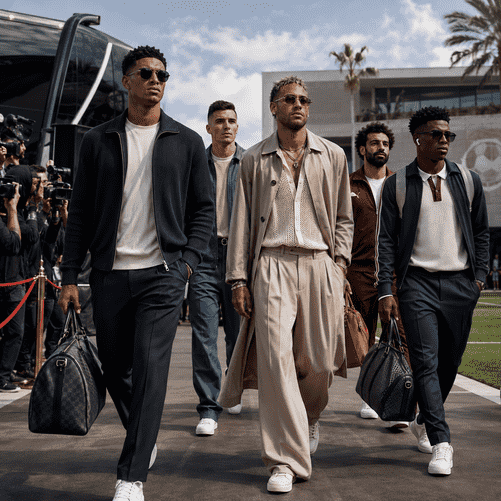
As national teams arrive at training camps across North America, airport terminals, hotel entrances and practice-ground walkways have begun functioning like informal runways. Every arrival is photographed, shared and judged, transforming players’ travel wardrobes into an increasingly important part of the tournament spectacle.
Footballers once attracted attention almost exclusively for their performances on the pitch. Today, their off-duty clothing, accessories and carefully assembled arrival outfits can generate almost as much discussion as their goals and assists.
At this World Cup, national teams are not merely competing through tactics and talent. They are also presenting distinct visual identities shaped by luxury houses, streetwear labels, sportswear companies and the individual tastes of their most influential players.
France Turns Clairefontaine Into a Catwalk
Few teams have generated as much early fashion interest as France.
The squad’s pre-tournament arrivals at its Clairefontaine training base offered a parade of carefully coordinated looks, with players including Jules Koundé and Kylian Mbappé reinforcing France’s reputation for combining football excellence with effortless personal style.
Even once the players changed into standard training uniforms, small details continued to matter. Footwear, sunglasses, jewellery and accessories allowed individuals to maintain a sense of personality within the restrictions of team clothing.
France’s official World Cup wardrobe has also benefited from the increasingly close relationship between football and luxury fashion. A collaboration between Nike and French label Jacquemus has produced a minimalist blue prematch jersey that draws on the national team’s Les Bleus identity while bringing a distinctly designer-led sensibility to sportswear.
For France, style appears less like an additional responsibility and more like part of the country’s cultural confidence.
Spain Embraces Understated Luxury
Spain has adopted a more formally elegant approach through its partnership with Loewe.
The Spanish luxury house has designed off-pitch tailoring featuring wide-cut trousers, relaxed one-button jackets and bright blue polo shirts. The resulting outfits avoid the stiff, corporate appearance traditionally associated with national-team suits.
Instead, the designs offer a looser and more contemporary silhouette that reflects the direction of modern menswear. Worn by players including Nico Williams, Pedri and Pau Cubarsí, the collection presents Spain’s squad as youthful, sophisticated and confident.
The collaboration also demonstrates why fashion houses are increasingly interested in football. Dressing a national team places a label before an enormous global audience while connecting it with players whose cultural influence extends far beyond sport.
Virgil van Dijk Leads the Netherlands With Quiet Confidence
Netherlands captain Virgil van Dijk has emerged as one of the tournament’s most closely watched style figures.
His personal approach is controlled and refined: expensive-looking knitwear, clean tailoring and carefully selected pieces rather than attention-seeking logos or excessive accessories. It is a wardrobe built around confidence, proportion and restraint.
That understated style contrasts effectively with the Netherlands’ bolder team clothing. A collaboration between Nike and Dutch streetwear label Patta uses striking orange-and-black patterns featuring lions and chains, bringing an expressive streetwear energy to the national team’s visual identity.
Van Dijk’s ability to carry both classic clothing and more graphic teamwear reflects the broader evolution of football fashion. The most influential players no longer follow a single formula. They move comfortably between tailoring, luxury, streetwear and sportswear.
England Keeps It Clean and Controlled
England’s players have largely avoided dramatic experimentation, favouring polished and accessible outfits.
Jude Bellingham has been among the early standouts, arriving in tasteful beige separates and a sleeveless knit. The look was simple, immaculate and carefully considered—a reminder that effective style does not always depend on taking the greatest risk.
England’s wider fashion strategy has also embraced streetwear through a partnership between Nike and Palace Skateboards. The collaboration reflects the strong relationship between English football culture, skate style and contemporary casualwear.
The result is an identity that feels recognisably British without relying solely on traditional formal tailoring.
The United States Dresses for the Corporate Sideline
As one of the tournament’s three host nations, the United States has presented a relaxed but coordinated image.
During the squad’s roster-reveal event, players appeared in blue suits worn over simple white T-shirts. The styling mirrored manager Mauricio Pochettino’s familiar preference for relaxed tailoring, creating a subtle visual connection between the coach and his squad.
The look was polished without appearing overly formal—appropriate for a host team seeking to project confidence while remaining approachable.
It also reflected a broader shift in menswear. Traditional suits are becoming softer, less structured and easier to combine with casual clothing, allowing athletes to look composed without appearing constrained.
Germany Chooses Practicality
Germany has approached the unofficial fashion tournament with characteristic restraint.
The team’s travel wardrobe featured variations of navy, beige and white, including chinos, knitwear, casual tailoring and clean T-shirts. The outfits were coordinated without being identical and stylish without appearing excessively designed.
Germany’s approach may not dominate fashion-focused social media feeds, but it offers something increasingly valuable: clothing that ordinary supporters could realistically imagine wearing.
In a tournament filled with designer collaborations and high-risk statement pieces, practical elegance may prove one of the most durable strategies.
Japan Blends Tradition and Modernity
Japan’s national team created one of the most distinctive arrival moments through a combination of immaculate tailoring and cultural symbolism.
The squad departed in sharp blue suits with slightly asymmetrical waistcoats, while veteran defender Yuto Nagatomo added a traditional hachimaki headband representing determination and fighting spirit.
After arriving in Monterrey, the team received cowboy hats, creating an unexpected visual meeting between Japanese tradition and the culture of the host region.
The moment captured one of the World Cup’s most appealing qualities: its ability to bring national identities into conversation with one another through sport, ceremony and style.
Footballers Become Global Fashion Influencers
The growing fashion focus surrounding the tournament reflects a deeper change in how footballers communicate with supporters.
Social media allows players to present carefully selected images of their lives beyond matches and training sessions. Their clothing choices can inspire fans, drive consumer trends and attract partnerships with brands seeking access to football’s enormous global audience.
Young stars such as Spain’s Lamine Yamal are increasingly comfortable experimenting with luxury fashion and bolder silhouettes. Meanwhile, established figures such as Van Dijk demonstrate how classic dressing can still produce a powerful personal identity.
The players arriving in North America are therefore not simply athletes wearing clothes. They are highly visible cultural figures whose appearances can influence how millions of young people understand masculinity, luxury and self-expression.
A Tournament Beyond the Pitch
The expanding connection between football and fashion is unlikely to disappear once the matches begin.
Prematch clothing, training gear, tunnel arrivals and post-match appearances will continue to create fashion moments throughout the competition. Every fixture will offer brands and players another opportunity to shape the tournament’s visual culture.
Some teams will impress through luxury tailoring. Others will rely on streetwear collaborations, traditional symbolism or simple, coordinated uniforms. Individual players will inevitably produce unexpected looks that divide supporters and dominate social media.
The World Cup’s sporting champions will not be crowned until July. Its early style leaders, however, are already making their case.
Before the tournament has produced its first goal, fashion has ensured that football’s biggest stars are already being watched.