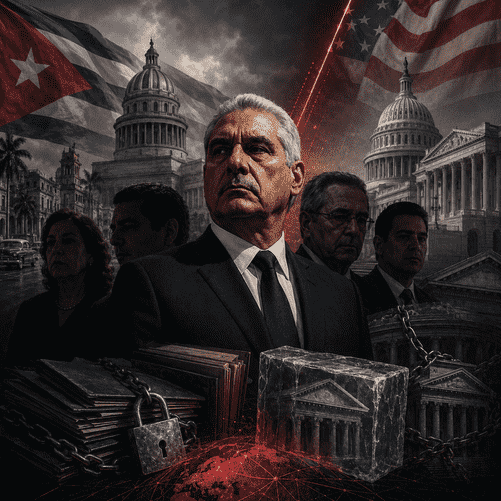
Washington targets Cuba’s political leadership, military institutions and state-linked businesses while warning foreign companies that continued cooperation could expose them to penalties

The United States has imposed a sweeping new round of sanctions against Cuban President Miguel Díaz-Canel, members of his immediate family and relatives of former president Raúl Castro, escalating Washington’s campaign to isolate the communist-led government financially and politically.
The measures target Díaz-Canel, his wife Lis Cuesta Peraza and his stepson, alongside Alejandro Castro Espín—Raúl Castro’s son—and other members of the influential Castro family network.
Several major Cuban state institutions and government-linked entities were also designated, including the Ministry of the Revolutionary Armed Forces and organisations connected to the country’s military-controlled economy.
Announcing the measures, U.S. Secretary of State Marco Rubio warned that the consequences could extend far beyond the individuals and organisations formally listed.
“Anyone providing services to listed entities is at risk of sanctions themselves,” Rubio said, delivering a direct warning to foreign banks, tourism operators, investors and commercial partners that continue to work with sanctioned Cuban institutions.
The latest action represents a further expansion of Washington’s efforts to restrict Cuba’s access to international finance, foreign investment and hard currency. Rather than targeting only officials inside the country, the policy increasingly seeks to deter overseas companies from maintaining relationships with Cuba’s government-controlled economic network.
Under the sanctions, property and financial assets belonging to designated individuals and entities that fall within U.S. jurisdiction can be frozen. American citizens and businesses are generally prohibited from conducting transactions with them.
The measures could also create significant difficulties for non-U.S. companies. Because many international payments pass through American financial institutions or involve U.S. dollars, foreign businesses risk losing access to the U.S. financial system if they continue dealing with sanctioned Cuban entities.
Targeting Cuba’s Military-Linked Economy
The sanctions form part of a wider strategy aimed at Cuba’s military-controlled commercial interests, which hold substantial influence across tourism, banking, retail, mining and other important areas of the island’s economy.
Washington argues that revenue generated through these sectors strengthens Cuba’s security institutions and political leadership rather than benefiting ordinary citizens. U.S. officials have also accused the Cuban government of suppressing political opposition and threatening American national-security interests.
The Trump administration has intensified pressure on Havana in recent weeks, sanctioning military-linked conglomerates and discouraging foreign companies from doing business with Cuba.
The cumulative effect is already becoming visible. International companies operating on the island face growing uncertainty, while Cuba’s ability to receive foreign payments and maintain commercial relationships is becoming increasingly restricted.
Havana Condemns “Interventionist” Policy
Cuban officials have strongly rejected Washington’s accusations and described the sanctions as an effort to deepen the country’s economic crisis and force political change.
Foreign Minister Bruno Rodríguez condemned the measures as an interventionist attack and argued that U.S. pressure would fail to divide the Cuban government and population.
Havana has long maintained that American sanctions are responsible for worsening shortages of fuel, food, medicines and other essential goods. Cuban authorities describe the restrictions as collective punishment that primarily harms ordinary citizens rather than political leaders.
Washington, however, insists that the measures are directed at the Cuban government and the institutions it accuses of repression and economic exploitation.
A Warning With Global Reach
Rubio’s warning to foreign service providers may prove to be one of the most consequential elements of the announcement.
By threatening penalties against companies and financial institutions that assist sanctioned Cuban entities, the United States is effectively asking international businesses to choose between maintaining commercial ties with Cuba and preserving access to the much larger American market and financial system.
The approach could accelerate the departure of foreign investors and tourism companies already concerned about the growing legal and financial risks of operating on the island.
It could also deepen Cuba’s isolation at a time when the country is facing severe economic pressures, energy shortages and declining access to international payment networks.
The latest sanctions demonstrate that Washington’s strategy is moving beyond symbolic action against individual leaders. By targeting the wider network of institutions, relatives and foreign partners surrounding Cuba’s government, the United States is attempting to make continued economic cooperation with Havana increasingly costly.
Whether that pressure produces political concessions—or further intensifies hardship and hostility between the two countries—remains uncertain.