After defeating Jakub Mensik in four sets, the German will face first-time finalist Flavio Cobolli in Paris with his long pursuit of a maiden Grand Slam title approaching a decisive moment

Alexander Zverev has spent years standing close enough to tennis immortality to see it clearly, only to watch it slip beyond his reach.
On Sunday, he will receive another opportunity—and perhaps his most favourable yet.
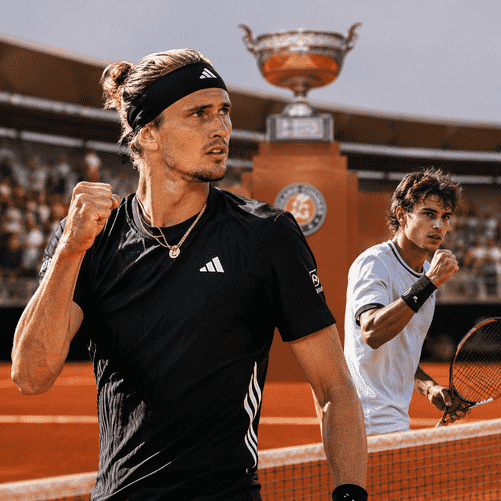
The German second seed advanced to his second French Open final after overcoming Czech 26th seed Jakub Mensik 7-5, 6-2, 3-6, 6-3 on Court Philippe-Chatrier. The victory moved Zverev within one match of the first Grand Slam title that has repeatedly eluded him during a career otherwise filled with major trophies, deep tournament runs and sustained success near the top of the rankings.
Waiting for him in the final will be Italy’s Flavio Cobolli, the 10th seed, who reached his first Grand Slam final after fellow Italian Matteo Arnaldi withdrew from their semifinal shortly before it was due to begin because of illness.
For Zverev, the circumstances create an opportunity of enormous significance. He enters the final as the more experienced player, the higher seed and the clear favourite. Yet his previous defeats on the sport’s largest stages ensure that Sunday’s match will be judged as much by his ability to manage pressure as by his tennis.
Zverev Survives Mensik’s Resistance
Zverev’s semifinal victory was controlled without being entirely comfortable.
Mensik, a powerful and increasingly confident 20-year-old, challenged the German throughout the opening set and briefly threatened to transform the match after winning the third. His aggressive serving and willingness to attack prevented Zverev from settling into a straightforward rhythm.
However, Zverev’s experience and consistency proved decisive.
The German secured the tight opening set 7-5 before dominating the second, using his first serve and deep groundstrokes to force Mensik into increasingly difficult positions. Although the Czech recovered impressively in the third set, Zverev regained control in the fourth and closed out the match after approximately three hours.
It was not a flawless performance, but it demonstrated the qualities Zverev will need in the final: patience, resilience and the ability to recover when momentum begins moving against him.
Mensik’s run to the semifinals confirmed his status as one of the leading talents of the emerging generation. Yet Zverev ultimately proved more capable of managing the physical and psychological demands of a major semifinal.
Another Chance to End the Wait
Sunday’s final will be the fourth Grand Slam championship match of Zverev’s career.
His first came at the 2020 US Open, where he led Dominic Thiem by two sets and served for the title before losing in a final-set tie-break. At the 2024 French Open, he again moved into a commanding position but was defeated by Carlos Alcaraz in five sets.
Zverev then reached the 2025 Australian Open final, only to lose to Jannik Sinner.
Those defeats have become unavoidable reference points whenever the German reaches the closing stages of a major. They have also created the central question surrounding his career: whether a player capable of consistently challenging the world’s best can finally deliver his strongest tennis when the stakes are at their highest.
Against Cobolli, Zverev will not face an established Grand Slam champion or one of the dominant stars who have repeatedly blocked his path.
That makes the opportunity unusually clear—and potentially more difficult psychologically.
As the favourite, Zverev will carry the greater weight of expectation. Anything other than victory will be viewed not simply as another defeat, but as a major opportunity lost.
Cobolli Arrives Rested but Untested
Cobolli’s path to the final has been both impressive and unusual.
The Italian produced one of the tournament’s strongest comeback victories in the quarterfinals, recovering from a set and a break down to defeat fourth seed Félix Auger-Aliassime. His energetic movement, emotional intensity and ability to compete from difficult positions have made him one of the surprises of the tournament.
However, he advanced through the semifinals without taking the court after Arnaldi withdrew because of a viral illness shortly before their match.
The walkover gives Cobolli additional rest before the final, which could be valuable after a demanding two weeks. At the same time, he will enter the championship match without the competitive rhythm normally provided by a semifinal.
Cobolli has also never previously played in a Grand Slam final. He will need to manage the scale of the occasion while facing an opponent whose game is built around imposing physical pressure through powerful serving and heavy baseline hitting.
Yet the Italian cannot be dismissed.
He has already defeated Zverev on clay this season, winning their semifinal meeting in Munich in straight sets. Although Zverev leads their overall rivalry, Cobolli has demonstrated that he can disrupt the German’s rhythm and compete successfully against him on the surface.
A Draw That Opened for Zverev
The men’s tournament in Paris has developed in a way few expected.
With several leading contenders eliminated or unavailable, Zverev has moved through the draw without facing a top-10 opponent. Mensik was the highest-ranked player he encountered on his route to the final.
That does not diminish Zverev’s achievement. Winning seven best-of-five-set matches at a Grand Slam requires sustained concentration, physical endurance and the ability to survive difficult moments regardless of the opposition.
However, the absence of the tournament’s most dangerous established champions has strengthened the sense that this is the moment Zverev must seize.
At 29, he remains capable of competing at the highest level for several more seasons. Yet future Grand Slam draws may not provide such a clear path, particularly as younger rivals continue to develop and established champions remain active.
The Final Test Is Psychological
Technically, Zverev possesses nearly every weapon required to become a Grand Slam champion.
His first serve is among the most powerful in the sport. His backhand is dependable under pressure, his movement is exceptional for a player of his height and his experience allows him to adapt across long matches.
The greatest uncertainty has often appeared during the decisive moments.
In previous major finals, Zverev has sometimes become cautious when victory moved close, allowing opponents to dictate play and forcing himself into increasingly defensive positions.
Against Cobolli, he must resist that instinct.
The German will be most effective if he accepts the responsibility of being the favourite and plays aggressively from the beginning. He must use his serve to control the match, attack shorter balls and avoid allowing Cobolli’s energy to turn the final into a prolonged emotional battle.
Cobolli, meanwhile, can play with comparatively little pressure. Reaching the final already represents the greatest achievement of his career, and his underdog status may allow him to compete with greater freedom.
That contrast could define the match.
One Match From Redefining His Career
Zverev has already achieved more than most professional players ever will. He has won major tour titles, an Olympic gold medal and spent years among the world’s highest-ranked competitors.
Yet Grand Slam championships remain the defining currency of elite tennis.
A victory on Sunday would transform how Zverev’s career is remembered. It would end years of questions about his ability to perform in major finals and confirm him as one of the leading players of his generation.
A defeat would be far more difficult to absorb.
There will always be other tournaments and potentially other opportunities. But few are likely to arrive with Zverev positioned as such a clear favourite against an opponent appearing in his first major final.
The long wait has brought him back to Paris, one match from the title he has pursued throughout his career.
This time, Zverev cannot afford to let the moment pass.