The live-fire exercise marks a new stage in Taipei’s effort to harden its western coast against a potential Chinese invasion

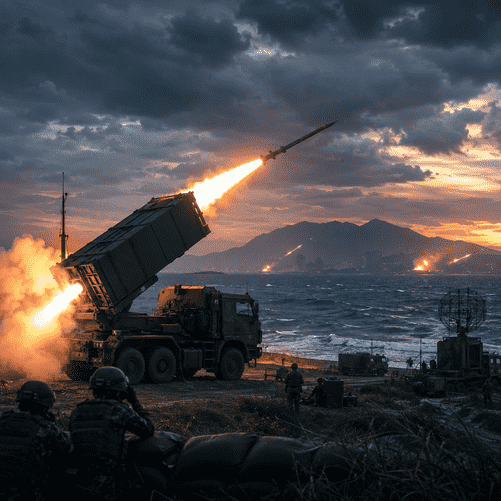
Taiwan test-fired U.S.-supplied HIMARS rocket launchers toward the Taiwan Strait on Wednesday, staging the system’s first live-fire use from its western coast as part of a major invasion-defense drill aimed at deterring China.
The exercise took place along Taiwan’s west-facing shoreline, the area most exposed to a possible amphibious assault from the People’s Liberation Army. Taiwanese forces fired rockets from the truck-mounted High Mobility Artillery Rocket System, known as HIMARS, into waters facing mainland China, demonstrating a mobile strike capability designed to hit enemy landing forces before they reach the island.
The drill formed part of a broader push by Taiwan’s military to make its defense posture more realistic and survivable. Rather than relying only on fixed positions, the HIMARS system allows troops to fire and quickly relocate, a tactic often described as “shoot and scoot.” That mobility is central to Taiwan’s strategy of surviving a first wave of attacks and then striking back against invasion fleets, beachheads and command positions.
For Taipei, the message was directed at both Beijing and Washington. To China, the test signalled that Taiwan is continuing to strengthen its ability to impose heavy costs on any attempted invasion. To the United States, it demonstrated that U.S.-supplied weapons are being integrated into Taiwan’s defensive planning at a time when American support remains crucial to the island’s security.
The use of HIMARS is especially significant because the system has gained international prominence from the war in Ukraine, where it was used to strike ammunition depots, command posts and logistics nodes behind Russian lines. In Taiwan’s case, the launcher’s range and mobility make it a valuable weapon for an asymmetric defense strategy against a much larger Chinese military.
China claims Taiwan as part of its territory and has not ruled out using force to bring the island under its control. Taiwan’s government rejects Beijing’s sovereignty claim, saying the island’s future can only be decided by its people.
The latest drill comes amid persistent Chinese military pressure around Taiwan, including air and naval activity near the island. Taipei has responded by increasing defense spending, expanding missile forces and focusing on weapons that could complicate any Chinese landing operation.
Military planners see Taiwan’s western coast as one of the most dangerous potential fronts in a conflict. Its beaches, ports and urban corridors would be central to any Chinese attempt to land troops and seize control quickly. By firing HIMARS from that region, Taiwan appeared to be rehearsing how it would turn the strait and coastal approaches into a contested “kill zone.”
The exercise also reflects a broader shift in Taiwan’s military doctrine. Instead of preparing for symbolic shows of force, commanders are placing more emphasis on rapid deployment, dispersed firepower and combat conditions closer to what soldiers could face in wartime.
While the drill does not change the military balance by itself, it adds another visible layer to Taiwan’s deterrence posture. In a region already shaped by rivalry between China and the United States, the test-fire served as a reminder that the Taiwan Strait remains one of the world’s most sensitive flashpoints.