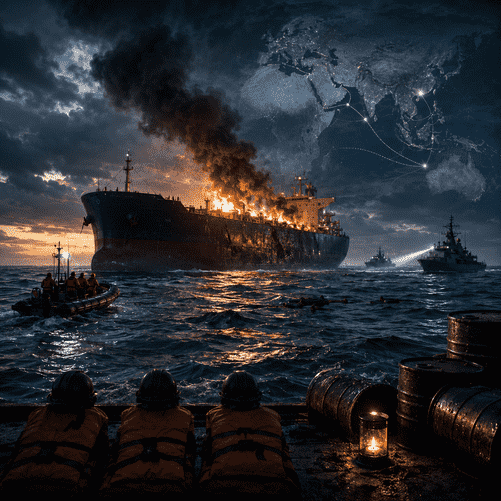
Three Indian sailors killed in U.S. operation mark the first known fatalities linked to Washington’s maritime enforcement campaign

India has said that three of its nationals were killed in a U.S. strike on an oil tanker near Oman, marking the first known deaths caused by American action to enforce its blockade on Iran-linked shipping.
The sailors were aboard the Palau-flagged tanker Settebello, which U.S. forces targeted in the Gulf of Oman as part of Washington’s campaign to stop vessels accused of carrying Iranian oil. Indian officials said the bodies of the three seafarers, initially reported missing, had been recovered and identified. Twenty-one other Indian crew members were rescued after the vessel caught fire.
The deaths have triggered a sharp diplomatic reaction from New Delhi. India summoned a U.S. diplomat and called for an immediate halt to attacks on vessels carrying Indian citizens, stressing that the safety of seafarers must be protected even during military enforcement operations. India’s foreign ministry also noted that none of the targeted ships were Indian-owned, although they carried Indian crew.
U.S. Central Command said the tanker had ignored repeated instructions before it was struck. According to the American account, the vessel was attempting to transport Iranian oil in violation of the blockade, and U.S. forces used precision munitions to disable its engine room. The ship’s managers have denied links to Iran and called for an international investigation into the incident.
The episode is a serious escalation in the maritime confrontation surrounding Iran. Washington’s blockade, imposed in April, is aimed at cutting off Iran’s oil exports and increasing pressure on Tehran amid the wider conflict in the Gulf region. The operation has already disabled several vessels and forced more than 100 others to turn back or change course. Until now, however, it had not been publicly linked to confirmed fatalities.
For India, the strike highlights a painful vulnerability: its vast maritime workforce is deeply embedded in global shipping, including in some of the world’s most dangerous sea lanes. Indian sailors serve on tankers, cargo vessels and commercial fleets across the Gulf, the Indian Ocean and beyond. As the U.S.-Iran confrontation expands at sea, Indian nationals risk becoming collateral victims in a conflict New Delhi has tried to navigate carefully.
The timing is also diplomatically sensitive. India has maintained strategic ties with the United States while also seeking to protect its energy security and avoid being pulled directly into Middle Eastern conflicts. The killing of Indian sailors now puts pressure on Prime Minister Narendra Modi’s government to demand accountability without provoking a deeper rift with Washington.
The incident may also intensify international scrutiny of the blockade itself. While the U.S. argues that it is enforcing restrictions against Iran-linked shipping, maritime safety bodies and governments with citizens working at sea are likely to question how such operations are conducted and whether enough is being done to prevent civilian casualties.
The Gulf of Oman and the Strait of Hormuz remain among the most strategically important maritime corridors in the world. Any disruption there affects oil prices, insurance costs, shipping routes and global supply chains. But the death of three Indian seafarers has shifted attention from the economic consequences of the blockade to its human cost.
The strike on the Settebello has turned a maritime enforcement campaign into a diplomatic crisis. For Washington, it raises questions about the risks of using military force against commercial vessels. For New Delhi, it is a test of how far it is willing to challenge a close strategic partner when Indian citizens are killed. And for the thousands of sailors still operating near the Gulf, it is a stark warning that the region’s shadow war is no longer confined to governments and navies.