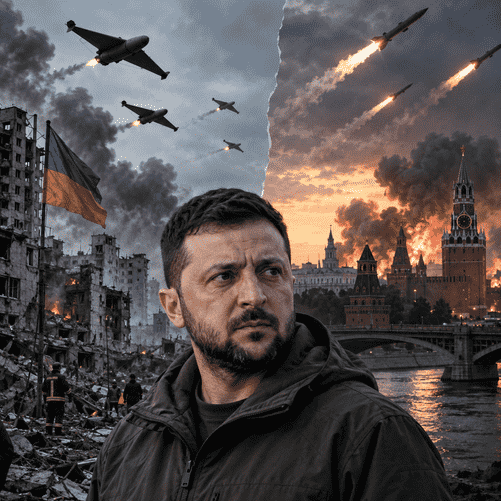
Around Lukianivska Square, repeated Russian missile and drone attacks have turned an ordinary part of the Ukrainian capital into a landscape of shattered buildings, sleepless nights and deepening fear

In the streets around Lukianivska Square, the evidence of war is no longer confined to a single ruined building or a temporary scar left by an overnight strike. Destruction has accumulated layer upon layer, transforming one of central Kyiv’s busiest neighbourhoods into what residents describe as an increasingly uninhabitable landscape.
Apartment windows are covered with plywood. Shopfronts remain damaged or abandoned. Sections of the local market and commercial buildings have been burned or reduced to rubble. The entrance to the Lukianivska metro station—a vital transport hub that also serves as an air-raid shelter—has repeatedly been damaged.
For those who live and work there, the area has become a symbol of the escalating Russian air campaign against the Ukrainian capital.
“It looks like Chornobyl,” one resident said, comparing the district’s shattered appearance to the abandoned landscape around the site of the 1986 nuclear disaster.
The comparison reflects more than physical damage. It captures the sense that normal urban life is slowly being emptied out by fear, uncertainty and the expectation that another missile or drone may arrive at any moment.
A Neighbourhood Struck Again and Again
Lukianivska Square lies in Kyiv’s Shevchenkivskyi district, not far from the city centre. Before Russia’s full-scale invasion, the area was known for its metro station, market, shopping centre, offices, residential blocks and steady pedestrian traffic.
It is now widely regarded as one of the capital’s most frequently targeted neighbourhoods.
The wider district contains government, industrial and strategic facilities, including the historic Artem weapons plant, which Russia has previously identified as a military target. But the repeated attacks have also devastated homes, businesses and civilian infrastructure across the surrounding area.
Residents say the distinction between a military target and the civilian neighbourhood around it offers little comfort when ballistic missiles and explosive drones descend in the middle of the night.
Successive strikes have damaged the same locations more than once. Repair crews replace windows and clear wreckage, only for new explosions to tear through nearby buildings weeks or months later.
The result is a cycle of destruction and reconstruction that many inhabitants increasingly believe cannot continue indefinitely.
Sleeping Under the Threat of Attack
For residents, the psychological consequences have become as severe as the visible damage.
Air-raid sirens regularly interrupt sleep. Explosions can arrive within minutes of a warning, particularly when Russia launches ballistic missiles that travel too quickly for people to reach shelters safely.
Some residents sleep fully dressed, with documents and emergency bags beside their beds. Others remain close to corridors, bathrooms or interior walls considered less exposed to blast waves and flying glass.
One woman described curling into a protective position at night because she feared a drone or missile might strike her building. Her darkest fear, she said, was not simply death but surviving with catastrophic injuries.
Such thoughts have become increasingly common in a city that has endured years of war but is now experiencing some of the heaviest and most sophisticated aerial attacks since the invasion began.
The attacks combine waves of inexpensive drones with cruise and ballistic missiles. Russia often launches the weapons from different directions and at different times, forcing Ukrainian air defences to respond continuously and making it harder to protect every part of the city.
Even when missiles or drones are intercepted, falling debris can ignite fires, damage buildings and kill people below.
Daily Life Among the Ruins
Despite the danger, Lukianivska has not been abandoned.
Vendors still sell flowers and food. Residents queue for public transport. Cafés and shops reopen where repairs make it possible. Workers sweep broken glass from pavements after nights of bombardment.
This persistence is often presented as evidence of Ukrainian resilience. Yet for many people, remaining is not a heroic choice but an economic necessity.
Moving elsewhere in Kyiv is expensive, and safer accommodation is difficult to find. Leaving the capital entirely may mean abandoning employment, relatives, schools and the networks on which families depend.
Some residents have already fled other parts of Ukraine, including areas closer to the front line, only to discover that safety in Kyiv is increasingly uncertain.
The neighbourhood therefore contains a painful contradiction: ordinary life continues, but almost every routine activity takes place under the possibility of another attack.
The metro station remains both a transport link and a refuge. During major alerts, residents descend to its platforms carrying blankets, folding chairs, pets and small children. Some spend entire nights underground before returning in the morning to assess whether their homes are still intact.
Russia’s Intensifying Air War
The destruction around Lukianivska forms part of a broader escalation in Russia’s long-range campaign.
Recent attacks on Kyiv and other Ukrainian cities have involved hundreds of drones and dozens of missiles in a single night. In one major nationwide assault in early June, Ukrainian authorities said Russia launched 656 long-range drones and 73 missiles.
Although Ukrainian forces intercepted many of them, dozens reached their targets. The attack killed civilians, injured more than a hundred people and damaged residential buildings and infrastructure across several cities.
The use of mass drone waves has placed extraordinary pressure on Ukraine’s air-defence network. Russia can produce and deploy large numbers of drones at a lower cost than the sophisticated missiles frequently used to destroy them.
Ballistic weapons present an even greater danger. Ukraine has only a limited number of systems capable of intercepting them, particularly the US-made Patriot platform.
Ukrainian officials warn that Russia is attempting to overwhelm those defences through the scale and frequency of its attacks. Kyiv has repeatedly appealed to its Western partners for additional interceptors, launchers and radar systems.
President Volodymyr Zelenskyy has argued that delays in supplying air-defence equipment directly increase the risk to civilians.
Waiting for the Next Mass Strike
The anxiety in Lukianivska has deepened amid warnings that Russia may be preparing another large-scale attack on Kyiv.
Russian officials have publicly threatened further strikes against what they describe as Ukrainian “decision-making centres.” Moscow frequently says its attacks are directed at military or defence-related targets and presents some operations as retaliation for Ukrainian strikes inside Russia or Russian-occupied territory.
Ukraine rejects Russia’s justification for attacks that cause widespread civilian casualties and destruction.
For residents, official explanations do little to reduce the immediate danger. The central question is not what Moscow claims it intends to hit, but what will happen to the homes, markets and streets surrounding the target.
The unpredictability has created a permanent state of anticipation. Each quiet night may be followed by a larger assault. Each repaired building may be struck again.
Some residents monitor social-media channels that track Russian aircraft, missile launches and drone movements. Others avoid the constant flow of warnings because it intensifies their anxiety without offering meaningful control over what happens next.
The Limits of Resilience
Kyiv has become internationally known for its resilience. Restaurants continue operating, cultural events take place and residents attempt to preserve the rhythms of ordinary life.
But in neighbourhoods such as Lukianivska, resilience has a cost.
Repeated exposure to explosions, interrupted sleep and the sight of ruined homes can produce lasting trauma. Families face difficult decisions about whether to remain, move elsewhere or leave Ukraine altogether.
Business owners must decide whether repairing damaged premises is worth the risk of another strike. Elderly residents may be unable to reach shelters quickly. Parents must explain to children why they are sleeping underground.
The language of endurance can sometimes conceal the exhaustion felt by people who have been asked to endure too much for too long.
Residents around Lukianivska Square are not simply rebuilding after an attack. They are living inside an ongoing pattern of destruction, without knowing when—or whether—it will end.
A Landscape of Europe’s Continuing War
The devastation around the square also serves as a reminder that the war in Ukraine is not a distant or frozen conflict.
In the centre of a major European capital, civilians continue to wake to missiles, drones and burning buildings. Public transport stations double as bomb shelters. Residential districts are repeatedly damaged by weapons designed for large-scale warfare.
For those outside Ukraine, the destruction may appear through a succession of photographs and casualty figures. For the people of Lukianivska, it is the environment in which they buy food, travel to work and try to sleep.
The neighbourhood still functions, but its residents increasingly question how much more it can absorb.
As Kyiv braces for another possible mass strike, the streets around Lukianivska Square stand as both a testament to survival and a warning. A city can continue moving under bombardment, but every attack leaves another building broken, another family displaced and another layer of fear embedded in daily life.