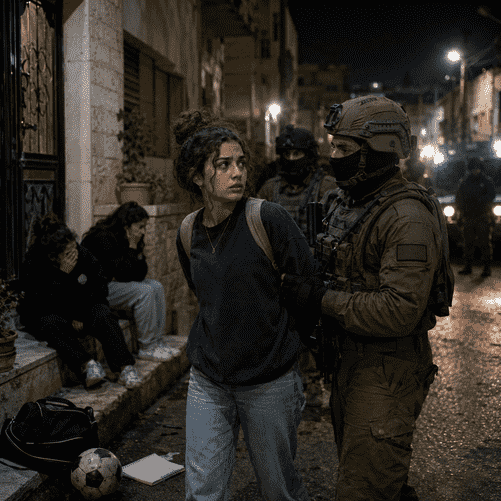
Twenty-year-old Sama Safi was detained during a pre-dawn West Bank raid alongside Birzeit University students, amid mounting concern over her health and calls from US lawmakers for her release

A 20-year-old Palestinian American university student has been held by the Israeli military without formal charges since soldiers arrested her during a pre-dawn raid on her family home in the occupied West Bank.
Sama Safi, a psychology student at Birzeit University, was detained on June 2 along with several other Palestinian women associated with the university. The arrests included a member of the Palestinian women’s national football team and came as Israeli forces intensified operations targeting students accused of involvement in political activism.
The Israeli military said Safi and three other women arrested at around the same time were suspected of promoting hostile or terrorist-related activities. However, no formal charges or specific evidence against Safi have been made public.
Her lawyer, veteran Israeli human-rights attorney Lea Tsemel, said Safi denies belonging to the student organisation at the centre of the investigation. Her family and supporters maintain that she has committed no crime and are demanding her immediate release.
The case has drawn growing attention in the United States, where several members of Congress have urged American officials to intervene. Safi holds US citizenship and has extended family in Florida, which she visited regularly while growing up.
Arrested in the Early Hours
According to her relatives, Israeli soldiers entered Safi’s family home at approximately 3am and took her into custody. She was subsequently transferred to an Israeli detention and interrogation facility in Jerusalem.
The Israeli military has linked the arrests to an investigation involving Qutub, a student organisation active at Birzeit University. Israeli authorities allege that the organisation is associated with the Popular Front for the Liberation of Palestine, or PFLP, which Israel and the United States classify as a terrorist organisation.
Tsemel said Safi denies involvement with Qutub. She also questioned the reliability of information reportedly obtained from other detained students, suggesting that names may have been provided during coercive interrogations.
The lawyer said Safi appeared to be in relatively good spirits when she visited her in detention, partly because the student remained confident that she had done nothing wrong. Nevertheless, Safi’s family is increasingly worried about her physical condition.
Serious Medical Concerns
Safi suffers from a chronic autoinflammatory illness that can cause severe fever, inflammation and debilitating pain. Her relatives said she had only recently begun recovering after spending months bedridden and requires daily medication as well as specialist treatment.
The family said that although she has received some medication while detained, it is not the complete treatment needed to manage her condition properly.
A representative from the US embassy in Jerusalem has visited Safi. According to information relayed to her family, she appeared to be in good spirits and was receiving sufficient food, although questions remain about whether she has access to adequate medical care.
The US State Department has declined to discuss the details of her case, citing privacy considerations. It said, however, that the administration was monitoring the situation and remained committed to securing consular access and appropriate medical treatment for Americans detained overseas.
Israel’s foreign ministry has not publicly provided further details about the allegations against Safi.
Footballers Among Those Detained
The arrests have also attracted attention because Palestinian women’s national football players were among those taken into custody during the wider operation.
Natalie Abu Diya, a Birzeit University student and former Palestinian youth international, was detained during an overnight raid on her university accommodation. Another national-team player, Rand Halawani, was summoned for questioning and detained before later being released.
The Palestine Football Association condemned the arrests, describing them as part of what it considers a wider pattern of Israeli actions against Palestinian athletes.
Birzeit University also denounced the detentions, arguing that they formed part of policies restricting Palestinian education and student political activity.
The Israeli military has rejected the suggestion that the women were arrested because of their status as students or athletes, maintaining that the operation concerned suspected security-related activity.
US Lawmakers Demand Action
Safi’s relatives in the United States have organised a public campaign urging Washington to press the Israeli government for her release.
Their efforts have received support from Senators Chris Van Hollen, Peter Welch and Jeff Merkley, as well as Representative Ayanna Pressley. The lawmakers have called for Safi to receive full consular protection, adequate medical treatment and due process.
Van Hollen said the United States should work urgently to ensure that Safi’s rights as an American citizen are protected.
The congressional pressure follows a previous campaign for Mohammed Ibrahim, a Palestinian American teenager who spent nine months in Israeli detention over allegations that he had thrown stones. He was released in November after repeated intervention by US lawmakers.
Safi’s cousin, Selma Farsakh Ulm, has said the family hopes her American citizenship will generate sufficient pressure to secure her freedom. At the same time, she stressed that the case reflects the experiences of many Palestinians who do not possess foreign citizenship or benefit from international political attention.
Detention Without Charge
Safi has not been placed under a formal administrative detention order, according to the available reporting, but she remains in military custody without charges while Israeli authorities continue their investigation.
Administrative detention is a separate procedure through which Israel can imprison people for renewable periods without presenting formal charges or publicly disclosing the evidence against them. Israel says the system is required in sensitive security cases when revealing intelligence could expose sources or operations.
Palestinian and international human-rights organisations argue that the practice denies detainees the ability to understand or meaningfully challenge the allegations against them.
Conditions for Palestinian detainees have faced heightened scrutiny since the Hamas-led attacks of October 7, 2023, and the beginning of the subsequent war in Gaza. Former detainees, journalists and rights organisations have reported beatings, medical neglect, food deprivation and other forms of abuse in Israeli detention facilities.
Israeli prison authorities have said that detainees are treated according to the law and have rejected allegations that mistreatment is systematic.
A Test of American Protection Abroad
The detention places the US government in a politically sensitive position. Washington remains Israel’s most important international ally, but it also has an obligation to protect American citizens detained abroad and advocate for access to legal representation and medical treatment.
For Safi’s family, consular visits are not enough. They argue that she should either be formally charged and given a fair opportunity to defend herself or released immediately.
Her next court hearing could determine whether the Israeli military seeks to extend her detention while its investigation continues.
Until then, a 20-year-old American university student remains confined without having been formally accused of a crime, as her relatives, lawyers and political supporters wait for Israeli authorities to explain the evidence against her—or allow her to return home.