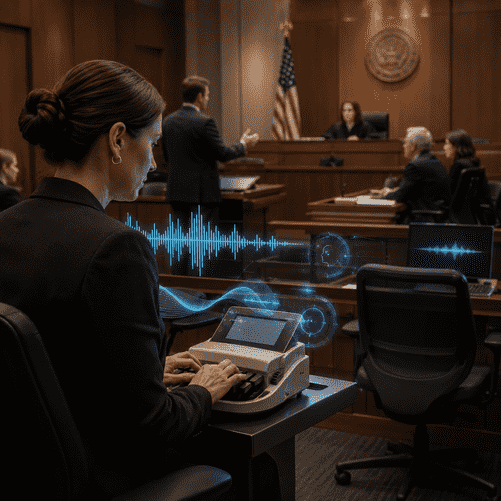
Court reporters continue to outperform automated transcription where accuracy matters most, but retirements and difficult training requirements are leaving courts without enough qualified professionals

For years, court reporting seemed like an obvious candidate for automation.
The work appears straightforward: listen to people speak and convert their words into text. As artificial intelligence and speech-recognition systems became faster and more accurate, predictions that software would replace courtroom stenographers appeared increasingly plausible.
Instead, the profession is confronting the opposite problem.
Courts across the United States need more human reporters, not fewer. Experienced stenographers are retiring faster than new workers can replace them, while automated systems still struggle with the complexity, noise and legal responsibility of producing an official courtroom record.
The result is a growing contradiction at the centre of the AI debate. Technology can transcribe ordinary conversations with remarkable speed, yet the legal system continues to depend on highly trained people capable of understanding not only what was said, but how, when and by whom.
The job AI was expected to destroy has become one of the clearest examples of work that technology may transform without fully replacing.
More Than Typing Quickly
Court reporters create word-for-word records of trials, depositions, hearings and other legal proceedings. Those transcripts may later determine the outcome of an appeal, clarify disputed testimony or establish exactly what a judge ordered.
Accuracy is therefore not merely desirable. It is essential to due process.
Traditional stenographers use specialised keyboards that allow them to record combinations of sounds, words and phrases at extraordinary speed. Rather than typing each letter separately, they press multiple keys simultaneously, much like a musician playing chords.
Some certification tests require candidates to reach 225 words per minute while maintaining at least 95 per cent accuracy.
Reaching that level can take several years of study and intensive daily practice. Students must learn legal and medical terminology, courtroom procedures, transcript formatting and the operation of complex stenographic software.
They must also develop the judgement required to work inside a live proceeding.
A skilled court reporter can identify speakers, distinguish between overlapping voices and ask a witness to repeat an unclear answer. Reporters note interruptions, gestures and other nonverbal events when they matter to the record.
They can recognise when a proper name, technical term or emotional statement has been misunderstood and correct the problem before it becomes part of the official transcript.
AI systems do not yet consistently perform those tasks.
Where Machines Still Struggle
Automated transcription works best under controlled conditions: clear audio, one speaker at a time, limited background noise and familiar vocabulary.
Courtrooms rarely offer such an environment.
Lawyers interrupt each other. Witnesses speak quietly, cry, mumble or use regional accents. Judges issue rapid instructions. Doors close, papers move, spectators cough and multiple microphones capture different levels of sound.
Legal proceedings also contain names, addresses, technical evidence and specialised terminology that may be unfamiliar to a general speech-recognition system.
An error that would be trivial in a meeting transcript can become consequential in court. Confusing “did” with “didn’t,” assigning a statement to the wrong speaker or mistranscribing a medical term could alter the meaning of testimony.
AI-generated text may also conceal uncertainty. A human listener who cannot hear a word can stop the proceeding or mark it as unintelligible. Software may instead produce a confident but incorrect guess.
This phenomenon is particularly dangerous in the legal system, where an official-looking transcript can carry enormous authority.
Court reporters also certify their work. Their professional identity is attached to the record, and they may be required to explain or defend how it was produced.
An algorithm cannot assume responsibility in the same way.
The Real Threat Is a Worker Shortage
The profession’s immediate crisis is therefore not technological redundancy but a shortage of qualified people.
Over the past decade, the estimated number of American court reporters has fallen sharply as older workers have retired and too few students have completed the demanding training process.
The US Bureau of Labor Statistics projects little overall employment growth in the profession through 2034. Yet it still expects approximately 1,700 openings every year, largely because existing reporters will retire or move into other occupations.
In California, the shortage has already affected access to justice.
The state has reported that large numbers of civil and family-law hearings take place without a verbatim record because no reporter is available. This can leave litigants without the transcript needed to challenge a decision on appeal.
The consequences are especially serious for people who cannot afford to hire a private reporter.
A wealthy company involved in commercial litigation may be able to pay for professional transcription. A tenant, domestic-abuse survivor or parent in a custody dispute may not.
When no official record exists, a legal right may remain theoretically available but practically impossible to exercise.
A Profession Hidden in Plain Sight
One reason for the shortage is that many young people know little about court reporting.
The profession lacks the public visibility of law, medicine or technology, even though experienced reporters may earn strong salaries. The median annual wage for court reporters and simultaneous captioners was more than $67,000 in 2024, according to federal data, while some freelancers and specialists earn more than $100,000 through depositions and transcript fees.
The work also offers several career paths.
Reporters may work directly for state or federal courts, operate independently in depositions, provide real-time captioning or assist deaf and hard-of-hearing audiences at public events.
Nevertheless, the training pipeline remains narrow. Stenography programmes have closed in some areas, and students frequently leave before reaching the speed required for certification.
The final stage can be particularly discouraging. Candidates may spend months attempting to improve from slightly below the required accuracy threshold to the passing standard.
Supporters of reform argue that the profession must reconsider how people are trained and tested without weakening the reliability of legal records.
Voice Writing Offers Another Route
Not every modern court reporter uses a stenographic keyboard.
A growing number practise voice writing, in which the reporter speaks into a sound-dampening mask connected to speech-recognition software. The reporter repeats every word spoken in court, along with punctuation and speaker identifications, using vocal shorthand.
Because the software is trained to recognise the individual reporter’s voice, the method can produce highly accurate real-time text. The human reporter remains responsible for monitoring the proceeding and correcting the transcript.
Voice-writing programmes can sometimes be completed more quickly than traditional stenography courses, making them one possible response to the shortage.
The approach also illustrates how technology may strengthen rather than eliminate the occupation.
Speech recognition performs part of the conversion, but a trained professional manages the context, verifies the language and certifies the result.
Courts Turn to Digital Recording
With too few stenographers available, some court systems are expanding the use of digital audio recording.
In this model, a trained operator manages microphones and recording equipment during the hearing. A transcript can then be produced later, sometimes with the help of AI-assisted software.
North Dakota has moved toward digital recording for proceedings that must be preserved, reflecting both staffing pressures and concerns about the cost of traditional transcripts.
Supporters say electronic recording can make court records more widely available and prevent hearings from proceeding with no record at all.
They also reject the idea that a digital reporter merely presses a button. Operators must monitor audio quality, identify speakers, maintain secure files and ensure that the proceeding is captured correctly.
However, digital recording does not eliminate the need for human labour. Someone must supervise the system, review the audio and correct the transcript. Poor microphone placement or an unnoticed technical failure can make parts of a hearing impossible to reconstruct.
Even advanced AI often requires extensive human editing before a transcript is reliable enough for legal use.
The debate is therefore not simply human beings against machines. It concerns what combination of people and technology can produce an accurate, affordable and trustworthy record.
Accuracy Versus Access
Traditional reporters argue that courts should not respond to the shortage by lowering standards.
They point to cases in which backup recordings or automated transcripts contained serious errors, making them of limited value to judges and lawyers.
Digital-reporting advocates counter that the absence of any record is worse than a record produced through technology and later reviewed by qualified professionals.
Both sides identify genuine risks.
Relying only on stenographers may leave thousands of hearings unrecorded because too few reporters are available. Relying too heavily on automation may create transcripts that appear authoritative but contain hidden mistakes.
The most realistic solution may be a layered system.
Experienced stenographers would remain essential for complex trials, appeals and proceedings where real-time accuracy is critical. Voice writers and certified digital reporters could help cover routine hearings and depositions. AI could accelerate initial transcription, search recordings and identify possible inconsistencies.
In every model, however, a trained human would retain responsibility for the official record.
A Warning About the Future of Work
Court reporting complicates the common story that AI adoption follows a simple path from human labour to machine replacement.
Many occupations consist not of a single task but of a combination of technical skill, judgement, accountability and interaction with other people.
AI may perform one component exceptionally well while remaining unreliable at the job as a whole.
In court reporting, software can transform sound into words. It cannot yet consistently manage a chaotic courtroom, recognise every contextual nuance, interrupt when testimony is unclear and accept responsibility for a record that may determine someone’s freedom, finances or family life.
The shortage also shows that fear of automation can itself damage a profession.
Young people may avoid court reporting because they assume the work will soon disappear. Training programmes then shrink, retirements accelerate and courts turn to technology not because it is superior, but because no human reporter is available.
That creates a self-reinforcing cycle in which predictions of technological replacement contribute to the worker shortage that makes automation necessary.
AI as an Assistant, Not a Substitute
The future court reporter may use far more technology than previous generations.
AI could automatically generate rough drafts, highlight uncertain words, organise exhibits and allow reporters to produce final transcripts more quickly. Remote platforms may enable professionals to cover proceedings in locations where no local reporter is available.
But those tools are more likely to change the work than erase it.
Legal professionals still need a record they can trust. Judges, lawyers and defendants must know that the words on the page accurately reflect what happened in the courtroom.
For the foreseeable future, that trust depends on human oversight.
Court reporting was supposed to offer a straightforward example of AI replacing an old-fashioned occupation. Instead, it has become evidence of the technology’s limits—and of the danger of neglecting skilled professions before machines are truly capable of assuming their responsibilities.
The courts do not simply need faster transcription. They need accuracy, judgement and accountability.
And for now, they need more humans.