During a carefully calibrated visit to Ireland, Canada’s prime minister promoted cooperation among middle powers while avoiding a public confrontation with Donald Trump ahead of a consequential summit.

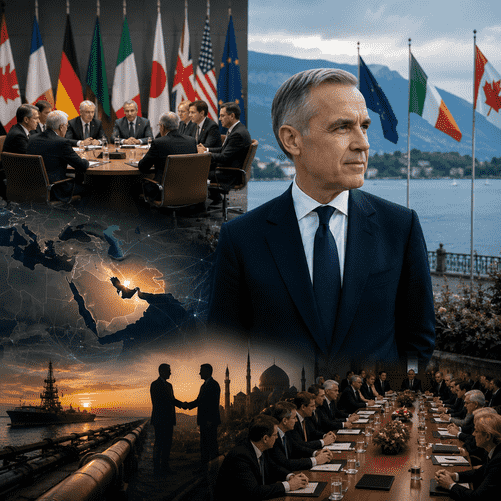
DUBLIN — Canadian Prime Minister Mark Carney has argued that the Group of Seven can play a timely role in supporting any agreement to end the conflict involving Iran, positioning Canada and its allies as potential stabilising forces at a moment of intense diplomatic uncertainty.
Speaking during an official visit to Ireland ahead of the G7 summit in France, Carney presented the international grouping as a forum capable of reinforcing a settlement, coordinating economic measures and addressing the wider security consequences of the crisis.
His intervention came as the United States promoted the prospect of an imminent agreement with Tehran. Although President Donald Trump expressed confidence that a preliminary deal could be concluded quickly, Iranian officials remained more cautious, indicating that significant questions had yet to be resolved.
Those issues reportedly include Iran’s nuclear programme, the future of sanctions, maritime security and the reopening of the Strait of Hormuz, a vital passage for international energy supplies.
For Carney, the potential agreement offers both an opportunity and a test.
The G7 includes several of the world’s most influential advanced economies, but its members have frequently differed over how to approach Iran, the use of sanctions and the Trump administration’s willingness to act without extensive consultation with traditional allies.
Canada is not expected to lead direct negotiations with Tehran. It could, however, contribute to the broader diplomatic and economic framework required to make an agreement credible.
That may include coordinating sanctions relief, supporting verification arrangements, protecting maritime trade and helping prevent renewed escalation across the Middle East.
A Carefully Managed Message
Carney’s comments were delivered during a visit designed primarily to strengthen Canada’s relationship with Ireland and deepen its broader ties with Europe.
The trip was the first bilateral visit to Ireland by a Canadian prime minister in almost a decade. Meetings with Taoiseach Micheál Martin focused on trade, investment, research, defence and technological cooperation.
The two countries are expected to develop a new framework covering sectors including life sciences, innovation and security. The discussions form part of Carney’s wider effort to diversify Canada’s international partnerships at a time when its historically close relationship with the United States has become less predictable.
Yet one name remained notably absent from much of the public diplomacy: Donald Trump.
Carney appeared determined to avoid language that could be interpreted as a direct criticism of the American president. That restraint reflected the delicate position in which Canada now finds itself.
Ottawa needs Washington’s participation in any meaningful Iran settlement. At the same time, Canada is attempting to reduce its economic dependence on the United States and strengthen its relationships with European and other middle-ranking powers.
Carney therefore emphasised institutions, alliances and shared interests rather than personalities.
The strategy allows him to promote a more cooperative international order without openly provoking a president whose decisions can have immediate consequences for Canadian trade and security.
The “Middle-Power” Strategy
The Ireland visit also provided Carney with an opportunity to advance one of the central themes of his foreign policy: closer coordination among middle powers.
He has argued that countries such as Canada should not compete individually for favour from larger states. Instead, they should combine their economic, diplomatic and military influence to protect common interests and preserve room for independent action.
Ireland offers a useful partner in that approach. Both countries maintain close historical and cultural ties, support multilateral institutions and depend heavily on open international trade.
Canada and the European Union together possess significant economic weight, advanced defence industries and extensive diplomatic networks. Greater coordination could allow them to exert more influence over international crises, even when Washington chooses a more unilateral path.
The Iran issue provides an immediate demonstration of that theory.
Should a preliminary deal be reached, the agreement would require support extending well beyond the United States and Iran. European and G7 governments could be asked to help monitor compliance, reopen shipping routes, coordinate sanctions policy and provide political backing for regional de-escalation.
The G7 may also need to respond to the economic damage already caused by the conflict. Disruption around the Strait of Hormuz has driven energy prices higher and intensified inflationary pressure in several economies.
A durable settlement would therefore be important not only for regional security but also for global growth, transport costs and household finances.
Canada’s Difficult American Relationship
Carney’s restrained language towards Trump cannot be separated from the tensions between Canada and the United States.
The two countries remain deeply integrated through trade, energy, manufacturing and defence. However, American tariffs, political threats and disagreements over cross-border infrastructure have placed the relationship under considerable strain.
The forthcoming review of the United States-Mexico-Canada Agreement adds another layer of uncertainty. Canada wants to preserve stable access to its largest export market and avoid further tariffs on strategically important industries.
That gives Ottawa a strong reason not to personalise its disputes with Washington immediately before Carney meets Trump and other leaders at the G7.
His approach appears to be one of strategic caution: defend Canadian interests, expand alternative partnerships and promote collective action—while leaving open the possibility of practical cooperation with the White House.
Such restraint does not mean that the differences have disappeared. Carney’s emphasis on middle powers working together is itself a response to concerns that the United States has become a less predictable ally.
But by avoiding direct criticism, the Canadian leader is attempting to separate his long-term strategy from the immediate need to maintain a functioning relationship with Washington.
The G7’s Moment of Relevance
The summit in France will show whether the G7 can meaningfully shape the Iran negotiations or merely endorse decisions taken elsewhere.
Its members could provide valuable diplomatic and economic support. They could also struggle to agree on the terms of a settlement, particularly if the proposed deal leaves unresolved questions concerning Iran’s nuclear programme, missile capabilities or regional influence.
Iranian caution presents an additional complication. Tehran has indicated that no final decision has been made, despite confident statements from Washington.
Any premature celebration could therefore undermine the process by raising expectations before the negotiating parties have agreed on the details.
Carney’s description of the G7’s role as timely reflects this uncertainty. The organisation may have only a narrow opportunity to help transform a tentative arrangement into a more durable international framework.
For Canada, the summit will also be a test of Carney’s emerging diplomatic identity.
He wants the country to remain a dependable American partner without becoming entirely subordinate to Washington. He also wants closer relations with Europe without appearing to turn away from North America.
His visit to Ireland captured that balancing act: warm engagement with a European ally, support for multilateral diplomacy and an unmistakable determination to keep Donald Trump out of the conversation whenever possible.
Whether that strategy succeeds will depend partly on the G7’s ability to move beyond declarations and make a practical contribution to peace.
If an Iran agreement is reached, Carney will argue that coordinated action among established allies can still influence events. If negotiations collapse, the crisis may instead reveal how limited the G7’s power has become in a world increasingly shaped by unilateral decisions and unstable alliances.