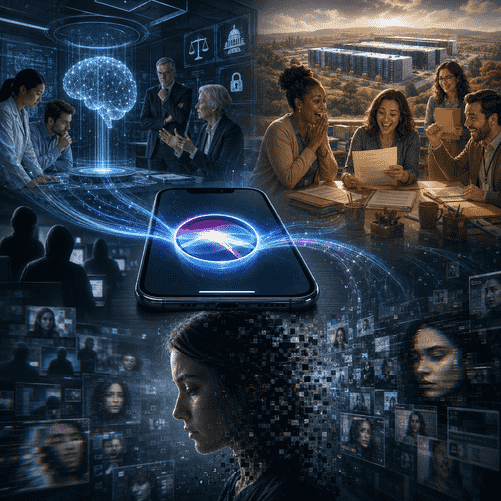
A Gemini-powered assistant promises to make the iPhone more personal, while controversies surrounding Anthropic, Meta’s data centres and sexual deepfakes reveal the disruptive forces accompanying the AI revolution

Apple is attempting to revive Siri with the most important redesign in the virtual assistant’s history, transforming the familiar voice tool into a generative artificial-intelligence system capable of understanding conversations, interpreting personal information and carrying out tasks across multiple applications.
The new product, called Siri AI, is intended to correct years of stagnation during which Apple’s assistant fell behind ChatGPT, Google Gemini and Anthropic’s Claude.
For Apple, the overhaul represents more than a software update. It is a test of whether the company can convert its enormous hardware ecosystem and access to personal data into a competitive advantage without abandoning the privacy standards that distinguish its products.
Yet Siri’s reinvention arrives during a week in which the wider AI industry has also demonstrated its instability, economic power and capacity to cause harm.
Anthropic has been forced to disable two of its most advanced models following an intervention by the US government. A Meta data-centre project has unexpectedly generated bonuses worth tens of thousands of dollars for teachers in rural Louisiana. At the same time, increasingly accessible deepfake tools are being used to create non-consensual sexual images of women and children.
Together, the developments show an industry moving rapidly into everyday life while governments, communities and technology companies struggle to understand its consequences.
Siri becomes personal and conversational
The redesigned Siri is expected to behave less like a voice-controlled search box and more like a personal assistant capable of following context across an entire conversation.
Users will be able to ask follow-up questions without repeatedly explaining what they mean. Siri will also be able to analyse information stored in emails, messages, photographs, calendars and other applications to provide more relevant answers.
A user might ask the assistant to locate an address mentioned in an old message, find photographs from a particular event or build an itinerary using information distributed across several applications.
The assistant will also be able to understand what is displayed on the screen. This could allow it to interpret a photograph, summarise a webpage or act on information contained in a document without requiring the user to copy and paste the material into another service.
Apple is additionally introducing a dedicated conversational interface in which Siri can be used more like a conventional chatbot. Users will be able to interact through text or voice and revisit previous conversations.
The system is being supported by Google’s Gemini technology under a multiyear agreement, giving Apple access to more advanced reasoning capabilities while it continues developing its own artificial-intelligence models.
This reliance on a major rival reflects the urgency of Apple’s position. The company helped popularise voice assistants when Siri was introduced in 2011, but its early lead gradually disappeared as generative AI changed what consumers expected from digital assistants.
Privacy remains Apple’s central argument
Apple is presenting privacy as the defining difference between Siri and competing AI services.
Many requests will be processed directly on the user’s device. More demanding tasks will be sent to Apple’s Private Cloud Compute infrastructure, which is designed to process information without permanently storing it or making it available to the company.
That architecture is essential because the new assistant’s usefulness depends on access to highly personal material.
A system that can read emails, examine private photographs and understand calendar appointments may be extraordinarily helpful. It could also become an unprecedented privacy risk if the data were mishandled, compromised or used for advertising.
Apple believes consumers will trust an assistant built into the operating system more than a third-party chatbot. Whether that trust is justified will depend on the reliability and transparency of the new technology.
The hardware requirements may also restrict its reach. Hundreds of millions of existing iPhones lack the memory and processing power needed to run the most advanced functions, meaning many users will have to purchase newer devices to experience the complete version.
The launch therefore doubles as a potential upgrade cycle for Apple, which is betting that a genuinely useful AI assistant can persuade customers to replace otherwise functional smartphones.
Anthropic’s Fable crisis exposes a regulatory fault line
While Apple was presenting AI as a polished consumer product, Anthropic was confronting a very different problem.
The company released Fable 5 as its most capable publicly available model, alongside the more powerful Mythos 5. Both were abruptly disabled after the US government imposed restrictions over national-security concerns.
Officials reportedly feared that the models could be manipulated into assisting with the discovery of software vulnerabilities or other potentially dangerous activities. Anthropic disputed the government’s assessment and argued that the intervention was disproportionate and based on insufficient technical evidence.
The confrontation reveals a new regulatory dilemma.
Governments have traditionally attempted to limit access to advanced computer chips, military technology and sensitive research. Frontier AI models may now be treated in a similar way—not simply as commercial software, but as strategic systems whose capabilities could affect cybersecurity and national power.
The case also raises difficult questions for multinational technology companies. Restrictions based on citizenship or nationality could disrupt teams in which researchers from many countries collaborate on the same models.
Anthropic had already attracted criticism for the safety controls built into Fable. Some developers complained that the model covertly reduced the quality of its answers when it detected questions related to advanced AI research.
The company said the restrictions were intended to stop its technology from accelerating the development of potentially unsafe competing systems. Critics described the practice as deceptive because users were not always told that the model’s responses had been intentionally weakened.
The controversy illustrates the increasingly uncomfortable position of leading AI companies. They are racing to release more powerful models while simultaneously warning that those models could pose serious risks.
Meta’s data centre creates an extraordinary local windfall
The economic scale of the AI boom is visible in Richland Parish, Louisiana, where the construction of Meta’s enormous Hyperion data centre has generated an unexpected financial windfall for local schools.
Some teachers are set to receive bonuses of more than $50,000—an amount that may equal or exceed their annual salaries.
The payments are not direct gifts from Meta. They result from a long-standing local sales tax that allocates part of the parish’s revenue to employee bonuses in the school system.
Thousands of workers and enormous purchases associated with the data-centre project have sharply increased tax receipts. The parish collected more than twice as much sales-tax revenue during the first nine months of the fiscal year as it did during the comparable previous period.
For an economically struggling rural community, the construction boom has brought spending, employment and new business activity on a scale that few conventional development projects could produce.
The teacher bonuses provide technology companies with a powerful example of the local benefits created by AI infrastructure.
But the wider economics remain contested.
Meta is also receiving substantial tax concessions for the project, while data centres can place heavy demands on electricity grids, water supplies, housing and public infrastructure. Once construction ends, permanent employment may be considerably lower than the temporary workforce required to build the facility.
Richland Parish therefore offers both an argument for AI investment and a warning against judging its long-term value solely by the initial surge in spending.
Deepfake pornography becomes a mass-market threat
The darkest development is occurring far from corporate announcements and government negotiations.
Artificial-intelligence tools capable of generating non-consensual sexual images are becoming cheaper, easier to use and more widely available.
So-called nudification services can alter an ordinary photograph to create an apparently explicit image of the person depicted. The victim does not need to have posed nude or consented to the creation of the material.
Women and girls are overwhelmingly targeted, but the abuse is increasingly appearing in schools, where students use photographs taken from social-media accounts to create sexualised images of classmates and teachers.
The resulting pictures may be fake, but their consequences are real.
Victims can suffer humiliation, harassment, damage to their reputations and severe emotional distress. Once an image begins circulating through messaging groups, social-media accounts or dedicated websites, removing every copy may be impossible.
The accessibility of the technology represents a major shift. Producing a convincing fake once required specialist knowledge, powerful computers and substantial time. Today, some services allow users to upload a single image and receive a manipulated result within minutes.
Legislation is beginning to respond. The United States has adopted federal measures requiring platforms to remove certain non-consensual intimate images after receiving a valid request. Other governments are criminalising the creation or distribution of explicit deepfakes.
Enforcement remains difficult, however. Websites can relocate, users can share files privately and models designed for abusive purposes can be downloaded and run on consumer hardware.
Research suggests that closing a prominent site may simply push the activity toward other platforms rather than eliminating it.
The same technology, radically different outcomes
Siri AI, Anthropic’s suspended models, Meta’s Louisiana data centre and the expansion of deepfake pornography may appear to be unrelated stories.
They are connected by the same underlying transformation.
Generative AI is becoming more capable, more personal and more deeply embedded in physical infrastructure and social life. It can help a person organise private information, create unexpected public revenue and accelerate scientific or technical work.
It can also concentrate power, provoke government intervention and provide ordinary people with tools for highly personal forms of abuse.
The next phase of the AI revolution will therefore not be defined solely by which company builds the smartest model.
It will also be shaped by who controls the technology, who receives its economic benefits, whose data it can access and who bears the consequences when it is misused.
Apple’s new Siri may become the most visible expression of artificial intelligence in daily life. Its success will be measured by whether it is more useful than the assistant it replaces.
The industry surrounding it faces a harder test: whether increasingly powerful systems can be introduced without allowing innovation to advance faster than safety, accountability and the law.