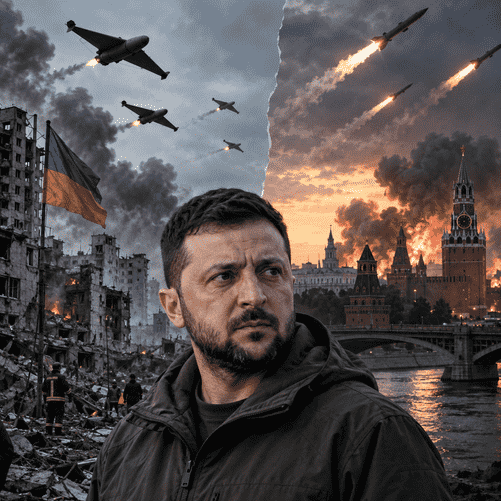
The Dormition Cathedral at Kyiv’s historic Pechersk Lavra was badly damaged during an overnight barrage that also struck homes, infrastructure and cultural institutions across Ukraine

Flames swept across the roof of one of Ukraine’s most important religious landmarks early Monday as a vast Russian missile and drone attack struck Kyiv and several other cities, killing civilians, damaging apartment buildings and leaving parts of the capital without electricity.
The Dormition Cathedral, the principal church of the Kyiv-Pechersk Lavra monastery complex, caught fire during the overnight assault. Images from the scene showed emergency workers battling flames around the historic structure as smoke rose above the gold-domed monastery.
The Lavra, founded in the 11th century, is among the most revered centres of Orthodox Christianity in eastern Europe. Together with Saint Sophia Cathedral, it forms part of a UNESCO World Heritage site recognised for its exceptional religious, architectural and cultural importance.
The attack therefore struck far beyond the physical walls of the cathedral. For many Ukrainians, damage to the monastery represents an assault on a central part of the country’s spiritual and national identity.
Ukrainian authorities said Russia launched 70 missiles and 611 drones during the night, targeting Kyiv, Kharkiv and other regions.
Air-defence units intercepted many of the incoming weapons, but ballistic missiles and the sheer scale of the drone assault overwhelmed parts of the defensive network.
Explosions echoed across Kyiv for hours as residents sheltered in underground stations, basements and corridors. Fires broke out in several districts, while missile fragments and blast waves damaged residential buildings, vehicles and public infrastructure.
At least four people were reported killed in the capital and numerous others were injured. Apartment blocks were struck or set ablaze, forcing emergency crews to evacuate residents from damaged homes.
The attack also disrupted electricity supplies, temporarily leaving about 140,000 people without power.
Ukraine’s emergency services worked through the morning to extinguish fires, search damaged buildings and clear debris from streets.
The Dormition Cathedral suffered substantial damage after fire spread across a large section of its roof.
Clergy and emergency workers reportedly moved religious objects away from the flames while firefighters attempted to prevent the blaze from reaching other parts of the monastery complex.
The cathedral has endured destruction before. The original medieval structure was blown up during the German occupation of Kyiv in 1941 and remained in ruins for decades. It was eventually reconstructed and reopened in 2000.
Its latest damage has revived painful memories of cultural destruction during previous periods of invasion and occupation.
The Pechersk Lavra had already sustained wartime damage earlier in 2026, when another Russian missile and drone attack shattered windows and damaged buildings near its historic cave system.
Monday’s fire, however, represented a far more serious threat to the complex.
President Volodymyr Zelenskyy described the cathedral strike as one of Russia’s gravest crimes against Christian culture and called for a strong international response.
He urged leaders attending the G7 summit in France to increase pressure on Moscow and provide Ukraine with additional air-defence systems, particularly equipment capable of intercepting ballistic missiles.
Ukrainian officials said the attack demonstrated that no civilian, religious or cultural site could be considered safe while Russian long-range strikes continued.
Foreign Minister Andrii Sybiha accused Moscow of deliberately destroying Ukraine’s cultural heritage while claiming to defend traditional and Orthodox Christian values.
The head of the Orthodox Church of Ukraine, Metropolitan Epiphanius, also condemned the attack, describing the destruction of the cathedral as a crime against history, faith and humanity.
Russia denied intentionally striking the monastery.
Russian officials claimed the cathedral had been damaged by a malfunctioning or misdirected Ukrainian Patriot air-defence missile rather than by a Russian weapon.
Ukraine rejected that account. Officials said evidence recovered from the monastery area included fragments associated with Russian drones and accused Moscow of attempting to avoid responsibility for the destruction.
The competing claims could not immediately be independently verified.
However, the fire occurred during a confirmed large-scale Russian attack involving hundreds of drones and dozens of missiles aimed at Kyiv and other Ukrainian cities.
Ukraine said it would formally raise the damage with UNESCO and other international organisations responsible for protecting cultural heritage.
The overnight violence extended far beyond the capital.
In Kharkiv, five emergency workers were killed in what Ukrainian authorities described as a double-tap attack—a tactic in which a second strike targets rescuers who arrive after an initial explosion.
The attacks also wounded civilians, including a baby, and damaged homes and infrastructure.
Double-tap strikes are particularly feared because they place firefighters, paramedics and rescue teams in immediate danger while they are attempting to save victims.
Other attacks were reported in the regions of Zaporizhzhia, Sumy and Dnipro, adding to the nationwide toll.
By Monday morning, at least nine deaths had been reported across Ukraine, although authorities warned that the number could increase as rescue operations continued.
The Dormition Cathedral was not the only important cultural site affected in Kyiv.
The Oleksandr Dovzhenko National Film Studio was also struck. The historic institution contains archives, production facilities and Ukraine’s largest and oldest collection of film costumes.
Damage to the studio intensified concerns that the conflict is steadily eroding Ukraine’s cultural memory as well as its physical infrastructure.
Since the beginning of Russia’s full-scale invasion in February 2022, museums, theatres, libraries, churches, archaeological sites and historic buildings have been damaged or destroyed throughout the country.
UNESCO has repeatedly warned that attacks near protected sites can cause irreversible losses to heritage belonging not only to Ukraine but to humanity as a whole.
The targeting or destruction of cultural landmarks has particular significance in a conflict centred partly on competing claims about history, language and national identity.
The Kyiv-Pechersk Lavra has occupied an especially sensitive position. It is both a religious sanctuary and a symbol of the historical development of Kyiv as a political and spiritual centre.
Russia frequently presents itself as the protector of Orthodox civilisation and claims that Russians and Ukrainians belong to a shared historical nation.
Ukraine argues that the destruction of its churches, monuments and archives exposes the contradiction at the heart of that narrative.
For Kyiv, the preservation of cultural heritage is therefore inseparable from the defence of national sovereignty.
The scale of the attack renewed Ukrainian appeals for more advanced air-defence equipment.
Ukraine has received Patriot systems and other defensive weapons from Western partners, but officials say the country does not possess enough launchers or interceptor missiles to protect every major city and critical facility.
Russia has increasingly combined ballistic missiles, cruise missiles and large numbers of comparatively inexpensive drones in an effort to exhaust Ukrainian defences.
The strategy forces Ukraine to decide which threats to intercept while preserving limited stocks of costly defensive missiles.
Even when most incoming weapons are destroyed, falling debris can still damage buildings and kill people on the ground.
Monday’s attack demonstrated how a small number of weapons penetrating the defensive shield can cause severe human and cultural losses.
The timing of the assault placed Ukraine at the centre of discussions among G7 leaders meeting in France.
Zelenskyy called for the summit to produce concrete decisions rather than statements of sympathy. His government wants tougher economic pressure on Russia, additional weapons and stronger protection against ballistic attacks.
France and other European governments condemned the damage to the cathedral, with some officials comparing its symbolic importance to that of Notre-Dame in Paris.
Poland temporarily mobilised military aircraft and placed air-defence systems on heightened alert as Russian strikes approached western Ukrainian regions.
The response reflected continuing fears that a missile or drone could cross into NATO territory, deliberately or accidentally.
As firefighters worked among the cathedral’s blackened roof beams, the scene offered a stark image of the war’s expanding reach.
The monastery had survived invasions, revolution, Soviet repression and the destruction of its principal cathedral during the Second World War. Its reconstructed domes became symbols of religious revival after Ukrainian independence.
Now, nearly four years into Russia’s full-scale invasion, the Lavra has again been marked by war.
The immediate task will be to assess the structural damage and rescue whatever religious artworks and historic objects can be preserved. The wider challenge will be protecting cultural institutions while Ukraine’s cities remain exposed to repeated aerial attacks.
The burning cathedral stands as a reminder that the consequences of war cannot be measured only in military positions or territorial gains.
When a historic sanctuary is set ablaze, the damage reaches into memory, faith and identity—parts of a nation that cannot easily be reconstructed once they are lost.