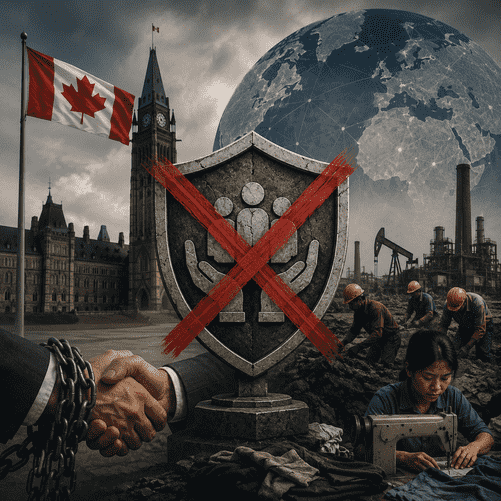
Prime Minister Mark Carney says the federal ombudsperson failed to deliver results, while critics warn that abolishing the office could weaken accountability for Canadian companies operating abroad.

Canada is eliminating the federal watchdog responsible for examining allegations of human rights abuses involving Canadian companies overseas, a decision Prime Minister Mark Carney has defended as part of a broader effort to remove ineffective government structures and strengthen enforcement through other means.
The Canadian Ombudsperson for Responsible Enterprise, commonly known as CORE, was established by Justin Trudeau’s government in 2019. Its mandate was to review complaints concerning possible human rights violations linked to Canadian companies working abroad, particularly in the mining, oil and gas, and garment sectors.
Carney said the office had not been effective and confirmed that the decision to eliminate the position had been taken several months earlier. He argued that Canada already possesses legislation and formal standards intended to address forced labour and corporate misconduct, but acknowledged that the government has been less successful in enforcing those rules.
CORE’s limited record has been central to the government’s justification. During its six years of operation, the watchdog launched only five formal investigations. Three involved the clothing companies Ralph Lauren, Nike and Levi Strauss, while two examined the mining firms GobiMin and Dynasty Gold. The cases centred on allegations that corporate supply chains were connected to forced Uyghur labour in China’s Xinjiang region. The office issued formal recommendations in only two cases.
The watchdog’s leadership had already been vacant since May 2025, when interim ombudsperson Masud Husain’s term ended. Although the office initially remained open, campaign groups said the absence of an appointed leader left staff unable to advance outstanding complaints and created prolonged uncertainty for communities seeking investigations.
Critics contend that the office’s weak performance reflected its limited authority rather than a lack of need. CORE could review complaints and make recommendations, but campaigners repeatedly argued that it lacked the independence and legal powers required to compel companies to produce documents or participate fully in investigations.
Green Party leader Elizabeth May said the watchdog should have been strengthened rather than abolished. She argued that CORE had never received the powers or institutional independence necessary to hold companies accountable and warned that eliminating it entirely would leave a significant gap in Canada’s human rights framework.
Labour and corporate-accountability organizations have expressed similar concerns. They have called for an empowered watchdog capable of demanding evidence, conducting credible investigations and imposing meaningful consequences when Canadian businesses are linked to abuses overseas.
The decision comes as Ottawa faces growing pressure over its response to forced labour in international supply chains. The United States has criticized Canada’s enforcement record and threatened tariffs over what it considers inadequate measures to prevent goods produced with forced labour from entering the Canadian market.
In response, the Liberal government has announced plans for legislation that would identify products and regions associated with forced labour. Importers bringing listed goods into Canada would be required to demonstrate that the products were not manufactured using slavery or other forms of coerced work.
Canada already has the Fighting Against Forced Labour and Child Labour in Supply Chains Act, which requires certain companies and government institutions to report on measures taken to identify and reduce forced-labour risks. Carney’s comments suggest that the government now intends to place greater emphasis on direct legal enforcement and import controls rather than relying on a specialized ombudsperson.
However, reporting requirements are not the same as independent investigations. Human rights advocates fear that without a dedicated body receiving complaints from affected workers and communities abroad, allegations involving Canadian companies may receive less scrutiny, particularly in countries where victims have limited access to courts or regulatory authorities.
The abolition of CORE therefore marks more than an administrative reduction. It reflects a change in how Canada intends to oversee the international conduct of its companies—moving away from a complaint-based watchdog and towards enforcement through trade restrictions, supply-chain legislation and existing government departments.
Whether that approach produces stronger accountability will depend on the scope of the promised legislation, the resources assigned to enforcement agencies and the government’s willingness to act against influential corporations. Without those elements, critics warn, closing an already underpowered watchdog could remove one of the few official channels available to people alleging harm from Canadian business activity overseas.