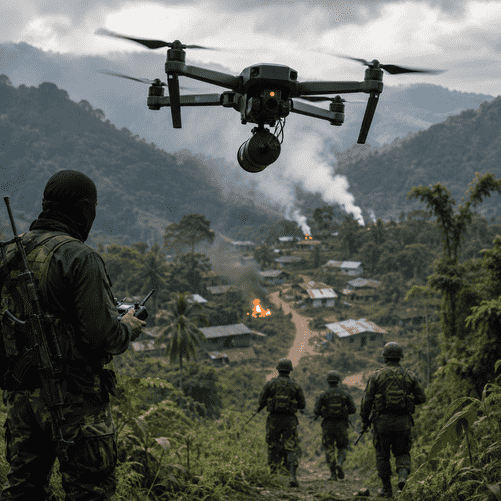
Cocaine revenues are financing a new generation of inexpensive aerial weapons, exposing soldiers, police officers and isolated communities to attacks that are increasingly difficult to predict or prevent

The familiar warning no longer comes from gunfire on a distant hillside or the roar of an approaching aircraft. In some of Colombia’s most violent regions, it begins with a faint mechanical hum above the trees.
Commercial drones—small, affordable and widely available—are transforming the country’s long-running internal conflict. Armed groups financed by cocaine trafficking, illegal mining and extortion are modifying the aircraft to carry grenades, mortar rounds and improvised explosive devices, allowing them to strike soldiers, police stations and civilian communities from a distance.
The technology has given militias a crude but increasingly effective air force.
Drones once used primarily for reconnaissance are now being deployed as bombers and, in some cases, as one-way attack weapons. Fighters can launch them from concealed positions, guide them towards a target and disappear before security forces determine where the assault originated.
For Colombia’s military, the development has altered the balance of power in remote areas where dense forests, mountains and limited infrastructure already make conventional operations difficult.
For civilians, it has introduced a new and deeply unsettling form of insecurity.
Residents in conflict-affected communities say the sound of a drone overhead can empty streets and force families indoors. The aircraft may be monitoring military movements, transporting explosives or searching for rival fighters. From the ground, there is often no way to know.
Hospitals, homes, schools, police facilities and public spaces have all been placed at risk as drone warfare spreads beyond isolated jungle battlefields. Even attacks directed at security forces can cause civilian casualties when explosives fall short, malfunction or strike populated neighbourhoods.
The escalation reflects the fragmentation of Colombia’s armed conflict following the 2016 peace agreement with the Revolutionary Armed Forces of Colombia, or FARC.
Although the accord led thousands of guerrillas to disarm, several commanders and combatants rejected the settlement or later returned to armed activity. Their factions now compete with the National Liberation Army, known as the ELN, the Gulf Clan and other criminal organisations for control of coca fields, trafficking corridors and illegal mining zones.
These groups may retain political language and military structures, but their continued survival is closely connected to illicit commerce.
Colombia remains the world’s largest producer of cocaine, and the enormous profits generated by the trade have allowed armed organisations to purchase communications equipment, explosives, weapons and increasingly sophisticated drones. Technology that once belonged mainly to national armies is now available through civilian supply chains at a fraction of the cost.
A commercial drone can be bought cheaply, modified in a workshop and sent against equipment or personnel worth many times more. Even when an attack fails, it can force security units to suspend patrols, abandon positions or divert personnel towards air defence.
The psychological impact can be as important as the physical damage.
A drone does not need to release an explosive to disrupt a military operation or frighten a community. Its presence alone can suggest that an armed group is watching roads, identifying residents who cooperate with authorities or preparing an imminent strike.
The threat has become especially severe in coca-growing regions and along strategic trafficking routes. Southwestern departments such as Cauca and Nariño, border areas near Ecuador and Venezuela, and territories affected by competing armed factions have emerged as important centres of drone activity.
In April, three Colombian soldiers were killed and two others wounded when an explosive-laden drone struck their position near Ipiales, close to the Ecuadorian border. The military attributed the attack to Comandos de la Frontera, a group formed partly by former FARC combatants.
Other incidents have demonstrated that the threat is no longer confined to distant rural zones.
In May, authorities found and disabled a drone carrying C4 explosive material near Bogotá’s El Dorado airport and a military air-transport command. Investigators linked the device to a FARC dissident faction and said its fibre-optic control system may have been designed to resist electronic jamming.
The discovery intensified fears that armed groups are experimenting with methods developed in international conflicts, where drones connected by fibre-optic cables can operate despite conventional radio interference.
Colombian authorities are attempting to respond with detection systems, signal jammers, specialised weapons and intelligence operations aimed at destroying drone workshops and capturing trained operators.
The government has announced plans for a national anti-drone shield, describing the programme as one of the country’s most ambitious security projects. Its initial phase is expected to include sensors, electronic countermeasures and equipment designed to protect military bases, police installations and critical infrastructure.
Yet the challenge is considerable.
Counter-drone systems can be expensive and difficult to deploy across Colombia’s vast territory. Armed groups, meanwhile, can continuously change frequencies, flight patterns and explosive mechanisms. A system capable of protecting a major airport may be impractical for a small police station surrounded by mountains and forest.
The militias also benefit from the simplicity of the technology. Operators do not require years of aviation training. Videos, manuals and combat footage circulating online offer lessons in modifying aircraft, releasing explosives and evading defensive systems.
Analysts say tactics seen in Ukraine and other drone-intensive conflicts are being studied and adapted in Latin America. But in Colombia, those methods are being incorporated into a war financed largely by narcotics rather than by a conventional state.
The growing use of drones has become another test of President Gustavo Petro’s “total peace” policy, which sought negotiated settlements with multiple armed organisations.
Talks and ceasefires have produced limited and uneven results. Critics argue that some groups used periods of reduced military pressure to recruit members, expand territory and improve their capabilities. Supporters of negotiations maintain that military action alone cannot resolve a conflict sustained by rural poverty, weak government institutions and the international cocaine market.
Both arguments now confront a changing battlefield.
The state must defend communities and security personnel against a technology that allows relatively small groups to project lethal force over long distances. At the same time, destroying drones and arresting operators will not eliminate the economic networks that finance their use.
Without stronger institutions, functioning courts, legal employment and reliable public services in neglected rural regions, armed factions will continue to find territory in which to operate and young people to recruit.
Colombia’s drone war is therefore not merely a technological development. It is the latest evolution of an old conflict—one in which global demand for cocaine, local inequality and limited state control combine to give criminal armies the resources to innovate.
The danger is that the technology will spread faster than the government’s ability to contain it.
For families living beneath contested skies, the consequences are already visible. The drone’s distant buzz has become a warning that a conflict once fought from the mountains and forests may now arrive without notice from directly overhead.