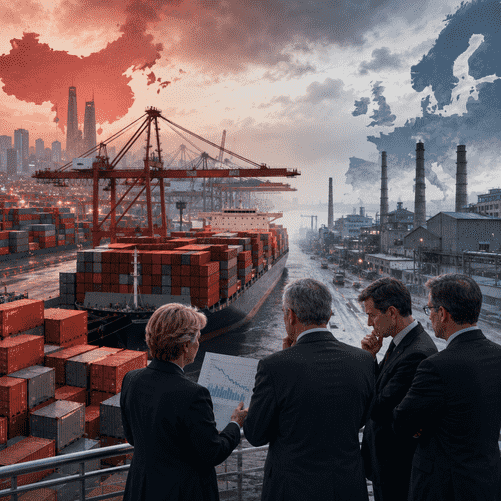
The European Union is moving closer to stronger action against Beijing as cheap imports strain manufacturers and revive fears of a new trade war.

Europe is preparing for a more confrontational phase in its economic relationship with China, as a wave of low-cost Chinese exports puts pressure on manufacturers across the continent and forces policymakers to consider stronger trade defenses.
The issue has moved rapidly up the European agenda. Officials in Brussels are examining new legal tools that would allow the European Union to respond more quickly to economic disruptions caused by subsidized imports, currency distortions and sudden surges of foreign goods. Although the proposed measures would be designed as country-neutral instruments, China is widely understood to be the central target.
For years, Europe sought to maintain a careful balance with Beijing: reducing strategic dependence while preserving access to Chinese markets and supply chains. That balance is now becoming harder to sustain. European industries, particularly in machinery, automotive production and other advanced manufacturing sectors, are warning that they face growing pressure from Chinese competitors benefiting from lower costs, state support and excess production capacity.
The economic stakes are considerable. The EU’s trade deficit with China reached a record level in 2025, deepening concerns that Europe’s industrial base could be weakened if the bloc fails to respond. For countries such as Germany, whose economy depends heavily on exports and high-value manufacturing, the problem is especially sensitive. Policymakers fear that a new “China shock” could damage employment, investment and competitiveness in sectors that have long formed the backbone of European growth.
At the same time, Europe remains divided over how far to go. Some governments and business groups worry that aggressive trade measures could provoke retaliation from Beijing, damaging companies that still rely on Chinese customers, suppliers or production networks. Others argue that delay would be more dangerous, allowing subsidized imports to reshape European markets before domestic firms have time to adapt.
The debate reflects a broader shift in global economic policy. Free trade is increasingly being tested by industrial subsidies, national security concerns and the race to dominate strategic technologies. Europe, once more cautious than the United States in confronting China, is now moving closer to the view that open markets require stronger protective instruments.
The coming months will show whether the EU can build consensus around a tougher strategy. If it succeeds, Europe’s trade policy could become more assertive, marking a turning point in its economic relationship with China. If it hesitates, the continent risks watching more of its industrial capacity come under pressure from a competitor it can neither ignore nor fully contain.