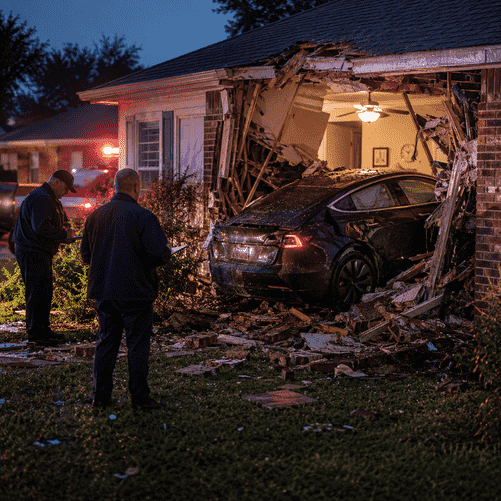
The crash that killed 76-year-old Martha Avila has renewed questions over Tesla’s driver-assistance technology and how safely it operates beyond controlled road conditions.

U.S. federal investigators have opened a second inquiry into a fatal Tesla crash in Katy, Texas, deepening official scrutiny of the company’s driver-assistance systems after a Model 3 slammed into a home and killed 76-year-old Martha Avila.
The National Transportation Safety Board has joined the investigation, following an earlier special crash probe launched by the National Highway Traffic Safety Administration. Together, the inquiries place the accident among a growing number of serious incidents involving Tesla vehicles and automated driving features.
The crash occurred on June 19, when a Tesla Model 3 left the roadway at high speed and struck a residential home. Avila, who was inside the house at the time, was hit and later died from her injuries. Other family members were also reportedly inside the residence when the vehicle crashed through the building.
According to authorities, the driver told investigators that a driver-assistance system was engaged before the crash. That statement has made the case especially significant for federal regulators, who are examining whether Tesla’s technology, driver behavior, or both contributed to the collision.
Tesla executives have pushed back against suggestions that the automated system was responsible. Ashok Elluswamy, Tesla’s head of artificial intelligence, said vehicle data indicated that the driver manually pressed the accelerator and that the car reached high speed before impact. Elon Musk also criticized media coverage of the crash and defended Tesla’s technology.
The competing accounts underscore a central issue in investigations involving advanced driver-assistance systems: determining where responsibility lies when software, sensors and human drivers interact in fast-moving emergencies. Tesla’s systems are marketed as advanced assistance tools, but the company says drivers must remain attentive and ready to take control at all times.
The crash has also triggered legal action. Avila’s family has filed a civil lawsuit against Tesla and the driver, alleging negligence and claiming that Tesla failed to adequately warn users about risks associated with its Autopilot and Full Self-Driving features. The lawsuit seeks more than $1 million in damages, along with additional punitive compensation.
For regulators, the Texas crash arrives amid broader concern over Tesla’s automated driving technology. Since 2016, federal officials have opened dozens of special investigations into Tesla crashes in which driver-assistance systems were suspected of being used, including incidents involving fatalities.
The case may become an important test of how U.S. authorities assess safety claims around partially automated vehicles. As Tesla continues to promote automation as central to its future, investigators will be looking closely at what the car was doing, what the driver did, and whether the system performed as intended.
For Avila’s family, however, the issue is more immediate and personal. A vehicle did not merely crash on a highway or city street; it entered a private home and killed someone who had no role in the drive. That fact has turned the case into a stark reminder that the risks of automated driving technology can extend far beyond the person behind the wheel.