Kyiv’s expanding long-range strike campaign is forcing Moscow to protect more territory, exposing gaps in Russian air defenses and embarrassing the Kremlin.

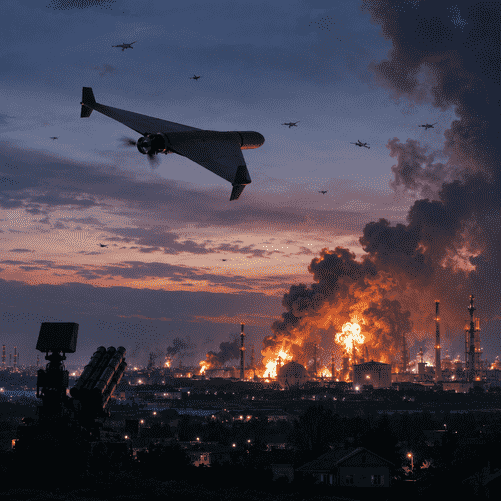
Ukraine’s rapidly expanding drone campaign is reshaping the air war with Russia, turning low-cost unmanned aircraft into a strategic weapon capable of reaching deep into Russian territory and straining Moscow’s air-defense network.
In recent weeks, Ukrainian drones have targeted oil refineries, fuel depots, logistics hubs and military infrastructure across Russia and occupied territories. The campaign has grown in both range and volume, forcing Russian authorities to respond to attacks far from the front line and raising uncomfortable questions about the Kremlin’s ability to defend its own territory.
The latest wave underscored the scale of the challenge. Russia said its air defenses intercepted hundreds of Ukrainian drones across multiple regions, including occupied Crimea and areas near the Black and Azov Seas. The attack was described as one of Ukraine’s heaviest drone bombardments since the start of the full-scale war.
For Kyiv, the objective is clear: make the war more costly for Russia by disrupting the infrastructure that supports Moscow’s military machine. Ukrainian President Volodymyr Zelenskyy has said he authorized a 40-day campaign aimed at increasing pressure on Russia to end the war, following consultations with Ukraine’s security services.
The strikes have increasingly focused on Russia’s energy sector, a key source of state revenue and military fuel. Ukrainian drones recently targeted refining facilities in Russia’s Tyumen region, more than 2,000 kilometers from Ukraine, demonstrating a significant expansion in Kyiv’s long-range capabilities. Zelenskyy has said Ukraine now has drones capable of reaching targets up to 3,000 kilometers away.
That reach creates a major dilemma for Moscow. Russia must decide whether to concentrate air defenses around politically sensitive locations such as Moscow, the Kerch Bridge and major military sites, or spread them more thinly across a vast country filled with energy, transport and industrial targets. Zelenskyy has claimed Russia is already shifting air-defense assets toward key locations, leaving other regions more exposed.
The problem is not only geographic. It is also economic. Many Ukrainian attack drones are far cheaper than the missiles and air-defense systems used to intercept them. Even when Russian forces shoot down large numbers of drones, Kyiv can still impose financial and operational pressure by forcing Moscow to expend expensive interceptors and constantly reposition defensive assets.
The result is a war of exhaustion in the skies. Russia continues to launch large-scale drone and missile attacks against Ukrainian cities, energy infrastructure and civilian areas. But Ukraine’s own long-range campaign has created a new vulnerability for the Kremlin: the sense that Russia’s rear areas are no longer insulated from the consequences of the war it began.
The political effect may be as important as the military one. Drone strikes near Moscow, St. Petersburg and major industrial regions undermine the Kremlin’s effort to present the conflict as distant and controlled. Each successful attack, even when damage is limited, carries symbolic weight by exposing weaknesses in Russia’s defensive shield.
At the same time, the campaign carries risks. Attacks inside Russia raise concerns about escalation and civilian harm, especially when drones strike near populated areas or critical infrastructure. Ukraine argues that its targets are tied to Russia’s war effort, while critics warn that the expanding range and intensity of drone warfare could blur the line between military pressure and broader disruption of civilian life.
Still, Kyiv appears determined to press its advantage. Ukraine’s drone industry has become one of the most dynamic sectors of its wartime defense effort, combining domestic production, rapid battlefield adaptation and increasingly sophisticated long-range systems. What began as a tactical tool on the front line has evolved into a strategic campaign against the Russian state’s military and economic depth.
For Moscow, the embarrassment is growing. Russia entered the war with one of the world’s largest air-defense arsenals, yet Ukraine’s drone armada is repeatedly forcing it into reactive defense across enormous distances. The Kremlin can still claim interceptions, but the frequency and scale of the attacks reveal a more difficult truth: Ukraine has found a way to make Russia defend almost everywhere at once.
As the war continues, the contest between Ukrainian drones and Russian air defenses is likely to become one of its defining battles. It is a fight not only over territory, but over endurance, innovation and the ability to impose costs far beyond the front line.