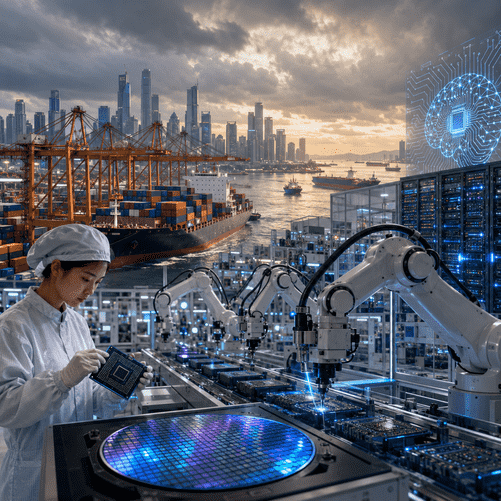
New manufacturing data show Asian exporters benefiting from the global artificial-intelligence boom, even as energy costs and geopolitical disruption continue to test regional supply chains.

Asia’s industrial economies entered the second half of 2026 with unexpected momentum, as factory activity strengthened across key manufacturing hubs despite cost pressures linked to the Iran war and broader uncertainty in global trade.
Fresh purchasing managers’ index data showed that demand tied to artificial intelligence, electronics and advanced components is helping Asian producers absorb higher input costs and supply-chain disruptions. The improvement stands in contrast to more fragile conditions in parts of Europe, where investors remain cautious even as macroeconomic indicators show modest improvement.
The strongest signal is coming from export-oriented economies, where companies are benefiting from orders for semiconductors, servers, electronic parts and related industrial equipment. Analysts say the AI investment cycle is increasingly functioning as a stabilizer for Asian manufacturing, supporting production even as energy markets and shipping routes remain vulnerable to conflict-related shocks.
Japan has also adopted a more positive tone. In its latest monthly economic report, Tokyo pointed to better private consumption and exports, while still warning that Middle East tensions could weigh on the outlook.
The broader picture remains uneven. China’s industrial profits have shown resilience as the economy continues to lean heavily on factories and exports, but domestic demand remains a concern. Meanwhile, global investors are watching whether the AI-driven surge in production can remain strong enough to offset higher costs, weaker consumer confidence and the risk of renewed trade friction.
For now, Asia’s manufacturing base appears to be benefiting from a rare combination of structural demand and short-term stockpiling. Companies are moving to secure components and finished goods ahead of possible supply disruptions, while global technology spending continues to channel orders toward the region.
The result is a cautiously optimistic economic signal: Asia’s factories are not immune to geopolitical shocks, but the region’s role at the center of the AI supply chain is giving it a buffer that many other parts of the global economy lack.