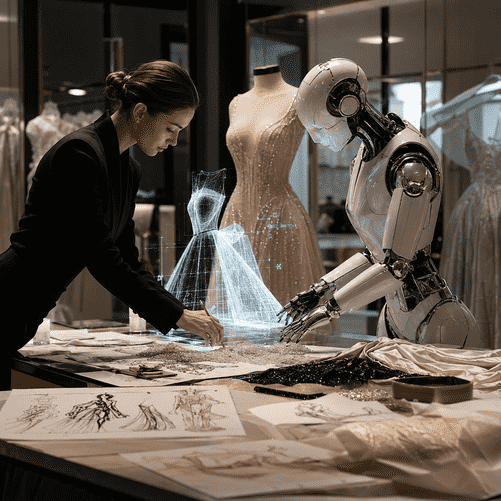
As luxury houses protect the mythology of craftsmanship, designers and retailers are quietly adopting artificial intelligence to speed up styling, product development and customer engagement.

PARIS — Artificial intelligence is becoming one of the most disruptive forces in fashion, pushing the industry into a new debate over creativity, authorship and the meaning of luxury in an increasingly automated age.
For years, fashion’s most powerful houses built their value around human imagination: the sketch of a designer, the hand of an artisan, the aura of a creative director and the emotional language of the runway. Now, AI tools are entering that world, offering brands the ability to generate visual concepts, test silhouettes, style looks, predict demand and personalize shopping experiences at a speed that traditional design teams cannot match.
The shift is especially visible outside the most conservative corners of luxury. Fast-fashion and mass-market brands have been more willing to speak openly about AI, using it to accelerate production cycles, analyze consumer data and create digital campaigns. Luxury labels, by contrast, have been more cautious. Their hesitation reflects a deeper concern: if exclusivity depends on craftsmanship and originality, openly admitting that machines help shape collections could weaken the very story that justifies premium prices.
Yet the technology is already moving behind the scenes. AI-assisted platforms are being used to build mood boards, simulate garments, refine styling and reduce the time between concept and prototype. For smaller designers, these tools can lower barriers to entry by making sophisticated visual development cheaper and faster. For major fashion groups, they promise efficiency at a moment when the luxury market is under pressure from cautious consumers, slowing demand in China and a more selective global shopper.
The business context makes the timing important. Bain has forecast only a slow recovery for personal luxury goods in 2026, with growth expected to remain modest after a difficult period for the sector. That has forced brands to search for new ways to protect margins, sharpen merchandising and reconnect with consumers who have become more skeptical after years of steep price increases.
AI is also changing how fashion speaks to customers. Retailers and brands are experimenting with digital assistants, personalized styling recommendations and data-led product suggestions designed to make online shopping feel more curated. In the luxury market, where service has always been part of the product, the challenge is to make technology feel intimate rather than mechanical.
But the risks are significant. Designers worry that AI could flatten taste, reward imitation and reduce the value of traditional skills such as drawing, patternmaking and technical sketching. There are also unresolved questions over intellectual property: if an algorithm is trained on decades of fashion imagery, who owns the resulting design language? And if AI helps create a collection, where does inspiration end and copying begin?
The debate is particularly sensitive because fashion is built on references. Designers have always borrowed from archives, street style, art, cinema and subcultures. AI accelerates that process dramatically, turning vast visual histories into instantly searchable creative material. That makes it powerful, but also dangerous for an industry already accustomed to accusations of appropriation and plagiarism.
Luxury groups are therefore walking a narrow line. They want the speed and analytical power of AI without losing the emotional authority of human creativity. The most successful brands may be those that treat AI not as a replacement for designers, but as an invisible assistant: useful in research, logistics and personalization, but kept behind the curtain when it comes to the public mythology of the maison.
The broader fashion market is already being reshaped by this tension. As consumers become more selective, brands must offer products that feel distinctive, meaningful and well made. At the same time, they must operate with greater precision in a slower-growth environment. AI offers a way to do both — but only if it strengthens rather than dilutes creative identity.
For now, the future of AI in fashion is unlikely to look like a machine replacing the designer at the runway’s end. It is more likely to appear in quieter forms: faster prototyping, smarter inventory, more personalized styling and design teams using algorithms as creative sparring partners.
Fashion has always turned change into desire. The question now is whether it can turn artificial intelligence into something that still feels unmistakably human.